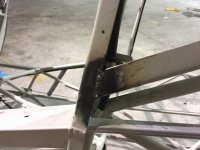
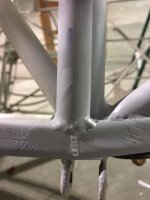
Brad- I have found that when I am trying to run a good bead- and I can see that the puddle seems to be getting a little dirty (when it resists flowing nicely) then the puddle will resist
wetting one side of the work--- and you move on---- that leaves a pit kind of defect there. It seems to be associated with the puddle not being completely clean. what that probably means is that
a tiny bit of air got to it as you were moving along. Could be torch angle, too little argon, using a gas lens on inside corner and making a vortex which sucks air in, and maybe other reasons
we cant even see. But --- when you see the puddle getting where its stops wetting ---- just stop--- use your steel tooth brush to clean it off, grind your tungsten for good measure--
then start again where you left off. you will see its is instantly better.
Also many times when I was learning-- if I held too big of a arc gap- that tended to make the puddle dirty- also it often gave a melt-through. The shorter the arc length the better
it will work. Try to keep it to 2 mm if you can. A short arc length will also keep those lateral edge gaps from forming. For thin steel tubing- use a small current with a short arc length
and be patient and wait for the puddle. Dont get in a hurry.
Something to watch for when dipping the rod--- when you dip- it is good to see the filler just added to the puddle wet forward a little. That is a sign that the puddle is clean and behaving
nicely. If it is doing that it is probably doing it sideways too- which is good as it tends to indicate it will likely be wetting into the sideways parts. On the other hand-- if you dip and you
dont see that nice wetting--- you may see that last dip draw up into a ball and just surface tension its self---- so if you see it stop wetting--- just stop --- brush the work, grind the
electrode and clip off the end of the welding rod. If you mess up and get the end of the welding rod out of the argon during the dipping--- the rod will oxidize on the red hot tip-
then on the next dip you may get the lack of wetting and surface tension thing starting. If the dips dont want to wet each side and forward---- something like that happened.
Accidently getting the rod out of the argon is very easy to do----- because you are often putting 150% of your attention on the arc gap trying not to touch the work-- trying not to
touch the rod to the tungsten- . you can practice keeping the welding rod as close to the arc as you can without the heat melting a liquid ball on the end of the rod. just back the rod
out a little at a time until its not melting the tip of the rod. This is useful for another reason---- when you dip the rod into the puddle-- that cools the puddle just a little. That allows
you to reduce the temp of the puddle. (to NOT overheat) Then you just wait a fraction of a second for the puddle to get liquid again for the next dip.
This is ALL SO MUCH EASIER if someone can show you this in person. I took a semester class at our local county tech school. It wasnt perfect--- but it got me started
on the basics and you had someone to ask questions of (when he wasnt swamped with the other 60 students) After that class I kept practicing for another 2 years
to refine my skills. During that period I got extra practice welding all kinds of stuff for other people and for work. That got me more practice in a short time which helped too.
gradually learned to weld thinner and thinner aluminum sheet. I can usually do .040 ---- maybe .032 on a good day. There are special cheats you can do when you get that thin too.
(like a thermally conductive back-up plate behind the joint.) or using a 50 or 60 % electrode negative setting (thats 40 or 50% cleaning) That helps keep the work cooler and the
extra cleaning helps prevent accidental holes.
Tig'ing is pretty easy and wonderfull once you get all the machine adjustments right and get your hands and feet synchronized. I also use a magnifying lens in the helmet.
My theory is that you cant weld any better than you can see. It seems to really help when you are trying to hold a very short arc gap. (which I always try to)
Hope this is encouragement for anyone who has a machine but got discouraged. Watch all of Jodys' vids at welding tops and tricks. He is really the greatest at teaching.
I like his technique WAY better than swain. I think Jody welds each day -every day - all day. You cant top THAT !!!!

If anything I know helps someone---- what more could I ask for !
Tim
PS--- Brad-- if you see a weld you dont like-- fear not ! Grind it down--- but keep in mind- you usually dont need to grind down
to the level of the tubing--- your new pass will be re-melting whatever is leftover and it will integrate into the puddle. Most times you can
just grind about 1/2 way down. Its usually nice and clean after you grind. remember this is NOT like stick welding.
Stick welding fails often involve hollow pits or pits with glassy flux inside them. With those-- you often have to grind all the way down
to get the slag gone. For Tig-- you have no flux or slag. That makes things way easier to remedy after a boo-boo.