EFII Fuel Pump

dramsey

Bearhawk 5
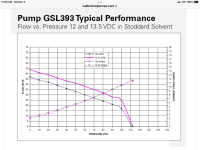
Wanted to share how I wasted time chasing a rabbit on my EFII fuel pump. Im sure many of you in your search for fuel boost pumps discovered amongst the available options, the EFII has the lowest pressure drop when its not running. I certainly did and that along with fact that it was working for Nev, I bought one for my Bearhawk 5 build. I was doing what I normally do before a build and size all my wires and breakers and looked to the EFII site for the normal current draw and could not find it but I saw that they recommended a 10amp breaker. I could not leave good enough alone and went to the Walbro pump curve on Walbro’s site and saw that thing would not only pull around 12 amps but it would be around 100psi at our fuel flows. I asked Nev questions and a 10amp fuse is working for him and he only sees a little over 30 psi. How can this be? What am I missing? So I called EFII only to find that the blue “bypass” is not just a bypass checkvalve, its also a pressure regulator which holds 30psi by recycling back to the pump suction. That reduces the “normal” draw to 4.5 amps. Now things made sense. He also said the pressure loss through their system when the pump is not running is not much more than 3/8” tubing. It also tells me that if that pressure regulator ever fails, your signs will be very high fuel pressure and perhaps pop your breaker. Good to know, Now I will set both high and low pressure alarms. Thought I would share one of my chase-a-rabbit-til-one-of-us-dies moment.
 
Last edited:
Yes, you nailed it. The GSL393 is the pump they use. The couple with their regulator and bypass check to make it work. IMG_0996.png
 
Thanks! I thought I saw a discrepancy in the current draw vs. your report, but that's because i was being stupid and not reading the correct vertical axis.
 
Haha. Sometimes nerding on something a bit too much can be beneficial.

I too am running a EFII pump. I had them adjust the pressure to 20psi and it’s been working great; though only use it for start up and emergencies.
 
though only use it for start up and emergencies.

Some thread drift here - and I recall a discussion about this before. Is there a reason to use the fuel pump only for emergencies on a Continental, or do others do the same on a Lycoming ? I'm in the habit of using mine for takeoff and landing "in case " the engine driven one fails, but really that's simply because that's the way I've always done it, and I've never changed.

Very interested to hear what others are doing.
 
Just a heads up on the current draws, there are two different models of the EFII pumps. One is larger and I think is a 60ish GPH pump and the smaller is a 40ish Gallon per hour from memory. This will likely effect current draws based on the model you have.
 
  • Like
Reactions: Nev
Some thread drift here - and I recall a discussion about this before. Is there a reason to use the fuel pump only for emergencies on a Continental, or do others do the same on a Lycoming ? I'm in the habit of using mine for takeoff and landing "in case " the engine driven one fails, but really that's simply because that's the way I've always done it, and I've never changed.

Very interested to hear what others are doing.

If your engine depends on a functioning pump to keep running, I'd prefer to discover that the engine driven pump failed above 1000 ft with time for recovery before impact than at 100 ft with insufficient time to get things running and insufficient runway to stop without damage.

My carburetored Bearhawk came with and engine driven pump and a backup electric pump. I take that to mean that the builder lacked confidence that the engine would continue to run on gravity alone. I run both pumps when at low altitudes.
 
Just a heads up on the current draws, there are two different models of the EFII pumps. One is larger and I think is a 60ish GPH pump and the smaller is a 40ish Gallon per hour from memory. This will likely effect current draws based on the model you have.

I'm aware of the single boost/backup pump nominally for mechanical fuel injection applications that is the object of the OP and a dual electric pump system that is typically used with the EFII injection system. The latter is normally used with a single pump at a time, the 2nd being a backup, but can be used for "up to 800 hp" if both pumps are run in parallel. ...at least I think that is what I've seen on the website.

https://www.flyefii.com/products/boost-pump/
https://www.flyefii.com/products/accessories/dual-electric-fuel-pump/

The dual system lacks the pressure regulator/flow through feature as those are not needed for the EFII application.
 
My O540A4D5 came with an engine driven pump. I left it on because it was there. Since then it is pretty well proven that gravity feed alone works fine for carb engines.
 
Some thread drift here - and I recall a discussion about this before. Is there a reason to use the fuel pump only for emergencies on a Continental, or do others do the same on a Lycoming ? I'm in the habit of using mine for takeoff and landing "in case " the engine driven one fails, but really that's simply because that's the way I've always done it, and I've never changed.

Very interested to hear what others are doing.

My engine came out of a Cessna 172XP. I tried to mimic the Cessna engine systems and procedures as much as possible. Using the boost pump for only startup and emergency is what was in the Cessna POH so that’s what I do. On the Continental IO360, running the electric boost pump changes the fuel mixture which is likely the reason Cessna doesn’t use the electric pump during takeoff and landing.
 
Back
Top