Someone may find this interesting. In the following, the "Max Load" condition consists of 380 lbs in the front seats, 300 in the rear seats, 54 gallons of fuel, and baggage set to whatever is necessary to get to max gross weight of 3000 lbs. The "Min Load" condition consists of 150 lbs in the front seats, 0 in the rear seats, 5 gallons fuel and 0 lbs of baggage. CG limits are defined as 10.5 and 22.5". Moment arms are as follows: [TABLE="width: 419"]
[TR]
[TD]
Rfs =[/TD]
[TD="class: xl63, bgcolor: #92d050, align: right"]
9[/TD]
[TD="colspan: 2"]
Moment arm of front seat[/TD]
[TD] [/TD]
[/TR]
[TR]
[TD]
Rrs =[/TD]
[TD="class: xl63, bgcolor: #92d050, align: right"]
46[/TD]
[TD="colspan: 2"]
Moment arm of rear seat[/TD]
[TD] [/TD]
[/TR]
[TR]
[TD]
Rbag =[/TD]
[TD="class: xl63, bgcolor: #92d050, align: right"]
80[/TD]
[TD="colspan: 2"]
Moment arm of baggage[/TD]
[TD] [/TD]
[/TR]
[TR]
[TD]
Rmf =[/TD]
[TD="class: xl63, bgcolor: #92d050, align: right"]
23.5[/TD]
[TD="colspan: 2"]
Moment arm of main fuel[/TD]
[TD] [/TD]
[/TR]
[TR]
[TD]
Raf=[/TD]
[TD="class: xl63, bgcolor: #92d050, align: right"]
27[/TD]
[TD="colspan: 2"]
Moment arm of aux fuel[/TD]
[TD] [/TD]
[/TR]
[TR]
[TD]
Rbal1 =[/TD]
[TD="class: xl63, bgcolor: #92d050, align: right"]
97[/TD]
[TD="colspan: 3"]
Moment arm of ballast position 1[/TD]
[/TR]
[TR]
[TD]
Rbal2 =[/TD]
[TD="class: xl63, bgcolor: #92d050, align: right"]
141[/TD]
[TD="colspan: 3"]
Moment arm of ballast position 2[/TD]
[/TR]
[TR]
[TD]
Rmains =[/TD]
[TD="class: xl63, bgcolor: #92d050, align: right"]
-1.5[/TD]
[TD="colspan: 2"]
Moment arm to main wheels[/TD]
[TD] [/TD]
[/TR]
[TR]
[TD]
Rtail =[/TD]
[TD="class: xl63, bgcolor: #92d050, align: right"]
215.5[/TD]
[TD="colspan: 2"]
Moment arm to tail wheel[/TD]
[TD] [/TD]
[/TR]
[/TABLE]
Assuming the aircraft is loaded to Max Load conditions, and the CG is at the the aft limit, this plot depicts where the empty CG needs to be as a function of empty weight. Notice that as the a/c gets lighter, the CG needs to move forward. Using a lighter prop or engine does the exact opposite. Also notice that at very light conditions, the CG gets only about 2.5" from the main wheels (mains are at -1.5"). This makes the a/c likely to tip on its nose due to a small upward load on the tail.

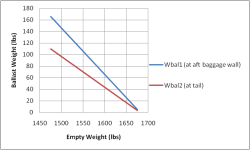
Assuming the CG is successfully placed as defined by the above plot, this following plot depicts how much ballast are needed so as to keep the CG at the forward limit when loaded to Min Load conditions. The blue line assumes the ballast are located against the aft wall of the baggage area. The red line assumes the ballast are located near the tail (141" radius arm). Putting them at the tail represents an increase in moment of inertia which will have an adverse effect on some flight characteristics. Moving ballasts from R=97 to R=141 has a 45% increase in the ballast inertia. Being that the ballasts are a relatively small percentage of the entire a/c inertia, this extra 45% may not be a deal breaker......maybe.
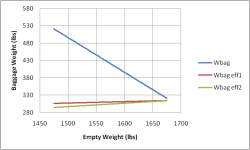
When at the Max Load condition and the CG at the max aft limit, the blue line depicts the allowed baggage weight…….assuming the ballast are not in the aircraft. It can be seen that as the aircraft weight changes by 200 lbs (1475 to 1675) the allowed baggage changes by 200 lbs. The red line depicts the allowed baggage assuming all required ballast are in the a/c and they are located at the aft wall of the baggage area. The green line depicts the allowed baggage assuming all required ballasts are in the a/c and they are located near the tail. Notice that for the two conditions where the ballast are in the a/c, as the empty weight decreases, the allowed baggage also decreases......counterintuitive, but reality. If you think you are going to need to fly the a/c anywhere near min load condition and thus decide that you need to bring your ballast with then reducing the empty weight of the a/c hurts load carrying capability.
The following plot is the same as the above except the ballasts are located in the baggage area at R=80. Notice that as the a/c empty weight is decreased by 200 lbs, the additional allowed baggage is only increased about 40 and 94 lbs for the red and green lines respectively. Again, if you think you are going to need to fly the a/c anywhere near the min load conditions and thus decide that you need to bring your ballast with then reducing the empty weight of the aircraft doesn't get you much.

This plot depicts the lbs/seat capability at the Max Load case. This is simply the sum of all weight in the seats and the baggage area all divided by 4. The blue line is with no ballast in the a/c. The red line is for an aircraft that uses aft baggage ballast, the ballast are in the a/c but they have been moved forward to the baggage area (R=80) . The green line is for an aircraft that uses tail ballasts, the ballast are in the a/c but the ballast have been moved forward to the baggage area.

From the above plots we see that as the aircraft gets lighter, if you want to use the weight savings to add more fuel and cargo, the empty CG must go forward. This is because as the aircraft gets lighter, we can add more weight to the tanks, rear seats and baggage area.....all of which are behind the CG, all of which move the CG rearward. A point is hit where the CG goes out of range. The only way to fix this is to remove fuel or cargo (and then not getting the max usefulness from your a/c), or to modify the a/c so that the empty CG is more forward. We typically get just the opposite.....we reduce aircraft weight via a lighter engine and lighter prop, both of which move the empty CG backward. How do we get the aircraft lighter for more cargo weight, and at the same time get the CG more forward? Keep the tail light, Use a lighter prop but put in a prop extension. Use a lighter engine but move it forward. Use a light battery but move it to the firewall. Using a CS prop is bad in that its is heavy but very good in that it is way out at the nose. The handiest variable is the battery. Can use a heavy or light battery, and can put it on the firewall or way aft. In general, just keep the a/c as light as possible, then move the battery and any other components to get an unloaded CG that is sufficiently forward that the a/c can be loaded to max weight and still stay within CG limits. We also see from the above, as the aircraft gets lighter, and we push the empty CG more forward, when loaded light the loaded CG gets too far forward and rear ballasts are necessary. In order to keep required ballasts to a minimum, don't put the empty CG any further forward than absolutely necessary for the max load case. Also, consider putting the ballast near the tail. When near the tail, less weight provides the same change in CG. Also notice that as the a/c weight is increased 200 lbs (1475 to 1675), the allowed baggage actually goes up if the ballast are brought along and located in their normal positions. If the ballasts are moved forward into the baggage area (R=80) then the amount of effective baggage only changes about 40 lbs for aft baggage ballasts, or about 93 lbs for tail ballasts.. Also, a heavy 1675 a/c doesn't need any ballast......big engine and heavy but the effective cargo is only 40 lbs less and don't need to carry any ballast ever. Also, the heavy case has a much more rearward empty CG, which makes it less likely to tip on its nose.
Summary: If you build real light and use a parallel valve engine you may be able to get empty weight down to around 1475. In order to get to the Max Load condition and stay within CG limits, the empty CG would need to move to about 0.8" It would be difficult to get the CG this far forward when putting a light engine up front. It would also lead to a tippy a/c. The end result is that you probably would not be able to reach the defined Max Load condition. If you did somehow get the CG this far forward, the Min Load condition would require about 170 lbs of ballast at the aft baggage wall in order to stay within CG limits. If you go on a trip and put sufficient load in the back that you don't need the ballasts, you may want to bring them along anyway just in case a need arises to fly near Min Load conditions. If you do bring your ballast with, and you locate them in their normal positions, you can actually carry more baggage in a heavy aircraft than you can a light one.
If you build real heavy and use an angle valve engine you may have an empty weight as high as 1675. In order to get to the max load condition and stay within CG limits, the empty CG would need to move back to about 10". This may be difficult even if a lead-acid battery is moved way back in the tail. If you did get the CG this far rearward, the min load condition would not require any ballast.......max load would put the CG at the aft CG limit, min load would put it at the forward limit.
Now consider something more in the middle......maybe 1575 lbs. This could be a light airframe with an angle valve engine, C/S prop, lead-acid, etc. This would require a reasonable empty CG of about 5.7" (I believe the prototype 5 has an empty CG a bit below 4"......and if the mentioned design changes bring the engine back a couple inches then 5.7 seems easily doable). It won't be tippy. At Min Load conditions it would require about 80 lbs of ballast at the aft baggage wall which could be provided via 2x5 gallon collapsible containers filled with water.....which weigh about nothing when empty. Assuming you can always find water, your ballast are always at your destination waiting for you. Allowed baggage at the max load condition is a respectable 425 lbs. With 54 gallons of fuel, you have about 275 lbs/seat of useful load.


