sheet metal brakes-- home brew ?

fairchild1934

Well-known member
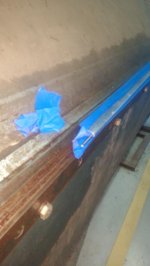
I was looking at the neighbors 10 foot brake designed for aluminum siding. It is made with a piano hinge running the whole length. However- because of the space needed to mount the hinge -
the pivot point of the leaf is not in alignment with the bend line. It is offset. Can this continuous hinge design be adapted for bending our wing spars ? I have several pieces of 11 or 12 foot
heavy angle iron. plenty long enough if the hinge idea can be made to work. Anyone tried this idea ?

Tim
 
HBA has a number of discussions on longer home-brew brakes, and certainly doable. Ultimately, we located a 12' brake in rural NJ, but went with paying a commercial HVAC sheet metal shop with beer and pizza for bending things up for the two airplanes.

We paid in beer, pizza, and the promise of a ride in the completed aircraft. They had a 12' shear to work the blanks, although you will need to know web width (measure your nose and center ribs). Do not expect them to get bends to precise angles - shoot for 90 degrees and hand-tweak from there with a set of Wiss or (pref) Fairmont #14030 (cushioned handle version) or 14010 (uncushioned handle version) offset hand seamers (there is some technique here for a ripple-free flange, but that is for another post). Once on site, I realized they also had a 12' leaf brake sitting unused in the corner, but the operator and his helper made clear that the finger brake was the better choice for consistent web width and bend radius.

https://www.amazon.com/MT14010-Fairmont-Seamers-Offset-Handle/dp/B000PW747A?th=1

First job is to shear spar blanks to size, leaving the flanges a little oversized for later trimming... getting the flange-to-flange/web height distance correct is the important part. Plan on a 3" strip of waste going to making a full-length shoe for their finger brake to keep radius at about 1/10". This gets taped to the press finger with specialty fiber tape that they will have on hand. An example spar section of 2" length for main, aft, aileron and flap spars which are known good fits to ribs helps the press operator to fine-tune - work this in your own shop with either the 48" press you'll use on the rest of the airplane or hand-bend with the usual

After bending, a set of 1/4" MDF go/no-go template gauges for flange angle gets things tuned to plans call-outs. Other MDF gauges make marking out centerline for lightening hole layout pretty easy.
 
Last edited:
one of the reasons I'd like to bend them myself is that I can take my time and get the bends ( I hope) and the height just right the first time. Not always easy to get a stranger in a hurry
to get as close as needed. Had my local place bend some stainless steel a while back and they did a rotten job.... looked like it was done by a 12 year old.
t
 
was thinking of something like this - but using a hinge with a 3/8 or 1/2 inch hinge pin---- and those through bolts where he has them wouldnt be far back enough to gt very much material under the clamp. This fellow is building a zeineth of some kind. image.png​
 
https://homebuiltairplanes.com; decent site with lots of archives on stuff like this.

I think we just got the right sheet metal place, but it may be that this was not the usual case of handing over material and hope they get it right... we did the shearing and bends with the two guys running the press and had enough scrap material to check the setups before committing to bends.
 
I found this video helpful in getting the measurements :
https://www.youtube.com/watch?v=h9fxo95D4Ik&t=5s

If at all possible see if you can find a 10 foot brake (patrol needs a 10 foot brake)
I used one at my local EAA chapter. EAA35

a.jpg
I made a variety of "shoes" out of the banding material used for steel strap.

b.jpg
The nose still did not create the bend radius I wanted.

So I added another nose from the 2024 scrap that you get from cutting spar blanks.


I held everything in place with a lot of tape.


c.jpg ​​​​​​

d.jpg make a bunch of coupons to test your calculated bend distances - use an ultra fine marker

e.jpg Double check your trial bends against the master template.


f.jpg Sheetmetal is squirly so it helps to have two people. Also 2024 is tough stuff and you need to put some muscle in it.
 

Attachments

  • d.jpg
    d.jpg
    276.6 KB · Views: 0
Make sure and check if there is an EAA chapter with a 10 foot brake within 200 miles.
 
Another reason to try HBA, EAA, and some of the scratch building specialty fora... places to ask about available brakes near you. If you provide your location, ability to travel (100 miles? 250 miles? 500 miles?) and need (10' brake to work 032 2024 means a minimum 16g full length, and 12g would be better). My network found a couple options, including one in an aviation museum in NJ. Fortunately, Carlo had used this particular sheet metal shop for his Mustang II built, so we went there... sounds like you may not have that option.

Ask around as Stan suggested unless you really want to invest the time in getting a brake beefy enough to give you straight bends in the material. The benefits on the home-brew brake would be more practice on your welding and machining work and a decent upper-body workout moving things around. Also consider the benefits of a bench stout enough to mount the brake... def beefy enough to support spar jigging, etc. Thought I was going to break down the 10.5' spar bench when I wrapped up (it has an additional 5.5' section to get to minimum length for wing spar built-up), but too darned handy as a 2' x 10.5' work table and tons of storage under the double- layer 18mm ply top (triple layer when built out to 16').
 
Last edited:
I advocate for a real 10 foot brake for the spars, flaps ,and the trailing edge. Click image for larger version  Name:	t.jpg Views:	0 Size:	75.3 KB ID:	100838


There is a use case for home built if you can find one of those 4 foot brakes. This one came from northern tool on sale.
Click image for larger version  Name:	a.jpg Views:	0 Size:	21.0 KB ID:	100837

I thought I could use it out of the box:
Click image for larger version  Name:	f.jpg Views:	0 Size:	1.25 MB ID:	100842 but it did not work
I tried 3/16 drill rod -no work
The mdf is to soft and gave way.​

I took note of the mechanism of a real brake:
Click image for larger version  Name:	a.jpg Views:	0 Size:	21.0 KB ID:	100837 This is absolutely necessary to make bends for aircraft purposes. You need a "nose" to create the correct radius.


plan a and plan b -the final way I did it:
Click image for larger version  Name:	f.jpg Views:	0 Size:	1.25 MB ID:	100842 Click image for larger version  Name:	t.jpg Views:	0 Size:	75.3 KB ID:	100838

I then modified the 4 foot brake to have the same mechanism a real brake has.
Click image for larger version  Name:	f.jpg Views:	0 Size:	1.25 MB ID:	100842

When I made my spars on the 10 foot brake - as part of the process- I made many assorted lengths of nose attachements out of steel strapping.

Click image for larger version  Name:	a.jpg Views:	0 Size:	21.0 KB ID:	100837

2024 t3 is really tuff stuff. The above 4 foot brake is almost too heavy to move. Even so, to bend relatively small lengths of 2024 the brake has to be clamped down to the table or the upward motion to bend will make the brake move instead of the 2024 bend.

For bends with even larger radius I made a range of nose attachements:
Click image for larger version  Name:	e.jpg Views:	3 Size:	233.3 KB ID:	100841


I eventually went back and used the 10 foot brake to bend the trailing edges. (as shown in bobs book that comes with the plans)
But, I did try to do it without real equipment.
Click image for larger version  Name:	g.jpg Views:	0 Size:	102.4 KB ID:	100847 Click image for larger version  Name:	h.jpg Views:	0 Size:	119.1 KB ID:	100848

I have built many crazy things - many of which I will not show because I would be embarrased .

But when it comes to bending 2024 in any lengths -without a real brake- I never had any luck.
 

Attachments

  • t.jpg
    t.jpg
    75.3 KB · Views: 0
  • a.jpg
    a.jpg
    21 KB · Views: 0
  • a.jpg
    a.jpg
    21 KB · Views: 0
Last edited:
Be careful with tables in your workspace. Someone keeps sneaking into my garage and piling stuff all over my airplane work area.
 
Yes stan--- it is quite amazing how much 2024 t3 resists being bent. Part of it is that it is work hardening as you are bending it.

I have several pieces of 4 inch angle with 1/4 inch wall. Thinking of welding 2 together to make a box. Maybe use that as the "core " or lower piece that does not move.
Then possibly a piece of 4 inch C channel on edge for the hold down clamp. Just to see if the hinge idea works might have to make one only 1 foot long and see how it bends.--
before i make an 11 foot one..........
 
Back
Top