
You are using an out of date browser. It may not display this or other websites correctly.
You should upgrade or use an alternative browser.
You should upgrade or use an alternative browser.
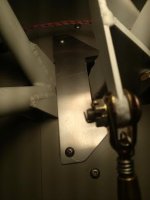
Aileron control stops
- Thread starter BTAZ
- Start date


Collin Campbell
Well-known member
Here's what I came up with.
Mark Goldberg
Bearhawk Aircraft
On both sides of the rear control stick I have attached pieces of hard nylon to the floor with screws/nuts. Just a little strip of nylon on each side which limits stick movement to the degrees of deflection Bob calls for. Mark
I am a skeptic; I believe little of what I read and hear, and only some of what I see.
I have never really been convinced that traditional methods of aileron-balancing are optimal for building LSA qualified aircraft.
50 years ago (+/-) I was a physics teacher but was then away from it for a long time. Now in my retirement I have gone back to it. I teach physics classes one-day/week at the Univ of Minn just to make my SS reach. I still remember just enough physics to wonder about the necessity of all the heavy lead that we are encouraged to add to our control surfaces.
I attempted to write down some of my musings and printed it out. I converted to a 4-page PDF file. It gets kinda wordy and possibly boring, so I will copy it to my web-server.
If anyone is interested in the theories of a daydreaming curmudgeon see
http://poplar.us/aileronflutter.pdf
Conflicting opinions and alternate theories are tolerated (after all, I did raise 4 kids).
Bergy
Last edited:

marcusofcotton
4A scratch NE Minnesota
Bergy,
Good stuff there but I think you're missing an important bit. Allow me to paste in from website: http://www.australianflying.com.au/news/vne-and-flutter-explained
"Have a look at the diagram. Now imagine that you hit a bit of turbulence and the wing deflects up. It won’t go far before it starts to spring back down towards its normal position.
Now look at what happens to the aileron – it gets left behind. So as the wing comes down the aileron goes up. It does this because its C of G (centre of gravity, the heavy bit which is marked with the little BMW sign) is behind the hinge point.
And when the aileron is up it forces the wing down so it sails straight through its normal position, reaches a maximum and then springs up again. But once more this causes the aileron’s C of G to swing past the hinge point and now it deflects the aileron down. This naturally forces the wing up again past its normal position and the whole thing starts again. Given the right combination of forces, each up and down stroke will be larger than the previous one until the wing thrashes itself to pieces."
Read more at http://www.australianflying.com.au/news/vne-and-flutter-explained#G3XMqyw36pEuYZLB.99
I believe a slight over balance will result in a certain degree of self correction in turbulence. I'm not as eloquent as you - I need my hands to explain it :>).
HI Bergy, thanks for the interesting article. It made me think of the RV4 ailerons, they had a 1/2 inch steel water pipe riveted in the nose of the ailerons. I've never heard of an RV having aileron flutter. I don't think the Bearhawk LSA has any weight in its nose. Do you know of any aileron flutter problems in the LSA?
Thanks,
David
Thanks,
David

Bcone1381
Finished Patrol
Aft cg of an individual control surface promotes flutter is my belief as well, Marcus. The above article also says that flutter becomes more of an issue at higher TAS.
Beartracks July 2008 says the Patrol was tested and promoted as a good LSA alternative if several weight saving actions were done. This included included an O-200 engine and NO CONTROL SURFACE LEAD WEIGHTS. The advertisement that follows lists Vne of 140 mph.
Today Bearhawkaircraft.com lists the Patrol's Vne of 165 mph and the LSA as 140mph. This gives credibility to my recollection that in the past Bob may have approved a reduced Vne of 140 mph for the Patrol if surface counterweights were not installed.
Last edited:
So what you guys are saying is that aileron flutter is not the simple action of an aileron flopping around as it hangs on the backside of a rigid wing, it is a compound interaction between a floppy wing and a floppier aileron; one might think of it as the oscillation of the aileron hinges bouncing up and down between the masses of the wing and aileron.
That is an interesting perspective. I will have to think about that for a while.
Thanks all
Bergy
That is an interesting perspective. I will have to think about that for a while.
Thanks all
Bergy
More aileron musings here .....
If an aircraft with no balancing weights in its ailerons has a Vne of 140, and with balanced ailerons has a Vne of 165, would it not make sense that a guy could save 5# on the aircraft (use half the amount of lead) and have a Vne of 150+ ? Let me know how it works out for you!
If an aircraft with no balancing weights in its ailerons has a Vne of 140, and with balanced ailerons has a Vne of 165, would it not make sense that a guy could save 5# on the aircraft (use half the amount of lead) and have a Vne of 150+ ? Let me know how it works out for you!


Please wear a parachute!

Bdflies
Between Projects
Robin, there are lots of areas to save weight while building an airplane. Less interior finishing, less electrical / instrumentation, smaller tires, etc.. Minimizing structure and mass balances are probably not the best areas to focus weight reduction efforts. As long as we're just talking and hypothesizing about 'what if's' and 'how abouts', the conversation is interesting and thought provoking. I'm a business major, not an engineer or physicist, so I can't produce equations or theories that would impress anyone. One might say that I hold a BS in BS.
With that in mind, my understanding of flutter, is as described in Marcus' articles. Further, it's my understanding that the aileron is either balanced or not. Balanced, with tight hinges and connections, the surface is not likely to flutter, at least to demonstrated safe velocities. Unbalanced or loosely connected, flutter propensity increases. Personally, I find your suggestion of halving the balance weights intriguing. You might be exploring an area to save significant weight, while sacrificing minimal performance. Or, you might be describing a path to an unknown edge of the flight envelope. Heck, I have no clue. The non-existent engineer in me says to take Jared's advice and go for it! On the other hand, the business guy in me says to balance those ailerons! I have great respect and appreciation for all the opinions and contributions of everyone on this forum. Yours included. And, on a purely selfish note, I'm just imagining the incredible loss of value that the entire Patrol fleet would suffer, as the result of a catastrophic in flight structural failure of a Patrol.
Such are the musings of another curmudgeon..
Bill

I gather that the term "aileron-flutter" is somewhat of a misnomer. Since such phenomenon tends to make an aircraft's wings fall off, I suspect that a better term might be "wing-flutter" (even though the flutter is exacerbated by interactions between a floppy wing and a floppier aileron). So the question then comes to mind ... Is it possible that the Bearhawk LSA can get along with unbalanced ailerons because it has no flaps? Even though flaps are rigidly mounted, each flap is hanging out there from only two hinges, and there must be some floppiness there (at least I am quite sure that wing tail-ribs are more rigid than any control-flap). I suspect that if an aircraft's wings could be made absolutely rigid (like maybe putting several struts on each wing) that aileron balance could be taken out of the flutter-equation.
Bergy
Bergy


lsa140
Plans Built Bearhawk LSA
This is all largely over my head but the subject has been studied in depth/documented well and the material is available. I got a kick out of Dan Raymer's book "Simplified Aircraft Design for Homebuilders" The flutter section basically states "refer to a good reference on the subject when designing your plane" Hmmm..... I thought that's why I bought this book
Design of Light Aircraft by Richard D Hiscocks has a good section on flutter and stiffness. He worked at De Havilland and was involved in many of the aircraft they produced including the Beaver. I believe he also had a hand in the Murphy Aircraft designs (Rebel). Briefly reviewing the section several factors impact aileron flutter: wing stiffness in deflection and torsion, aileron torsional stiffness, aileron shape and hinge location, aileron center of mass/CG, control circuit stiffness, etc.
Flaps exist on a portion of the wing that moves less and is inherently more rigid. Ailerons are out further where the wing has the most deflection up/down and twisting.
The LSA ailerons may not be statically balanced on the hinge line but that doesn't mean a great deal of care wasn't placed in their static/dynamic balance.
Attachments


Last edited:
Hiscocks is my favorite design book