Who is using VGs?

Battson

Moderator
I am interested to hear from anyone who is using VGs or who has experimented with them.

I have had feedback on BCP Forum from Mike Creek, that his VGs yielded improvements in control and handling during the lowest speed regimes, as well as a possible reduction in cruise speed and stall speed - albeit minor.

I tend to think that the Bearhawk already stalls with such a high nose attitude at such low speed, that it is practically impossible use the last few knots before the stall during a short landing. That being said, there is always the take-off, and riding through squally wind conditions on-approach - more control and safety margin is always good.

There is a local Murphy Rebel which apparently made 5kts better on the stall speed with VGs, which is a safety margin worth investigating. My research into the brands suggests that each are equally effective, it's the placement which makes all the difference.

Keen to hear from other Bearhawkers!

Jonathan
 
I'm thinking about trying VGs on my Patrol. I really cannot get a full stall with 28 degrees up elevator (which is all I have) with idle power and mid to forward CGs. Under these conditions I just get behind the power curve and develop a healthy sink rate, but still have full control. I looked into installing VGs on the bottom of the HS. Micro Aerodynamics sells VG kits without the STC for $395. Kits include a installation template and some double-sided tape which can be used to mount the VGs temporarily. They have an STC for the Husky, and that template should be close enough to start with. It kind of turns me off to pay for all the wing VGs, which I do not think the Patrol requires, and they don't want to sell the HS VGs separately. I have also looked into just buying a length of tee extrusion and making my own. The only source I found that might be suitable is Mann Made Inc - II, which specializes in miniature Al extrusions.

Owen Smith
 
Owen -

Tke a look at the STOLspeed VGs, one of the best I found, and just $97 US...

The kit includes laser cut 3M adhesives, and patterns for mounting the VGs at the correct angle.
They are also soft and flexible, unlike many STCd ones, which makes cleaning easier. Available from Aircraft Spruce. If you need a specific number, just email JG at his personal website, he's helpful.

These are the best I found, and I ordered a set.

I am very interested to hear from anyone who has installed any kind of VGs, and experimented - it would be good to know what percent of MAC they work best at, for the Bearhawk wing, without days of test flying???
 
Last edited:
Dan Shilling has VGs on his BH wings and the underside of his horizontal stab and likes them, but that's all I know. I don't believe he monitors any group anymore.
 
I earned my tailwheel endorsement in our bearhawk, and installed the Vg's part way through. They helped me round out a bit in the flare without the "bearhawk bounce". We operate off airport and I also notice them in short field ops.
 
Last edited:
I screwed up my post somehow, anyway, we installed the vg's on the wing and underside of the horizontal stab. They were moved back a few inches on the cord of the wing compared to blackrocks to in theory keep the air attached longer and improve cruise performance. This change is virtually unnoticeable between the two bear hawks. Think vg's are a worthy addition and comparatively cheap. I don't recall what brand ours are but they are clear, stiff 3m plastic. Make your template out of something somewhat stiff but still has flexibility similar to linoleum. I stole blackrocks and it was made of something similar. I have since heard horror stories of folks having to remove vg's along with some paint because they didn't realize they were getting off line.
 
More of a skip really. Other bearhawkers coined the phrase, but for me it was an inexperienced 3 point landing, never really bounced it. The plane touches then hops or skips just a little before settling. With experience I have gotten away from that mostly....or the bush wheels cover it up well. They are wonderful to fly and land. I didn't have any trouble earning my tailwheel endorsement in ours.
 
It may be relative to most taildraggers, all my t.w. experience is in a bearhawk. The first time I heard that was from a builder from Salt Lake City that has a great deal more time than I have in type. I have approx. 200hrs in our bh, the vg's did make a favorable change.
 
Here is a YouTube video of my very first landing in my Bearhawk. It shows the skip that I usually experienced. Not really a bounce, more of a skip. I think it is a product of too much airspeed. I found that with mine, to get the full stall three point, you had to end up with the tail wheel touching down just slightly before the mains.

<iframe width="420" height="315" src="//www.youtube.com/embed/5Iz2EjFtQOw" frameborder="0" allowfullscreen></iframe>
 
I agree. I've found in that case it's easier to make a tailwheel low wheel landing. Just relaxing some back pressure on the stick rolls the mains on. Our skips, hops ect.,may have been a product of pretty high d.a. also. (our strip is at 5,200 ft msl).
 
It may be relative to most taildraggers, all my t.w. experience is in a bearhawk. The first time I heard that was from a builder from Salt Lake City that has a great deal more time than I have in type. I have approx. 200hrs in our bh, the vg's did make a favorable change.
I have been told by others who are flying that it can be hard to avoid a little landing "skip", unless you're using a lot of flap to make sure the wing is dead once you get to the ground.
The tailwheel first landing issue is clear to us already. Hopefully some 29" wheels alleviate the problem to some degree. I was initially thinking "there's no point in having VGs" as a result, but they do a lot more than just shave a couple of kts off the stall speed. Certainly flaring at full flaps needs a burst of power if you don't have VGs under the horizontal.

Good to see you on the forum, Maverick, can you tell me what distance you placed your VGs on the wing?
 
I'll make a measurement and get back to you. I have 31" ABW's and they certainly take the ugly out of a bad one. I would definitely recommend the vg's from my experience. Also as I mentioned, rolling the mains on tailwheel low works best for me.
 
Our vg's are 8 1/2 in. from the front of the wing to the REAR of the vg. Measured using a square, not along the contour of the wing. I made several marks then chalk lined the wing. Then just taped the template up and started gluing. Ther are 57 per wing.
 
Our vg's are 8 1/2 in. from the front of the wing to the REAR of the vg. Measured using a square, not along the contour of the wing. I made several marks then chalk lined the wing. Then just taped the template up and started gluing. Ther are 57 per wing.

Awesome - thanks Maverick!

Did you get any interesting results in terms of performance changes after the VGs were installed?
 
Nothing more than Mike added. I liked the slow flight and mostly the latter part of the landing evolution. Since I installed them in the middle of my tailwheel endorsement I really noticed that they kept me from plopping on as easily. With full flaps it seems to float a little unless you are slow enough. Nothing alarming and all improvement other than cruise, in my opinion.
 
Interesting it has been labeled a "bearhawk bounce". I fly a DHC-2 Beaver on wheels and unless you are proficient it does this as well. Not a bounce, but a skip.
 
Until I had about 9-10 hours, I just thought I was a retard. Interesting about the Beaver. I have always liked them and wondered about their characteristics. Do any of them have VG's?
 
No vg's but there have been companies that make all sorts of mods. I'm only aware of flow fences for the wings as far as aerodynamics go. I think some may have the VGs available, but I've never sen them. It would be really tough to improve on that aerodynamic design. They really got it right the first time.

No retard that I can see! As far as I know, you only go back in the air for a few reasons. One is mechanical, i.e. if the gear puts you back up, like spring gear. The other reason is the aircraft is not done flying. This may be due to gusty wind or the touchdown was made before the airplane quit flying.
 
(Untitled)

Dave Roberts may chime in on this one. He said he didn't care for his Bearhawks handling until he installed the VG's. After installation of the VG's he fell in love his Bearhawk. Mark M. Sent from my iPad using Tapatalk
 
Installed VGs on the HS today and did one flight. It certainly solved the problem I was having with lack of elevator authority at low speeds and forward CGs. Landing characteristics are now much more conventional, even with full flaps. No need to add a little power in the flare, or alternatively run a little higher approach speed and time the flare just right. I used STOLspeed VGs and installed them at the recommended 100 mm forward of the elevator.

Owen Smith
 
(Untitled)

I installed STOLspeed under the horizontal stab. Made a significant improvement in my ability to get to a 3 point landing at full flaps and no power. I later added them to the wing and got zero improvement in stall speed or handling. Mine are reasonably far forward (don't recall the distance). My understanding is that forward could hurt cruise, but should only ensure good low speed performance. I've been getting around to trying some variations before removing them. My pairs aren't as close as typical, though were placed using the STOLspeed wing template. Ty -- Bearhawk
 
My STOLspeed VGs arrived this week, and I might get a chance to trial them this weekend. Depends if we get weather taking the plane hunting or not.

First impressions are they are a lot harder and stiffer than the advertising might make you think, flexible but very stiff, it's definitely Polycarbonate not PVC/ Nylon. They are good to look at compared to the usual STCd designs, for sure, and the packs are well presented. I can tell they are going to be a subtle addition to the aircraft, and the laser-cut adhesive pads and cambered base make them look a natural fit on the wing. There is certainly a lot less instructional materials than you get with an STCd set, but hey - that's home-building. There's also a big warning that fuel degrades Polycarbonate, haha... But they include (at least) 8 spares in case you have an "oops", and they would be dead-easy to change given the adhesive pads - compared to a glued on version anyway.
 
Our vg's are 8 1/2 in. from the front of the wing to the REAR of the vg. Measured using a square, not along the contour of the wing.
I finally found time to read the installation literature that came with the brand I bought.

They recommended 8-12% of chord, to the back/top of the VG ​(that is 5.2" to 7.9" on the Bearhawk) but the main thing is they are meant to be at the highest point on the upper surface when the wing is in stall attitude - to catch maximum airflow; otherwise they can be buried in the separating boundary layer and have no effect right when you need them. I figure about 6" to the back in that case, but I need to fly some tests.

Tyson - I would love to know roughly where you put yours if you have a measure nearby one day? Sounds like Mavrick's are a little further towards the back of the envelope.
 
No Title

I hope I have done this correctly. I have attached? 5 photos of my VG's. Sorry, I don't have measurements as I didn't have measuring tools with me.

The VG's under the stab were installed per STOLspeed's instructions for closely spaced VG's under a stab. I found them to make a very real difference in ability to 3-point/flare and get closer to a power off stall with a forward CG.

The wing VG's made little to no difference. The first thing I'm getting around to trying is making it so that each pair is close to each other. I installed them using STOLspeed's wing template which spaced them all evenly, instead of close pairs. If you look closely at the close-ups, you should be able to see the most forward rib rivet under the front end of one of the VG's. ...is that a good enough indication of how far back they are? You can also get an idea of it from the picture showing the span of the wing.

As I said before, my understanding is that for STOL/stall performance, unless you are getting so that they are under the leading edge, they can't be too far forward, only too far aft. Placing them further forward than needed may increase cruise drag, but shouldn't hurt STOL performance. Also, different airfoils are going to behave differently. Just because they help a Cub or Rebel, doesn't mean that they will do the same for the airfoil on a Bearhawk.

...but I'm going to keep trying when time and temperatures allow!

Please ignore the oil/cruft streaming back from my elevator hinges. ;-)

Cheers!
Ty
 

Attachments

  • photo368.jpg
    photo368.jpg
    380.9 KB · Views: 0
  • photo369.jpg
    photo369.jpg
    282.2 KB · Views: 0
  • photo370.jpg
    photo370.jpg
    314.2 KB · Views: 0
  • photo371.jpg
    photo371.jpg
    333.2 KB · Views: 0
  • photo372.jpg
    photo372.jpg
    1 MB · Views: 0
Hey Ty - I have the same streaks from my back hinges - no shame there!! :) Thanks for sharing those pictures!

I see the front of your VGs are upon the forward-most (1st) rivet in the leading edge ribs.
I installed the STOLspeed VGs this weekend just past. I placed them so the back of the VGs aligned to the fourth (4th) rivet from the front. I chose this location because (theoretically) it exposes the maximum amount of VG's tail to the airflow over the highest point of the wing at stall attitude. This allows for maximum effect, in theory. These were my results in practice:

I tested with minimum payload and 1/2 fuel, at 3,000 ft. We installed VGs on the wing, but not the tail (yet - I have some).

Vso before the VGs installed was 37 KIAS.
GS was a little faster of course, but there was some wind so GPS airspeed couldn't be checked exactly. Cruise speed LOP at 9.25 gal/hr was 108 KIAS (this is how I usually x-country).

After the install, Vso dropped clearly by 3kts, to 34 KIAS.
GPS ground speed changed by the same 3kt margin, but again wind... Cruise speed LOP 9.25 gal/hr remains unchanged at 108. I did check the 75% cruise too, which was unchanged, but crucially I failed to record the vital fuel flow reading without VGs... so that 75% measure is worthless.
2025 Update: Subsequent testing has confirmed that when cockpit instruments are indicating 34 KIAS, the lowest ground speed we can achieve is 37 knots GPS, on calm wind days, with the aircraft as light as possible (around 1,750 lbs including minimum legal fuel and pilot). This different is expected, caused by the ASI becoming inaccurate at high angles of attack.

IMG_20180107_202801.jpg - Click image for larger version  Name:	IMG_20180107_202801.jpg Views:	0 Size:	1.06 MB ID:	53026

Before VG installation
IMG_20180107_202801.jpg - Click image for larger version  Name:	IMG_20180107_202801.jpg Views:	0 Size:	1.06 MB ID:	53026

After VG installation
IMG_20180107_202810.jpg - Click image for larger version  Name:	IMG_20180107_202810.jpg Views:	0 Size:	1.38 MB ID:	53027

IMG_20180107_205108.jpg - Click image for larger version  Name:	IMG_20180107_205108.jpg Views:	0 Size:	1.55 MB ID:	53028

Post install:
We are pleasantly surprised and will keep the VGs. The stall was now much clearer and well defined, and there was a clean break-point and minor nose dip, instead of the formerly mushy transition. No buffet in either case. I could fly the plane in 20 degree turns with full control (in balance of course) at 36-37 KIAS, which was something else. I felt a bit like I was flying a heavy Cub.

2025 Update:
Subsequent more aggressive testing, many years later, has revealed the plane will tolerate crazy nose attitudes and extreme bank angles (60 degrees), without stalling - even way out of balance. The thing is almost impossible to stall without a concerted and prolonged effort. I have NEVER been surprised by a stall in this Bearhawk 4-place, EVER. This is certainly the safest plane I have ever flown.

Back to 2014:
It was hard to precipitate a stall without a little power on, there was not enough elevator to get the nose up far enough (full flaps).
At take-offI perceived the plane want's to lift off a fraction sooner, but I think I need more technique to take advantage of that small change.

I re-calibrated my AoA system, this was my favorite result - instead of being audibly warned about the approaching stall AoA at 47-50 KIAS on approach, I was flying approaches (at altitude) at 40-45 KIAS before the entering the same "near-stall" realm - so that is a big improvement. This change in approach speeds makes a significant difference to my ground roll, and accuracy at touchdown time. This is the biggest benefit I perceived.
The first real approach I flew at this speed just felt plain wrong having done about 50 circuits without VGs this month. But once I got used to it, it was no different in control-ability. I did find the AoA has a smaller "margin" between first activation and full stall post-VGs, where before hand there was a much wider band. But that makes sense - you need to be more careful if you want to fly closer to the limit.

That was my experience at least; I am glad I tested before and after. Of course, YMMV!

Jonathan
 
Last edited:
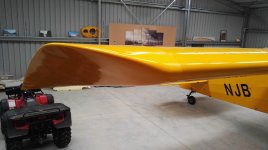
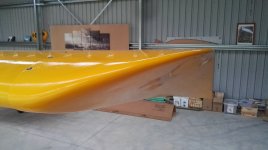
Bump - updated with new pictures of the VGs installed on the Hoerner STOL wingtips.

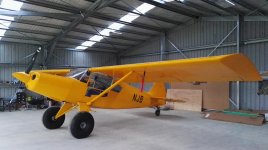
She might be 6 years old now, but looking better than ever I reckon. I still get a kick out of it, every time. The build is totally worth it, guys :)
 
Last edited:
It sounds like you may be able to purchase a set in the near future - North America based.
 
Last edited:
Hi guys,
I have sets being made for the model "B" airfoil if your interested. They are Carbon fiber and will be 18" wide. We have a 6" straight section that can be trimmed down for less extension followed by 12" of taper to the tip. I have 2 sets spoken for so far. Im unsure of the price just yet but let me now if you want me to notify you when they are ready. Im guessing a couple weeks out yet. Please connect with me on Instagram @ bearhawk_aircraft or email at mike@bearhawkcanada.ca as Im not connected to the forum often. thx
 
Guys, I finally bit the bullet and installed STOLSPEED VGs I had for years intending to put on my Rans S12. I have done a lot of reading and was always convinced that they could help but would not hurt.

I have a 4-place with a Lyc O-360 motor currently running 8.50 tires. My home base (1N1) is at 6500 feet so I always have to fly at high density altitudes. The following test was done at 2400 rpm, 9000 feet altitude, 21 inches manifold and 67degrees F. I usually land with 2 and sometimes 3 notches of flaps and a touch of power, often with a bit more power right before touchdown. 4 Notches of flaps makes the nose too high for me and makes go-arounds very difficult. I also noticed much better handling around the stall speed after the VGs were installed. I saw no reduction in cruise speed. I have not yet put them on the tail. Not very much info on performance after tail installation out there.
[TABLE="class: MsoTableGrid"]
[TR]
[TD]Flaps[/TD]
[TD]Stall before VGs[/TD]
[TD]Stall after VGs[/TD]
[/TR]
[TR]
[TD]0[/TD]
[TD]52 mph[/TD]
[TD]48 mph[/TD]
[/TR]
[TR]
[TD]1[/TD]
[TD]51 mph[/TD]
[TD]45 mph[/TD]
[/TR]
[TR]
[TD]2[/TD]
[TD]48 mph[/TD]
[TD]42 mph[/TD]
[/TR]
[TR]
[TD]3[/TD]
[TD]46 mph[/TD]
[TD]-[/TD]
[/TR]
[TR]
[TD]4[/TD]
[TD]45 mph[/TD]
[TD]-[/TD]
[/TR]
[/TABLE]
 
Battson,
Do you fly an A model? I’m trying to determine the best location for stol speed VG’s on my A model. Did you ever install on the horizontal stab?
 
Yes this is on the A-model. Lots of people have used this location now, and it seems to give consistent results. While it may not be the perfect location, it seems to be pretty effective.
I didn't put any under the H-stab. Hasn't been an issue.
 
Back
Top