
You are using an out of date browser. It may not display this or other websites correctly.
You should upgrade or use an alternative browser.
You should upgrade or use an alternative browser.
Trim Tab Travel.
- Thread starter schu
- Start date

JimParker256
Bearhawk Enthusiast
Probably good to specify which model you need the information for, since you posted in the "general discussion" area.
Mark Goldberg
Bearhawk Aircraft
Matt - without the cables attached the trim tabs move much more than needed. Set up the trim horns vertical or 90 degrees to the fuselage when leveled and those arms (that the pushrods attach to) also straight down when the trim tabs are in trail. If you do that you will be fine. Mark

schu
Well-known member
Yes, I know, but I'm going to use a push pull cable and need to know how much travel the trim tab needs in flight to spec out everything.
If the travel is only 2" as measured on the very end of the tab, or say 30%, then that tells me how much throw I need.
Another way my question could be answered, is using the Avipro trim wheel, how many rotations of the wheel do I use for full trim up and full trim down? If it's only 1 turn, then I can do some math and figure out what what equates to at the very end of the trim tab.
Thanks,
schu
I have completed our BH and now have 32 hours on it. it's true the trim is very sensitive, but it's just a part of the learning curve. I have a completely stock trim system. the travel adjustment is minimal for any flight operation. i don't feel the install of a wire type cable is a good idea. if you do, be sure to have a vernier cable type as this will help to make the small adjustments you need, especially in rough air conditions. i still think the stock trim wheel is probably the best answer. if i didn't have a quick build kit and the elevators were not already welded, i would have made the tabs half as deep and that would desensitize them. the movement travel now is less then a quarter of a rotation on the control wheel for any flight situation. i like the trim best when the flaps are applied to counter the pitch changes. I realize this topic was posted a while ago, but this might help someone anyway.

Mark Moyle
Well-known member
Schu,
Are you using Pat Fagan's trim system?
Are you using Pat Fagan's trim system?
Mark Moyle
Well-known member
Schu,
Are you using Pat Fagan's trim system?
Are you using Pat Fagan's trim system?
schu
Well-known member
Thanks for the comments Whee and N134RT. I want to run the Pat Fagan push/pull like Whee, but I'm also going to use the Bristol SG servo as I feel way more comfortable with the strength and metal push rod. Looking at the throw of .7 or .11 over 12 or 19 seconds may allow me to skip past any kind of bellcrank and make for a very simple electric trim.
I'll do some math and measuring and post what I come up with.
schu
I'll do some math and measuring and post what I come up with.
schu
schu
Well-known member
So this servo: http://www.bristolsg.com/B6specs.html can be purchased with 1.1" of movement over 19 seconds and will provide a force of 50lbs and a static holding thrust of 500lbs.
Measuring out my kit trimwheel and trimtab using accurate enough methods I come up with the following (when using the lower most hole on the trim tab):
Turns of the wheel Pushrod movement Tab Angle
0 0 12*
1/4 .250" 3*
1/2 .500 -4*
3/4 .750 -10*
So for 3/4" of movement the tab has a total of 22* of movement. This is really all the more you would ever move it because the trim crank on the back turns pretty flat at this point.
So if the bristolsg servo moves .058" per second, then the 1/4 turn that Rob was talking about above is 4.3 seconds of trim.
I'll change the trim tab mounting so that 1/4 trim is more like 7-8 seconds of trim (or use a voltage divider to slow the servo) so that it's go about the right amount of movement and sensitivity.
Thanks,
schu
Mark Goldberg
Bearhawk Aircraft
Just a couple thoughts/comments. Schu - have you flown in a BH with the kind of trim set up you are installing? I am curious. I know you have flown in mine.
Secondly, runaway electric trim can be very deadly in planes with lots of trim authority like a BH. So I would be sure that you can disable and overcome any electric trim system. I know some builders have used electric trim successfully. But runaway electric trim is something to be very cautious of. Mark
Secondly, runaway electric trim can be very deadly in planes with lots of trim authority like a BH. So I would be sure that you can disable and overcome any electric trim system. I know some builders have used electric trim successfully. But runaway electric trim is something to be very cautious of. Mark

Battson
Moderator
I have tested flying the Bearhawk with full trim runaway, and it's not an unstoppable problem.
I also tested responding an unexpected and unplanned trim runaway too. No problem, a pilot's instinct is to hold the plane level. It doesn't zoom / dive much before you react.
You just need to slow down a bit to reduce stick forces if you are going to keep flying for a long time.
You want about 30 degrees tab-down down, less for tab-up. Maybe 20 degrees.
I did a thread on electric trim, if you are interested.
Last edited:
schu
Well-known member
Battson, thank you for your reply.
Is this the thread you were talking about?
https://bearhawkforums.com/forum/bearhawk-4-place-quickbuild/770-electric-trim-in-a-qb-kit
I was looking at it, but the images are all not working.... we see "Please update your account to enable 3rd Party Hosting"
https://productforums.google.com/forum/#!topic/blogger/UbGagxy2Kbc
Anyway, perhaps you can answer a few questions for me. That would help me a lot!
Did you use mount the servo and use a pushrod between it and the trim bellcrank?
What I'm talking about doing is attaching the servo directly to the push/pull cables and doing something like what you did, but with Pats push pull cables.
You mentioned 30 degrees tab down and 20 degrees tab up, but that doesn't agree with Rob's comment that it only takes a quarter turn on the trim wheel to go from full nose up and full nose down, because a quarter turn on my trim wheel is only about .250" of pushrod (under the elevator) movement and around 15 degrees of total movement at the trim tab. Any thoughts on why these findings don't agree? Perhaps Rob hasn't explored every edge of the weight/cg envelope.
According to my more precise measurements, using the hole closest to the elevator, it takes about 7/8" pushrod movement to move the tab 30*. So with 1.1" of servo movement, I can expect around 38* total trim tab movement. If this is enough, then great, if not, I might be able to get another 10* by moving the arm closer to the tab, other than that I'll have to build some sort of bellcrank which I really wan to avoid.
Thoughts?
Battson
Moderator
I will have to fix those photos later. P.S. Those fools at Photobucket are deranged, they won't even let me access my own photos now. Their business is surely finished... they just don't know it yet.
Yes, I mounted the servo and used a pushrod.
I can't account for other builders. My pushrod travels 1.2 inches, and it connected halfway up the horn - doubling the movement at the tab. If you connect your cables to different places, you can double or half the amount of defection at the tab. It also depends on the position of the elevator, I am talking elevator neutral. This is how I got the required movement from a 1.2 inch servo.
Note this notional thirty (30) degrees is just a guess.
The first part of the tab's movement creates the most effect on the controls. I would say the second half of the 30 degrees movement (guesstimated) gives a lot less benefit.
schu
Well-known member
I will have to fix those photos later. P.S. Those fools at Photobucket are deranged, they won't even let me access my own photos now. Their business is surely finished... they just don't know it yet.
Yes, those guys are serious nose-pickers.
I can't account for other builders. My pushrod travels 1.2 inches, and it connected halfway up the horn - doubling the movement at the tab. If you connect your cables to different places, you can double or half the amount of defection at the tab. It also depends on the position of the elevator, I am talking elevator neutral. This is how I got the required movement from a 1.2 inch servo.
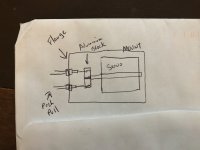
I am planning on having the servo push rod (the heavier duty Bristol SG servo) push the cables directly with a block that works like a yoke. This means the 1.1" of travel is directly applied through the push/pull cable to the horns on the bottom of the trim tab.
With your setup, you have the pushrod attaching to the trim bellcrank which allows you to add travel with leverage. I want to avoid this bellcrank altogether.
If you can, this is what would help me the most (instead of digging up pictures)....
Set your airplane for neutral trim, measure the distance between the trailing edge of the elevator and the trailing edge of the trim tab. Then go full up trim and measure again, then down trim. That will absolutely give me the full range of your trim system accurately and with minimal effort.
Battson
Moderator
I'll head over to the hangar in about 20 minutes.
Ahhh - forgot my battery is out of the plane right now, I can't get the measurement today sorry.
What I have done instead is uploaded photos showing the full travel of the system to the link posted above. Here it is again https://bearhawkforums.com/forum/bea...im-in-a-qb-kit
Ahhh - forgot my battery is out of the plane right now, I can't get the measurement today sorry.
What I have done instead is uploaded photos showing the full travel of the system to the link posted above. Here it is again https://bearhawkforums.com/forum/bea...im-in-a-qb-kit
Last edited:
schu
Well-known member
Just a couple thoughts/comments. Schu - have you flown in a BH with the kind of trim set up you are installing? I am curious. I know you have flown in mine.
Secondly, runaway electric trim can be very deadly in planes with lots of trim authority like a BH. So I would be sure that you can disable and overcome any electric trim system. I know some builders have used electric trim successfully. But runaway electric trim is something to be very cautious of. Mark
I haven't flown an airplane with electric trim, but I suspect that having the button right on the stick would make it much easier and safer to trim while in the pattern and slowing down.
I'll be extra careful to make sure that I don't have runaway trim. I'll probably use some sort of circuit to limit the trim actuation time.
schu
Well-known member
I'll head over to the hangar in about 20 minutes.
Ahhh - forgot my battery is out of the plane right now, I can't get the measurement today sorry.
What I have done instead is uploaded photos showing the full travel of the system to the link posted above. Here it is again https://bearhawkforums.com/forum/bea...im-in-a-qb-kit
Thank you!
Let me know when you have the battery mounted again and can get measurements.
For now.... do you use all of your trim travel? Your other thread mentioned you moving the push rods to the holes closest to the elevator, so either you didn't have enough total trim, or you wanted it to move faster, I'm not sure which.
Looking at your pictures, 1.1" of total pushrod movement under the elevator seems like enough, but I'm not going to order anything until you have a chance to confirm.
Thanks,
schu
Battson
Moderator
Thank you!
Let me know when you have the battery mounted again and can get measurements.
For now.... do you use all of your trim travel? Your other thread mentioned you moving the push rods to the holes closest to the elevator, so either you didn't have enough total trim, or you wanted it to move faster, I'm not sure which.
Looking at your pictures, 1.1" of total pushrod movement under the elevator seems like enough, but I'm not going to order anything until you have a chance to confirm.
Thanks,
schu
I use all the nose-up trim (tab down) range for landing any time the plane is loaded light.
Mark Goldberg
Bearhawk Aircraft
My comment was two parts. One was about the danger of runaway trim. The other was about the trim system you are going to install with the vernier cables instead of the stock as designed trim system. I was curious if you had flown a plane set up like that. MG

Bcone1381
Finished Patrol
As far as I know, every aircraft with electric elevator trim I have ever flown is actually a dual switch to prevent what Mark says....run-a-way trim. I recall the preflight test of the electric trim on one aircraft I flew in the last century was to activate one half of the trim switch and check for movement, then the other half, then both halves together.
Here is a switch from Aircraft Spruce that may help visualize a rule trim switch.
https://www.aircraftspruce.com/pages/in/switchesselector/trimswitch11-15410.php
Here is a switch from Aircraft Spruce that may help visualize a rule trim switch.
https://www.aircraftspruce.com/pages/in/switchesselector/trimswitch11-15410.php
