Need assistance in determining best welding option. What did most builders do?

Guy Delumeau

New member
Just starting and we need to decide what kind of welding to use. Cannot find a consensus. Analysis for best option goes back and forth. What did most builders do here? EAA seems to use gas tig. Don't know the plus and minus of gas or gasless tig. We were thinking of gasless tig or gasless mig but we found a very experienced gas mig welder that would work with us. Our welder worked on trucks that (mostly) did not fly though. Without him, we would need to learn if we did not choose gas mig.

Trying to get in the right direction before we start welding. Appreciate any direction or warnings.
Thanks
 
Guy.....you are not going to get consensus on your question. Bob the designer prefers Oxy/Acetylene. There are many builders who successfully TIG, like me. Choose the process you are most comfortable with and build, it will work either way.
 
I can save you a lot of time. You can stroll through the internet for days and never find consensus (Ive just done it). Oxy/Acet 'gas welding' or TIG welding (TIG uses argon) are the 2 options. I suppose some people will MIG weld but there's reasonable agreement that this is less than ideal.

I have done a lot of gas welding, and you need a gas rig to bend some steel parts on a Bearhawk. Gas welding has a much lower initial purchase price as well. All of this means I should gas weld my fuselage.

But if I can save the money up, I'm probably going to TIG weld it for 2 reasons...one is that I'm interested in TIG welding and the precision of playing with dials and buttons, the other is that I prefer the 'stack of dimes' look of the welds versus the slightly cave-man look of a gas weld (particularly on welded fittings).

Don't stress over heat-treating either...there is zero consensus on that topic.

So I'll end up with both in the shop...along with my MIG for fixing the tractor.
 
MIG welding, using either shielding gas or flux core wire, is not an accepted method for aircraft construction. Either O/A welding using RG45 (preferred) or RG60 filler wire or TIG with shielding gas using ER70S2 or ER70S6 filler wire are the two processes that are pretty much the standard for aircraft construction. I use mainly TIG, but have used O/A in some areas. If you don't know, get some training! A local community college or VoTec may offer welding classes...and tell them what you plan on doing. My welding instructor tailored my training to what I was doing and tested my samples, giving me tremendous confidence. And to drive the point home, practice, practice and practice some more. It's not hard, just get some good instruction. This may help: https://www.youtube.com/watch?v=ZEA-g8sMynY
 
There is no consensus so you’ll need to make your own decision. If you don’t want to read through the old threads and other information then I’d suggest defaulting to what Bob specifies which is O/A welding using RG60 rod.

Essentially every EAB kit manufacturer tube and rag airplanes uses mig welding. The only one that I know of that doesn’t is Bearhawk Aircraft and they use O/A. Maule and American Champion also use mig. I personally would not build my airplane using mig.

I used TIG on my airplane. TIG is fine but it does result in a more brittle joint. Realistically though, the joints will not see loads that would cause them to fail. I would have preferred my airframe be O/A welded just for piece of mind.

A good O/A welding can stack dimes just like a good TIG welder. The weld looks dirtier due to a larger HAZ but once blasted and pained then look the same. Plus, O/A welding is much more tolerant of mistakes and/or poor workmanship.
 
I don't know anyone or heard of any EAB using MIG. Everything I have read discourages it with the exception of tack weldong. I guess it's possible though. Maule does, but the weldors are highly trained and do it under controlled conditions. As to TIG being more brittle, I welded a T sample, 4130 3/4in dia and .035 wall. I put it in a vice and beat the snot out of the welded on piece, back and forth with a 5lb hand sledge. I bent it every way it could bend but the weld never broke or showed signs of cracking. YMMV.
 
RANS, American Champion, Maule all MIG weld airframes with the exception of really tiny fittings or extremely critical welds. MIG is fine but requires a pulsed approach to avoid too large a heat affected zone. That technique is best learned from someone who welds airframes for a living. For a novice I would avoid MIG. Otherwise oxy/acetylene or TIG are fine. TIG is pretty much the standard of the aerospace and race car industry now for its small heated affected zone and quality of the weld. Look at Lincoln Electrics YouTube videos on TIG as they have some specific to airframes. Likely you will end up owning both. Either way I highly recommend taking a class from the EAA academy they have excellent instructors in either type of welding.
 
I’ve stood I the hangars where the fuselages are built for two different kit manufacturers and witnessed the fuselages being mig welded. I also called several others and asked what their processes was. Every time it was mig. This was back before I had decided to build a BH and was trying to decide which kit I wanted to build.

There is a blurb in an old Beartracks where a guy welded a sample and broke it off in the HAZ by bending it back and forth. I can’t remember how many time he had bend it but it was very few. I did the same test and mine broke pretty quick. It doesn’t break the weld it breaks in the HAZ. Heating the HAZ with a gas torch after welding helps reduce the brittleness of the HAZ. Post heating used to be the standard for TIG on thin wall 4130 but it has since been determined that it isn’t necessary. There is no failure mode on an airplane or car chassis that will bend a welded joint back and forth till it breaks. I did another test with O/A and never could get it to break.

Guy, as you can see there will never be a consensus. AKBH and I have gone the rounds on this several times before with many other builders sharing their opinions too. Search for those threads, study the EAA material, and look for other reliable resources. AKBH has a cool YouTube video where he puts a welded sample in a tensile test machine and pulls it till it breaks.

There is a lot that goes into welding a safe and reliable airframe so do the proper homework before striking that first arc.
 
If you have some time, start reading the thread below on about page three and keep going until at least post #111. Then get in touch with Dave and others to find out "Dos and Don'ts" Dave has amazing resiliency and stamina. I really look up to you all who scratch build. You guys are a group of humble pillars of the amateur built industry!! Quietly doing what no common man would conceive in ones imagination.

https://bearhawkforums.com/forum/bearhawk-lsa-plans-build/26929-davzlsa-progress/page8
 
  • Like
Reactions: Nev
The majority of my project is TIG welded, I think it is great for some of the smaller parts where you need to be precise, and produces less dimensional distortion. My TIG welds look much better than my gas welds, but that doesn't mean they are better/stronger. If starting over I would go with mostly gas. MIG sure would be convenient for tack welds and probably OK if totally remelted with TIG or gas, but I didn't have one.
 
Okay. Got it. Throwing away my mig. Going O/A. Just starting out but encouraged by the support in the forum. Feel much more confident in our direction. Thanks.
 
  • Like
Reactions: Nev
Unless you are an accomplished welder I recommend you just buy a factory welded fuselage kit. It will save you tons of time and money.
 
For my LSA, I used my TIG for the aluminum tanks and for some of the heavy welding in the landing gear and shocks.

The rest I gas welded. Many years ago I took a one semester welding class and spent the whole semester gas welding. That got me the basics but it took a lot of practice and actual welding on the airplane to get up to speed again.

I found it much easier to gas weld when out of position, reaching across/through/around tubes in the fuselage, etc. than TIG with the helmet and foot pedal

I would recommend buying a few 8' sticks of typical 4130(.035 or so wall, 5/8 or so OD) and not the "welding practice drops" as the latter tend to be much thicker wall thickness.

Make sure things are clean.

Make sure you see the filler melt into the metal and not just sit on top.

Make sure the flame is set correctly to avoid adding carbon to the weld.

Quiet puddle good, sparking puddle bad.

Cool slowly.

Appearance doesn't matter that much if you are confident the above was followed.

By the time you are done, you will be well along the way to the "appearance" criteria.

But it isn't all that difficult and a great learning experience if that is why you are building an airplane.
 
Lots of airplanes are mig welded these days, though they are welded by expert welders that know exactly what they are doing. The carbon cub stuff is all mig, which surprised me. So, it's possible, but it takes expert level of proficiency. Everything works if you are an expert, but if you aren't then gas welding is the easiest to get right.

I have a tig and know how to use it, but if I was building the engine mount, I'd use a gas setup.
 
Oxy acetylene welding & TIG are both easy process that an inexperienced operator can easily tell if he has screwed up. Meaning final weld inspection is very straightforward.
MIG, requires a little bit more experienced and training the operator should understand what cold lap is. Weld inspection should be done by somebody that is certified in the welding trade.
Being a professional in this field I would advise against mig unless you have a very good operator!
 
I learned to TIG during my QB build because I wanted to. I am still not good enough to do primary structure or primary flight controls, but I am getting there. Worst case, if I was going to build a fuselage myself, would be to tack it together and hire out the rest of the welding. I will probably try out OA welding in a few months.

Mig is pretty easy.
 
Its not humility Brooks just dogged determination to get an airplane built and not kill anyone along the way.
 
I have had to weld thin metals with mig. I can tell you that it makes one of the strongest and sweet joints. Takes practice, but once you get it right, you are good to go. Saves you lots of hours on the build gas/flux core.
when it comes to joints needing more penetration, adjust your wire feed and heat adequately.

Mind you I still own a Lincoln Electric Tig . And use it often
 
I believe the Bearhawk factory will MIG tack a fuselage together and then re-melt the tacks with their OXY welding. This is a pretty handy approach as you can very quickly get a fuselage framed up. A MIG weld tends to not re-melt as easily as fresh welding rod so getting a re-melt can be tricky. I have watched and know the welders at American Champion where the bulk of the airframe is MIG welded. Those guys need to recertify every year as technique is very important for MIG welds which require a stitch welding approach. They actually use old school MIG welders which have been modified to give continuous gas flow between bursts. For the novice I would stick with TIG or OXY.
 
If anyone is interested in comparing TIG and Gas welding for aircraft take a look at the book Performance Welding Handbook 2nd Ed by Finch. It has a chapter Comparing Welding Processes that mentions which welding processes were used in the manufacturer of various historical airplanes, including numerous examples of TIG and MIG. The author claims he was responsible for revising the welding section of AC 43.13-1A.
 
Last edited:
I will chime in with my 2 Cents-----
either oxy or tig will be fine---- but for either one you will have to have a certain level of proficiency. Lots more grime and oxidation with oxy--- but it may be more forgiving as far as heat control on thin parts. Go and take a semester of training on either one and then you will know the basics.
That will give you real world practice and in person feedback from a teacher. That will give you help you wont get on your own. Ideally --- have both systems on hand. You can get a fairly inexpensive Tig setup used for 600-1000-$ (wont do aluminum) like a used miller maxstar. You wont need hardly any current capacity for tubing and sheet. The smallest maxstar or equivalent should work great. I think there are places for both types of welder when building a tubing fuselage.
 
I will chime in with my 2 Cents-----
either oxy or tig will be fine---- but for either one you will have to have a certain level of proficiency. Lots more grime and oxidation with oxy--- but it may be more forgiving as far as heat control on thin parts. Go and take a semester of training on either one and then you will know the basics.
That will give you real world practice and in person feedback from a teacher. That will give you help you wont get on your own. Ideally --- have both systems on hand. You can get a fairly inexpensive Tig setup used for 600-1000-$ (wont do aluminum) like a used miller maxstar. You wont need hardly any current capacity for tubing and sheet. The smallest maxstar or equivalent should work great. I think there are places for both types of welder when building a tubing fuselage.

Good advice,
I did a one year community college program for my welding certificate long before I decided to build a Bearhawk. At the time, I think it was $600-800/semester and was money well spent. Several of the students there were retirees that wanted to learn welding for different reasons. Another consideration, is that many companies (Snap-On for instance) offer significant discounts on tools and equipment to students so you may be able to recoup the cost of tuition.
 
i think my semester's tuition was like --- less than 200$. another bene of it -- was it gave me an idea of which brand and model of welder I wanted.
You kind of have to try them to tell i think. so it was a twofold gain. it was a trade school on the community college level.
 
My 2 bits of advise. My background is 50 years in auto racing small bore formula racing cars. In that time I have help put 200 cars on the tracks for SCCA racing. About 100 of those cars had MIG welded frames and they were solid cars with very few frame cracking problems. Starting in the 1980's I switched to TIG welding. I spend many thousands of dollars trying to get MIG welding equipment that would give the the quality of TIG welded frames. No Luck.

My take away from all those years is that it takes very expensive MIG equipment and a very good welder to make good MIG welds in thin walled tubing. Also, I have never seen a successful repair of a stress crack in a frame with MIG equipment.

Bottom line, gas or TIG is the best option.

The Issue I see with a MIG weld is the shape of the weld bead. The center of the weld is quite thick and heavy. At the edges of the weld bead there is a very sudden change in the thickness of the weld. With gas and TIG you have a weld that has a very gentil transition from the edges of the weld bead to the base metal that is being welded.
 
FWIW, the cost advantage of O/A is largely gone... inexpensive DC inverters machines and even some AC/DC TIG machines are under $600 with a 9 or 17 torch/hose, etc., which is less than what you'll pay for a new Smiths AW-1A O/A torch, regulators, a set of tips, safety valves, and light weight hose. Consumables are a wash, with the TIG system less on gases (acetylene and 02 not cheap), a little more for collets, cups, etc. for TIG, and RG-45/60 running about the same cost as ER80S-D2 and ER70 (for mild steel to 4130N). I have both O/A and TIG, and continue to get better by using both for anything I can (modified my TIG cart the day the Everlast 255XLT was delivered... using O/A... further mods with the Everest TIG).
 
  • Like
Reactions: Nev
Do any of you proficient in both TIG and O/A have situations where you find the O/A gives better results?

Still learning TIG welding and having only tried O/A once, it seems O/A would give less control due to the force of the gas out of the nozzle.

Maybe there are cases where O/A's larger HAZ is helpful during the weld?
 
Last edited:
Budd Davisson always cheers me up. You probably saw his latest Shop Talk in Sport Aviation. I'll always remember him arguing tig vs. o/a at Oshkosh one year. And I never miss his webinar even though quite repetitive. This latest article offers tips on tube notching. Some relevant quotes:

"First a quick, and borderline controversial, discussion of TIG versus gas welding. Just let it be known that TIG is happiest with small gaps, super clean joints, and good equipment maintenance (tungsten care and all that). Basically, it’s more persnickety and less forgiving than gas, but much faster.

"Oxygen-acetylene is much less dependent on tight gaps, mostly because it’s easier to control the puddle and OA weld beads are always much wider. Better yet, once the bead is started, surface tension can keep the puddle intact over ridiculously wide gaps. We should try to keep gaps down, but occasional meanderings can be tolerated.

"The following comment is what’ll generate incoming emails: I personally think first-time builders will benefit from the more forgiving nature of OA. And it’s cheaper. However, that’s just me. And that’s a subject for a later Shop Talk. However, if you have TIG, by all means, use it."
​
 
Last edited:
My approach will be to start with o/a first, and attempt to fabricate steel parts for the wing. See how it goes. Then move on to tig if that looks like a good idea.
 
Thanks Frank, that makes sense. During the TIG process, the puddle is small and the alignment and distance between the tungsten and work piece must be precise. I've heard other skilled welders also warn not to attempt to bridge gaps with TIG.
 
I'm enrolled in the welding program at my local community College beginning in the new year. I figured I could knock it out while I wait for my companion QB kit.

One of the primary goals coming out of the class is to be able to construct a good fuel header tank out of aluminum for placement behind the baggage bulkhead to feed my proposed UL 520T motor.

The school is not even charging me tuition based on my Veteran status. If anyone has ever wanted to learn to weld, check out their local tech schools. The entire certificate program was less than $2k and they prep you for passing local employers weld tests. The school is fully stocked with new Miller equipment. It's a nice setup.
 
I believe it is best to learn O/A welding first before TIG. I also got training at a local community college, that was their preferred sequence, a semester of O/A before a semester of TIG. The courses were geared towards industrial welding, not aircraft. The instructor, same for both courses knew what my needs were and helped me develop skill in welding aircraft tubing and fittings.
 
I agree wholeheartedly, oxyfuel welding teaches puddle control, teaches you to read the puddle, and directly translates to every other form of welding. Once you have the basics down with it, all other processes are just technique and practice.
 
This is an excellent approach, back when I was getting my weld certs there were several retirees that were in the class for assorted reasons. It is a very inexpensive way to get the needed knowledge and practice for a project such as this.
 
Do any of you proficient in both TIG and O/A have situations where you find the O/A gives better results?

Still learning TIG welding and having only tried O/A once, it seems O/A would give less control due to the force of the gas out of the nozzle.

Maybe there are cases where O/A's larger HAZ is helpful during the weld?

Frank summed it up pretty well above with Budd Davidson's quote but ultimately everything is a trade off.

Oxyfuel welding is better for bridging large gaps and is more tolerant of mill scale, rust, and other contaminants. Tig (If you want to use the current nomenclature GTAW) is much faster and as you mentioned has a smaller HAZ but with the thicknesses we are welding on a BH will not matter to a great extent provided best practices are followed. Tig can make a very small puddle/weld bead on thin material but that is NOT what we want to be doing, a very narrow tig weld will not have enough heat input which will in turn encourage martensite formation. I think this is one of the reasons Bob and others recommend oxyfuel welding over tig since there is enough heat input from oxyfuel that it eliminates that risk.

Ultimately it comes down to which process you are more comfortable and skilled with. My side job to support my aviation hobby (addiction?) is repairing aircraft fuselages for a local FBO where I typically use tig. Since you will be welding on clean new material and controlling your fit-up, either should provide great results as long you ensure that the weld joints are clean and have all mill scale removed. I am really looking forward to welding my fuselage since there are few things nicer than welding on new, clean, uncontaminated material!

A good weld starts with good preparation, cleanliness and fit-up are CRITICAL no matter which process you are using as they will dictate the final result.

With either process, ensure that the weld is not cooling quickly since this will encourage martensite formation and cause brittleness. This has been covered in great detail on this forum and elsewhere..

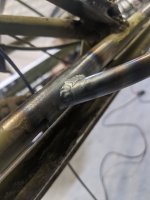
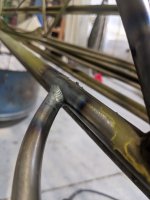
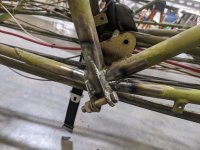
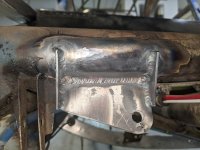
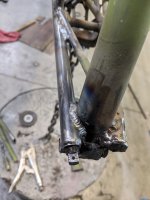
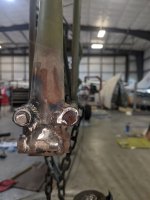
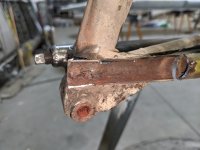
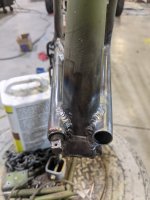
Here are a couple of obligatory pictures of a recent project I just finished up for the local FBO installing float fittings onto a Stinson 108-2. As part of it, we had to replace the last two feet of the lower longerons when I discovered internal corrosion (I have done the same thing on multiple other aircraft as well so it bears mentioning to make sure to drill witness holes between your fuselage members prior to welding and oil them internally when you are finished welding).

Click image for larger version  Name:	PXL_20230816_012722734.jpg Views:	0 Size:	1.55 MB ID:	86743
Click image for larger version  Name:	PXL_20230816_012712441.jpg Views:	0 Size:	2.05 MB ID:	86745

Click image for larger version  Name:	PXL_20230824_015059547.jpg Views:	0 Size:	3.08 MB ID:	86750

Click image for larger version  Name:	PXL_20230816_012712441.jpg Views:	0 Size:	2.05 MB ID:	86745
Click image for larger version  Name:	PXL_20230824_015059547.jpg Views:	0 Size:	3.08 MB ID:	86750
 
Last edited:
When I first was learning to weld, I was lucky enough to be close to several fabricators who gas welded aluminum as a regular business. Most of the work was done for race car body work where the welds would be hammered out and the part would be finished smooth. Because of the challenge, I learned to gas weld aluminum with O2 and acetylene gas. The preferred aluminum welding method was to use hydrogen gas and oxygen for aluminum but it can be done satisfactorily with acetylene. After that beginning, TIG was a snap to learn.

In my early years of race car construction we used aluminum tanks. Fuel cells were not required back them. The big advantage of gas welding aluminum is the back side or the weld is way better than TIG. The back side of the weld looks as good as the welded side with a smooth weld bead and a gradual taper to the welded material. A tig weld can come out this nice if you "back purge" the welded area with argon. But on flat sheets that is a hassle.
 
That is a skill I would like to learn. My attempts at oxy/acetylene aluminum welding ended in a melted mess. Great to have mentors.
 
Back
Top