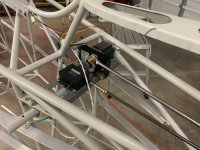
To convert to Electric Pitch Trim in a Bearhawk, you really must disable/remove the manual trim.
To explain this in more detail, aircraft with both manual and electric trim use trim cables connected to a rotary jackscrew to move a trim pushrod, or bellcrank that is connected to the control surface. The trim servo's in this arrangement are a servo with a multi-glooved pulley allowing for endless motion of a bridle cable, or the primary trim cable. (The cable will have 1.5-2 wraps around the pulley and then continue on)
This setup allows for trim cable movement from either the servo or the cockpit trim wheel, which would be another rotary pulley. The combination of these wrapped pulleys (one on servo and one on trim wheel) provides a completely closed loop cable.
And importantly, trim servo's do not have a brake on them holding a cable in position. It relies completely on the jackscrew to hold position and load from the flight control surface.
The manual Bearhawk trim, using a gear/chain at the trim wheel, is a dual cable, one connecting to the top of the bellcrank and terminating at the chain for the trim wheel, and the second connecting to the bottom of the chain and terminating at a turnbuckle, which attaches to the bellcrank.
If you were to attempt to add a servo to this system, you would need to retain the "friction lock" of the manual system to hold the control surface in place. In doing so, it becomes a fight between enough friction to hold the surface from moving, and especially fluttering, and keeping it loose enough for the servo to move it precisely from point to point. The trim wheel "load" in a Cessna is 90% cable tension and pulley condition, and 10% actual load placed on the jackscrew. The "load" on a Bearhawk manual trim is a combination of cable tension, friction in the drag in the steel torque tubes, and bolt tightness to keep it all from moving. While there could be cases of a system working, I do not feel it would be reliable enough without adjustment.
The second part of this is a GSA28 servo used for pitch trim would be far too fast in movement when actuated. It would need to be geared down with a secondary pulley arrangement a'la many Piper Trim systems, (which also still go to a jackscrew actuator) and we are not in the business of developing an entire autopilot trim system.
To actuate a direct-connection control surface for trim, the Ray Allen Trim servo provides the answer, via an electrically driven jackscrew. It just doesn't have a cable attachment.

pb