backcountry tailwheel mod-TK1/Shock Monster

COMTNHAWK

New member
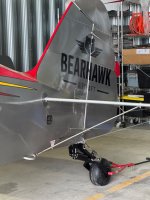
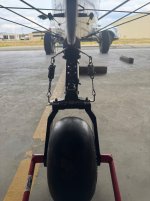
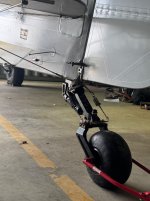
I had been doing a lot of research to get a non-inner tube tailwheel tire On my bearhawk 4 for appropriate ops off-airport/backcountry as tubes fail too easily. After a lot of research I went with the Tk1 racing/shock monster tailwheel assembly with an Alaskan bushwheel baby bushwheel tire.

I am so thrilled with this setup: it is beefy, steers phenomenal, smooth (no shimmy on pavement, absorbs so much off-pavement, absorbs any hard touchdowns). The full assembly only ended up weighing 2 pounds more than the full bearhawk tailwheel assembly as well.
I also had experience with a T3 tailwheel assembly and was severely disappointed mainly due to it lifting the rear thus decreasing your angle of attack/incidence OnX takeoff roll and constantly hit the tailwheel on take-off. It increase my take-off distance by at least 100’ if not more. The Shock monster does not do this and retains the factory angle of attack/incidence on the ground, and in some setups increases it!
Lastly it was a very easy and straight-forward install. The biggest challenge was getting the adjustment for height correct and took a few tries, as the system lowers when it is weighted from where it is set jacked up without any weight bearing, but smarter people than I could probably figure it out quicker! Also please disregard the mismatched springs: prior owner had mismatched springs installed and I corrected this upon install completion.

The reason I did not go with a matco tire is that it is squared off and all reports state it steers awful on pavement, the baby bushwheel is rounded and steers great, and retains the same (if not better) performance off-airport.

I wanted to share this in case anyone else is looking for a similar set-up as I am absolutely thrilled with this Setup and shock monster absolutely nailed it.
 

Attachments

  • IMG_9082.jpeg
    IMG_9082.jpeg
    690.6 KB · Views: 44
  • IMG_9081.jpeg
    IMG_9081.jpeg
    842 KB · Views: 44
  • IMG_9080.jpeg
    IMG_9080.jpeg
    555.2 KB · Views: 44
How much did you beef up the fuselage steel structure, to stop all that additional force and torque moment from gradually cracking longerons or the tail-post lower cluster?

Ask me how I know....

Also FYI, those Maule stopper-springs are explicitly not recommended, last I checked. People have broken rudder system components with aggressive pedal inputs, in years past.

Edit to add: sorry if that all sounded a bit negative. I think I may hold the record for "most tailwheel damage in a Bearhawk" across more than one aircraft, so all that first-hand experience weighs heavily on my mind!
Thanks for the input and information, and good info at that! there had already been damage to the rear from the stock set--up (prior owner) and was beefed up. Also the bearhawk tailwheel failed on me and broke the fork in half, so seemingly multiple bad issues. Thankfully it happened pulling it into the hangar. The (hopeful) advantage to this tailwheel design is the shock takes up most of the impact forces, and it only weighs two pounds more than the stock setup. The only other viable option I found was a Scott 3200 on the stock spring assembly with a baby bushwheel setup which also is heavier and felt would increase torque more being on the spring with a heavy moment arm of the 3200 and BBW?
I am aware of the maule spring issue also: I work with very renowned AI/A&P individuals that specialize in tailwheel and we went over everything (risks, enhancements, etc). In the end these were found appropriate.

i do appreciate the info though as bearhawks are new to me and I am not a builder
 
The (hopeful) advantage to this tailwheel design is the shock takes up most of the impact forces, and it only weighs two pounds more than the stock setup. The only other viable option I found was a Scott 3200 on the stock spring assembly with a baby bushwheel setup which also is heavier and felt would increase torque more being on the spring with a heavy moment arm of the 3200 and BBW?
I would agree that the shock absorbing capacity is better, but the problem is twisting and sideways bending forces the tailwheel places on the fuselage. The weight of the tailwheel system is not the main problem, it's the moment arm and flexibility which matter.

We've seen the rear lower longerons can bend significantly, when twisting forces are applied to the tailwheel with enough moment arm or too little flexibility in the tailwheel spring system.

These family of replacement tailwheel systems (T3, TK-1, etc) all lack any meaningful rotational flexibility, compared to a leaf spring or ideally the stinger. So 100% of the twisting and bending force is transferred to the fuselage longerons and tail post, highly impulsively, by these replacement tailwheel systems. Highly impulsive forces can easily amplify the force by a factor of 2x or 3x, if the (twisting) force is applied quickly. The faster the force is applied, the higher the amplification factor.

So we can conclude that rigid tailwheel spring and shock-absorber systems do increase the likelihood of permanently deforming or cracking the tail post or lower longerons. The more often the system is exposed to sudden twisting forces, the more likely something will deform immediately or eventually crack. Ground handling and rough / rocky surfaces are the highest risk times.

We have bent things with a single quick U-turn in the backcountry, so it's possible to do all the damage at once. Something as simple as a rabbit hole can do it.

The other spring designs (stinger / leaf spring) are not immune from these risks either, but they are flexible and will reduce the impulse. I have yet to see a leaf spring system cause damage the longerons. It took us many (many!) hundreds of rough riverbed landings with some weight aboard e.g. rear seat pax, to crack the tail post, and latter kits already include a stronger tail post sleeve (ours is an earlier kit).

Same comments apply for the IA's comments on the Maule steering springs, they can deem them to be appropriate... but, those springs are known to have cracked the upstream Bearhawk components (rudder horns, pedal horns), so their assessment of the risks misses those facts.

Edit: clarify which springs are which.
 
Last edited:
I would agree that the shock absorbing capacity is better, but the problem is twisting and sideways bending forces. The weight of the system is irrelevant, it's the moment arm and flexibility which matter.

We've seen the rear lower longerons can bend significantly, when twisting forces are applied to the tailwheel with enough moment arm or too little flexibility in the tailwheel spring system.

These family of replacement tailwheel systems (T3, TK-1, etc) all lack any meaningful rotational flexibility, compared to a leaf spring or ideally the stinger. So 100% of the twisting and bending force is transferred to the fuselage longerons and tail post, highly impulsively, by these replacement tailwheel systems. Highly impulsive forces can easily amplify the force by a factor of 2x or 3x, if the (twisting) force is applied quickly. The faster the force is applied, the higher the amplification factor.

So we can conclude that inflexible tailwheel systems increase the likelihood of permanently deforming or cracking the tail post or lower longerons. The more often the system is exposed to sudden twisting forces, the more likely something will deform immediately or eventually crack. Ground handling and rough / rocky surfaces are the highest risk times.

We have bent things with a single quick U-turn in the backcountry, so it's possible to do all the damage at once. Something as simple as a rabbit hole can do it.

The other spring designs (stinger / leaf spring) are not immune from these risks either, but they are flexible and will reduce the impulse. I have yet to see a leaf spring system cause damage the longerons. It took us many (many!) hundreds of rough riverbed landings with some weight aboard e.g. rear seat pax, to crack the tail post, and latter kits already include a stronger tail post sleeve (ours is an earlier kit).

Same comment for the IA's comments on the springs, they can deem them to be appropriate... but, those springs are known to have cracked the upstream Bearhawk components (rudder horns, pedal horns), so their assessment of the risks misses those facts.
I learned a lot from this Post, Battson. Thank you for explaining the Tail Wheel/fuselage environment, the engineering fixes, and exposing the the Bearhawk Service Difficulty. I did not know about most of this data on how forces damage things and the riskier environments that cause damage.

Feedback on Springs:. I use Tension Springs. I like them, I have outstanding service and steering results.

Data and definitions: to expand understanding. Spring Preference seems to be inspire strong preference & opinions sometimes.
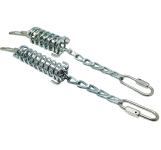
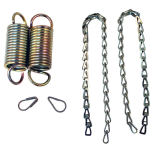
  1. The First photo is of Maule Compression Spring. The second is a tension spring.
  2. The Compression Spring will compress until it reaches its limit then bottom out. The Tension Spring just extends and extends and will stretch until "the Spring is Sprung" and does not perform spring action any more.
  3. If I bend a rudder steering arm, the rudder comes off and I sent it out for repair.
  4. My tailwheel install manual says to only use Tension Springs. "Please don't use Compression Springs that can bottom out and damage your tailwheel." but then "If you choose to use Compression Springs, leave slight amount of slack to prevent bottoming out the rudder at full deflection."
  5. Screenshot 2026-11-05 at 6.32.32 AM.pngScreenshot 2026-11-05 at 6.32.59 AM.png
 
Brooks I think Jonathan is talking more about the spring that goes between the tailwheel assembly and the fuselage rather than the steering springs.

There is a safety update about reinforcing the longeron junction here, which also includes a warning about making fast turns on rough ground:

Here is the update about reinforcing the tail post due to in-service cracks because of twisting loads imposed by the rod spring:

Not knowing the vintage of the damaged fork, if it was very old it may have been subject to a beef-up called out in the 2008/9 era:
If it was not, I'm sure Bob would love to hear about it.

The first two above relate to Jonathan's posts. When the tailwheel is turned 90 degrees off to one side, all of that tail weight is being applied in a twisting motion, with an arm that you can measure but is probably something like 8 inches. Combine that with a swift swing around of the tail on rough ground and you can imagine the forces are quite large.
 
There's a whole other thread on this subject (below) for anyone interested. Damage has occurred to several Bearhawks - thought to have resulted from tight turns on rough ground. It's probably not a Bearhawk thing but is likely to affect any tailwheel aircraft operating on rough ground.

 
Not knowing the vintage of the damaged fork, if it was very old it may have been subject to a beef-up called out in the 2008/9 era:
If it was not, I'm sure Bob would love to hear about it.
The aircraft involved appears to be same one which we flew in the American desert, as preparation for our own first flight in NZ.
If so, it was built around the late 2000's.

So you are probably correct, the tailwheel was probably mid-2000's vintage, and probably lacked the necessary strengthening modification.
 
Back
Top