Hi everyone, I know this has been discussed in the past but I am moving my battery location. My PC 680 has failed a couple of times in cold weather even after being on the charger. It just doesn’t seem to have the cranking power to turn the 3 bladed Trailblazer prop unless it’s warm. So I’m upgrading to a Earthx 900. My 680 was mounted on the firewall but not in a place to jumpstart without removing the top cowl. So I’m moving the new battery inside for better accessibility and heat protection the Earthx batteries seem prone to. It seems that under the seat is a common place so it will likely go there. My question is did you run the ground cable back to the firewall on a ground block or did you ground it near the battery to the steel frame, or how did you do it? Also any recommendations on how to best route the starter cable from the contractor to the battery under the seat is appreciated. Thanks

You are using an out of date browser. It may not display this or other websites correctly.
You should upgrade or use an alternative browser.
You should upgrade or use an alternative browser.
Battery relocation
- Thread starter Tim213
- Start date

marcusofcotton
4A scratch NE Minnesota
I'm of the camp that says to never use your frame as a current carrying device so as to avoid magnetizing it. That said, I'm also a weight weenie!
Last edited:

I am not opposed to airframe grounding but I would definitely not put the battery under the seat. Put it on the aft side of the firewall instead. Some folks put the heavy battery under the seat for weight purposes, but that is moot with the lithium. By putting the battery that far from everything, you will require more wire which means more weight, cost, resistance, and voltage drop. Also, you create the need to fabricate some robust short circuit protection from passenger feet and cargo. And you lose that space which is perfect for a tool bag or autopilot servo.
Also, the temperature rating on the Earthx is higher than the rating on your PC680. I ran the Earthx on the forward side of the firewall on our last plane and it held up better than the SLA batteries in the same spot. I never could get more than a year out of a lead battery on the forward side of the firewall.
If you get the vented version, you can route the vent right through the firewall and into the engine compartment.
Also, the temperature rating on the Earthx is higher than the rating on your PC680. I ran the Earthx on the forward side of the firewall on our last plane and it held up better than the SLA batteries in the same spot. I never could get more than a year out of a lead battery on the forward side of the firewall.
If you get the vented version, you can route the vent right through the firewall and into the engine compartment.

Battson
Moderator
The earth connection between the engine and battery is key.
If you are having trouble starting with a PC680, it's more likely an earth / circuit issue combined with a cold battery, than purely a battery issue. The starter draws hundreds of amps at 12V, a very low resistance circuit is required for this to work. There are many ways to have resistance in the circuit, e.g. is there paint between your starter and your engine block?
I think you get the point. You really want a huge and solid earth strap either direct from the engine block directly to the negative battery terminal, or at least to your star-point earth.
This means a battery on the firewall, or alternatively a lot of extra power cable. Remember, the longer the cable the heavier it needs to be. Originally I was quite optimistic about cable sizes (some 13 years ago). Now I would say 4 AWG is the absolute bare minimum, assuming a firewall battery run. I think 2 AWG or 1/0 AWG is a better choice. I had problems starting with 4G and upgraded to 0G cables, and moved the battery from under the seat to the firewall. This helped a lot.
If you have the battery high up the firewall, it will get hotter after engine shutdown (when things get the hottest). It also makes it harder to jump start. For anyone building anew, I suggest battery low on the engine side of the firewall, near the cowl door. My PC680 has lasted several years on the firewall, since the move from under the seat. They don't like being overheated.
If you are having trouble starting with a PC680, it's more likely an earth / circuit issue combined with a cold battery, than purely a battery issue. The starter draws hundreds of amps at 12V, a very low resistance circuit is required for this to work. There are many ways to have resistance in the circuit, e.g. is there paint between your starter and your engine block?
I think you get the point. You really want a huge and solid earth strap either direct from the engine block directly to the negative battery terminal, or at least to your star-point earth.
This means a battery on the firewall, or alternatively a lot of extra power cable. Remember, the longer the cable the heavier it needs to be. Originally I was quite optimistic about cable sizes (some 13 years ago). Now I would say 4 AWG is the absolute bare minimum, assuming a firewall battery run. I think 2 AWG or 1/0 AWG is a better choice. I had problems starting with 4G and upgraded to 0G cables, and moved the battery from under the seat to the firewall. This helped a lot.
If you have the battery high up the firewall, it will get hotter after engine shutdown (when things get the hottest). It also makes it harder to jump start. For anyone building anew, I suggest battery low on the engine side of the firewall, near the cowl door. My PC680 has lasted several years on the firewall, since the move from under the seat. They don't like being overheated.
Last edited:

kestrel
Offering Bearhawk rides
I'll second everything that Jared said.
I have my EarthX on the engine side of the firewall because it lives in the same box as all the PC680's that died before it. I insulated the battery box and ran a small cooling duct to it. The cooling duct is small enough diameter that it may not be helping anything, but I can't motivate myself to remove it.
Assuming that you move yours, Jared has the right advice.
I have my EarthX on the engine side of the firewall because it lives in the same box as all the PC680's that died before it. I insulated the battery box and ran a small cooling duct to it. The cooling duct is small enough diameter that it may not be helping anything, but I can't motivate myself to remove it.
Assuming that you move yours, Jared has the right advice.

Nev
Quick-build 4-place B #25
What they said. My EarthX is mounted on the engine side of the firewall, with a vent in the cowling directly above it to help with cooling after engine shutdown.
During testing I ran a remote temperature sensor through to the battery compartment on the engine side of the firewall and sampled the actual temps during operation. The hottest temperature recorded under my cowling was approximately 13 minutes after engine shutdown, (but below the EarthX max operating temp). Inflight temps were relatively low.
During testing I ran a remote temperature sensor through to the battery compartment on the engine side of the firewall and sampled the actual temps during operation. The hottest temperature recorded under my cowling was approximately 13 minutes after engine shutdown, (but below the EarthX max operating temp). Inflight temps were relatively low.
Nev
Quick-build 4-place B #25
I also meant to say, it is relatively simple to add a ground power plug for charging and jump starting. Mine is located on the cockpit side of the firewall, between the rudder pedals. This enables me to use a jump pack if I need to, while remaining in the aircraft so it can be done by one person.
I also meant to say, it is relatively simple to add a ground power plug for charging and jump starting. Mine is located on the cockpit side of the firewall, between the rudder pedals. This enables me to use a jump pack if I need to, while remaining in the aircraft so it can be done by one person.
There is good wisdom here. If you need to make an extension cord, make one for the battery charger instead of the whole electrical system.

noema
Stefan Hechenberger
I hung mine on the firewall after watching some yt videos on burning LiFe batteries. The burn down is more controlled than with LiPos but they still generate a ton of white smoke. This is presumably why EarthX has a VNT version with vent tubes that need to be routed to the outside.
bearhawk2015
Well-known member
I’ve had my earthx on the firewall for 7 years with no cooling tube and I’ve had no problems.
Nev
Quick-build 4-place B #25
I’ve had my earthx on the firewall for 7 years with no cooling tube and I’ve had no problems.
This is good data point. Mine has a cooling tube, but I will likely remove it. I'd be better off having a slightly higher pressure above the cylinders that removing the cooling tube will give.
Battson
Moderator
I’ve got to change my battery again, they are lasting about 3 years on the firewall (many years of testing now). The battery is getting too soft / low power in its third winter, on very cold mornings. It can really struggle if it's not used regularly, I've measured the voltages and it's not pretty during a start.
I have seen the 60°C upper limit on the Odyssey PC680 mentioned in other threads. I think that number comes from Odyssey’s technical manual for maximum continuous operating temperature. But I don't think that's the problem.
I've since learnt that running the battery case continuously above about 25°C significantly accelerates internal degradation.
It's easy to assume the high heat spike after engine shutdown kills firewall batteries. But if you look at the chemistry, continuous heat during cruise flight actually does far more long-term damage.
I now understand that battery degradation is a function of temperature multiplied by time. As a general rule of thumb in battery chemistry, the internal wear rate roughly doubles for every 10°C rise above room temperature. In a 540 engine bay, ambient cowl air in flight probably runs around 45°C to 60°C. Sitting in a 50°C engine bay for a two or three hour flight means the core of the battery heats right up and stays there for hours, while the alternator is actively charging it. That continuous hot charging degrades the battery internals much faster than a ~15 minute heat spike after the prop stops, the battery core doesn't heat up very much in that short time.
Installing a 3/4 inch blast tube off the rear engine baffle to blow fresh air directly onto the battery case is probably the best way of extending the battery life, so that's my plan now. Blowing cool air across the battery during flight should reduce the battery core temperature by 15°C to 20°C, which effectively cuts that internal wear rate by more than half.
In practice, that blast air should extend a 3 year battery replacement cycle into 4 or 5 years, I hope....
I still like the PC680 as it's a cheaper firewall battery on a $/year basis than the alternatives, which is also available on shelfs all over the country. Plus it strikes a fair balance of weight and cost.
If your battery has to live in the engine bay, putting a simple heat shield between it and the exhaust, combined with a dedicated blast tube for cruise, is probably a good idea.
I have seen the 60°C upper limit on the Odyssey PC680 mentioned in other threads. I think that number comes from Odyssey’s technical manual for maximum continuous operating temperature. But I don't think that's the problem.
I've since learnt that running the battery case continuously above about 25°C significantly accelerates internal degradation.
It's easy to assume the high heat spike after engine shutdown kills firewall batteries. But if you look at the chemistry, continuous heat during cruise flight actually does far more long-term damage.
I now understand that battery degradation is a function of temperature multiplied by time. As a general rule of thumb in battery chemistry, the internal wear rate roughly doubles for every 10°C rise above room temperature. In a 540 engine bay, ambient cowl air in flight probably runs around 45°C to 60°C. Sitting in a 50°C engine bay for a two or three hour flight means the core of the battery heats right up and stays there for hours, while the alternator is actively charging it. That continuous hot charging degrades the battery internals much faster than a ~15 minute heat spike after the prop stops, the battery core doesn't heat up very much in that short time.
Installing a 3/4 inch blast tube off the rear engine baffle to blow fresh air directly onto the battery case is probably the best way of extending the battery life, so that's my plan now. Blowing cool air across the battery during flight should reduce the battery core temperature by 15°C to 20°C, which effectively cuts that internal wear rate by more than half.
In practice, that blast air should extend a 3 year battery replacement cycle into 4 or 5 years, I hope....
I still like the PC680 as it's a cheaper firewall battery on a $/year basis than the alternatives, which is also available on shelfs all over the country. Plus it strikes a fair balance of weight and cost.
If your battery has to live in the engine bay, putting a simple heat shield between it and the exhaust, combined with a dedicated blast tube for cruise, is probably a good idea.
The EarthX has a higher temperature rating, and the back side of the firewall is much cooler!

Bcone1381
Finished Patrol
You can get real data about your cowl temps the temp inside the battery case.
K type Thermocouples are dirt cheap. The reader is also very affordable. Measuring actual temperatures opens up a whole world of firewall forward knowledge. I taped the wires to the outside of the boot cowl and bring them up thru the side window. Arborite calls this a Minimally Viable Product.
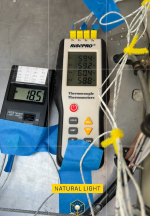
K type Thermocouples are dirt cheap. The reader is also very affordable. Measuring actual temperatures opens up a whole world of firewall forward knowledge. I taped the wires to the outside of the boot cowl and bring them up thru the side window. Arborite calls this a Minimally Viable Product.

Gerhard Rieger
Well-known member
I ful
I fully agree, never make your airframe part of the battery, run +- wiring trough out. You will stop most if not all galvanic corrosionI'm of the camp that says to never use your frame as a current carrying device so as to avoid magnetizing it. That said, I'm also a weight weenie!
Nev
Quick-build 4-place B #25
Very interesting discussion. I’m currently at 515 Tacho / 630 Hobbs hours over 4.5 years, and my original EarthX battery is still going strong. It’s mounted high on the firewall, inside the engine cowling.
Originally, I had a cooling blast tube directed at it. However, when I measured the temperature in that area in flight, I was surprised to find it never got above about 35°C. The highest temperatures actually occurred after shutdown, once the cooling airflow stopped. Typically, about 10 minutes after shutdown, the temperature would peak at around 60°C.
Based on that, I removed the blast tube a couple of years ago, and the battery is still performing strongly.
Originally, I had a cooling blast tube directed at it. However, when I measured the temperature in that area in flight, I was surprised to find it never got above about 35°C. The highest temperatures actually occurred after shutdown, once the cooling airflow stopped. Typically, about 10 minutes after shutdown, the temperature would peak at around 60°C.
Based on that, I removed the blast tube a couple of years ago, and the battery is still performing strongly.
Battson
Moderator
In case anyone wondered how I arrived at the temperatures above:
If I touch my firewall during flight, even after a relatively short cruise, it's too hot to touch. Do others find this too?
I mean, it's not melting rubber off shoes, but you pull back immediately if you touch it with your fingertips. It's stainless steel (painted).
Being "too hot to touch" is a fairly consistent temperature indicator, usually means reaching >45*C at the skin on fingers - but that's the temperature of the skin itself - the surface being touched is almost always hotter, as the heat isn't perfectly conducted into the skin. So the firewall is probably sitting at 45 to 50*C.
Based on that datapoint, I assume the battery and other metal parts touching the firewall (on the FWF side) are also reaching temperatures of 45-50*C as metal is an excellent conductor, noting stainless steel isn't the very best. But they could be hotter.
Then, it gets hotter after shutdown, before cooling down. Ergo the probable 45 to 60*C temperature range.
I haven't tried to measure it with thermocouples etc. I would love to have the spare time, interest, and energy to do these things! But I always end up going fishing instead
If I touch my firewall during flight, even after a relatively short cruise, it's too hot to touch. Do others find this too?
I mean, it's not melting rubber off shoes, but you pull back immediately if you touch it with your fingertips. It's stainless steel (painted).
Being "too hot to touch" is a fairly consistent temperature indicator, usually means reaching >45*C at the skin on fingers - but that's the temperature of the skin itself - the surface being touched is almost always hotter, as the heat isn't perfectly conducted into the skin. So the firewall is probably sitting at 45 to 50*C.
Based on that datapoint, I assume the battery and other metal parts touching the firewall (on the FWF side) are also reaching temperatures of 45-50*C as metal is an excellent conductor, noting stainless steel isn't the very best. But they could be hotter.
Then, it gets hotter after shutdown, before cooling down. Ergo the probable 45 to 60*C temperature range.
I haven't tried to measure it with thermocouples etc. I would love to have the spare time, interest, and energy to do these things! But I always end up going fishing instead
Bcone1381
Finished Patrol
For those who are use to Fahrenheit 45C = 113F 60C = 140F
I fought hot cowl temps and won. Last year on a warm day I could feel heat radiating off my firewall. I learned that my second (Left) heat box flowed a very nice volume of bypass exit air that was about (touch test) 125F. The way I mounted it was not encouraging the exit air to flow out the bottom of the cowl so I removed that entire heat system. I also added an exit duct on the R. box to ensure all of its bypass air flows out the cowl.
On a 90 degree day last weekflying low, I reached up and felt my firewall. It was not warm and I was pleased. So I think my heat boxes added hot air to my cowl temps. I also have my exhaust ceramic coated, and a good differential betwen the upper and lower plenums with a cowl lip. But those items did not compensate for the hot heat box bypass air contaminating my cowl environment with heat.
I fought hot cowl temps and won. Last year on a warm day I could feel heat radiating off my firewall. I learned that my second (Left) heat box flowed a very nice volume of bypass exit air that was about (touch test) 125F. The way I mounted it was not encouraging the exit air to flow out the bottom of the cowl so I removed that entire heat system. I also added an exit duct on the R. box to ensure all of its bypass air flows out the cowl.
On a 90 degree day last weekflying low, I reached up and felt my firewall. It was not warm and I was pleased. So I think my heat boxes added hot air to my cowl temps. I also have my exhaust ceramic coated, and a good differential betwen the upper and lower plenums with a cowl lip. But those items did not compensate for the hot heat box bypass air contaminating my cowl environment with heat.

Have-Purple
C18
For those who are use to Fahrenheit 45C = 113F 60C = 140F
I fought hot cowl temps and won. Last year on a warm day I could feel heat radiating off my firewall. I learned that my second (Left) heat box flowed a very nice volume of bypass exit air that was about (touch test) 125F. The way I mounted it was not encouraging the exit air to flow out the bottom of the cowl so I removed that entire heat system. I also added an exit duct on the R. box to ensure all of its bypass air flows out the
Can you describe your exit duct? Assuming you pushed it lower and closer to the cowl lip.

aerolithium
Member
I talked to Virgil at Oshkosh explaining that the new battery chemistry of Sodium would alleviate the heat issue ( and the cold temp issues).In case anyone wondered how I arrived at the temperatures above:
If I touch my firewall during flight, even after a relatively short cruise, it's too hot to touch. Do others find this too?
I mean, it's not melting rubber off shoes, but you pull back immediately if you touch it with your fingertips. It's stainless steel (painted).
Being "too hot to touch" is a fairly consistent temperature indicator, usually means reaching >45*C at the skin on fingers - but that's the temperature of the skin itself - the surface being touched is almost always hotter, as the heat isn't perfectly conducted into the skin. So the firewall is probably sitting at 45 to 50*C.
Based on that datapoint, I assume the battery and other metal parts touching the firewall (on the FWF side) are also reaching temperatures of 45-50*C as metal is an excellent conductor, noting stainless steel isn't the very best. But they could be hotter.
Then, it gets hotter after shutdown, before cooling down. Ergo the probable 45 to 60*C temperature range.
I haven't tried to measure it with thermocouples etc. I would love to have the spare time, interest, and energy to do these things! But I always end up going fishing instead
Bcone1381
Finished Patrol
Yes, I push it lower so it must exit the cowl without question.Can you describe your exit duct? Assuming you pushed it lower and closer to the cowl lip.
Its a fabricated shroud to direct the airflow out. To fabricate this I applied a mold release (clear packaging tape) to the heat box and firewall where the shroud would contact, then I impregnated some fiberglass cloth (worked it into the cloth with a putty knife...saturated the cloth with it) with Permatex high temp RTV. Do this between a couple sheets of visqueen. The apply it to the area to form a duct. It can handle the high temps, and is flexible. Also a bit ugly...use the Ultra Black RTV to hid it a bit. It has MVP qualities (MVP = minimally viable product).
Battson
Moderator
This is great advice and something I hadn't considered - it seems so obvious now!So I think my heat boxes added hot air to my cowl temps. I also have my exhaust ceramic coated, and a good differential betwen the upper and lower plenums with a cowl lip. But those items did not compensate for the hot heat box bypass air contaminating my cowl environment with heat.
When my cabin heater isn't in use, it dumps all the hot air into the middle of the FWF area. Surely, that doesn't do anything good to the cooling for firewall-mounted and engine accessory equipment.

It would be so easy to duct that waste hot air into the cowl exit, so it doesn't heat the firewall etc.
It's very interesting to hear that you experienced a reduction in firewall heating, following the changes you made.

svyolo
Junior Member
My 2 cabin heat valves are angled so they are oriented about 40 degrees "up" for the exit when closed. Seems like an easy fix to duct them down. Changing their orientation is a big job as mine are cable controlled.
Seems like a good idea overall. BTW I re-purposed one of those valves as a "defog" for the windescreen. I am in the PNW US with humid and cold winters. I only used it twice but it worked great. I put a couple of cheap 2" plastic vents in the glare shield. I just dump that heat valve under the glare shield, and those two vents do a good job of defogging the windscreen.
Seems like a good idea overall. BTW I re-purposed one of those valves as a "defog" for the windescreen. I am in the PNW US with humid and cold winters. I only used it twice but it worked great. I put a couple of cheap 2" plastic vents in the glare shield. I just dump that heat valve under the glare shield, and those two vents do a good job of defogging the windscreen.