Bearhawk Tailwheels Tundra Tailwheels are finally Ready

Enewton57

Member
Hi Everyone,

After a lot of work and Bob Barrows testing, we are finally ready to offer the Tundra version of the Bearhawk Tailwheel. Bob redesigned the standard Bearhawk Tailwheel to have a larger, wider and beefed up fork system. He also included a modification of the Tailwheel main body to include an adjustable friction control.

For testing, the prototype Tundra tailwheel was bolted on to a Bearhawk and Bob did a series of flight tests on asphalt runways, including some cross wind landings, bouncing the tailwheel up and down, swerve testing, etc. He did a series of landings with differing friction adjustments to determine an adjustment for minimal shimmy. He said that with the friction control all the way loose, he got some slight shimmy but not real bad. He then tightened the friction control a little and the shimmy went away.

So It all checked out and Bob has given us the thumbs up to start offering the Tundra Tailwheel for sale.

You might be asking yourself, "Do I really need a Tundra Tailwheel?"

Here are my general recommendations:
  • If you run 8.00 x 6 or smaller tires on your mains, use an 8" tailwheel.
  • If you have 8.50 x 6 or larger use a 10" tailwheel.
  • If you run 28" Tundras or larger on your mains, or if you do a lot of rough terrain off-airport landings, use a Tundra Tailwheel

If interested - Here is the website for the Bearhawk Tailwheels LLC
http://bhtailwheels.com

Please allow 3 to 4 weeks for delivery.

Thanks,
 
Last edited:
(Untitled)

I got some pictures of the Bearhawk Tundra Tailwheel mounted to Mark's Bearhawk. I am posting these through TapaTalk so I hope this works.
e027073a87fd407a4b1c987ef033d53d.jpg
e385f22fbefff8173de51cc268b40b1e.jpg
f9342bf38cb7bba4b59bd03e411d8d14.jpg
01ec3f35e671aef2cdd57b54513f039a.jpg
4e1b6ee5abd1ae13853202d9430d0037.jpg


Eric Newton - Long Beach, MS
Bearhawk Tailwheels LLC
Bearhawk Manuals
http://mybearhawk.com
 
Hey Eric,
Did you end up using a different wheel for the tundra tailwheel than the 8"/10" version? The reason I ask is I already have an 8" wheel/tire.
 
I'm going to be picky here. There doesn't appear to be much clearance on the side walls and very little at the center of the tread. Gar Aero first made the baby bushwheel and the complaints were that rocks, mud, sticks, etc were getting caught between the wheel and yoke, Alaska Bushwheels came up with a version that allows for much more clearance and no complaints from the owners of those, or very few. See attached. White is Gar Aero.gar aero.jpg Bushwheel.jpg
 
(Untitled)

Interesting comments. Bob required a clearance of no more than 3/16" and he would prefer 1/8". I made one with larger clearance and he asked me to keep it as close to 1/8" as possible.

Bob's reasoning was that the smaller clearance would prevent rocks from getting in there and getting wedged between the fork and the tire. He said smaller rocks would be less likely to jam the tire and lock it up. A larger opening would allow a larger rock to get in there and lock the tire up.


Eric Newton - Long Beach, MS
Bearhawk Tailwheels LLC
Bearhawk Manuals
http://mybearhawk.com
 
Last edited:
(Untitled)

Eric, outside of the friction adjustment, can the fork and wheel assembly from the bush version be used on your 8" tailwheel body? I bought the 8" tailwheel from you a couple months ago hoping to eventually upgrade without buying a whole new body, but if I mounted the bush wheel it would be with the intention of avoiding pavement as much as possible. Thanks.
Nic
 
(Untitled)

Yes - it's the same Tailwheel body. The friction adjustment needs to be added unless all your operations are not on asphalt or you keep the tail up until you slow down significantly.


Eric Newton - Long Beach, MS
Bearhawk Tailwheels LLC
Bearhawk Manuals
http://mybearhawk.com
 
(Untitled)

Yes - if you buy the fork assembly for the tundra and send me your tailwheel body, I will install the friction adjustment for free.


Eric Newton - Long Beach, MS
Bearhawk Tailwheels LLC
Bearhawk Manuals
http://mybearhawk.com
 
That is good to know - I would rather just buy the fork and wheel, if I can reuse the body.
Being overseas, it's unlikely I can on-sell sell my existing set-up, so just buying the parts I need would save on storeroom parts gathering dust.

Eric, would you be selling "upgrade kits" more widely?
 
If you access to a welder, I could send the friction adjustor to you. You would drill a 3/8" hole in your tailwheel body right at the back and then weld a nut on the outside lined up with the hole. Then repaint the body. Pretty easy to do.
 
(Untitled)

It might on the 10" but let's discuss this for a minute. Generally speaking the larger the Tailwheel the more tendency to shimmy. The tailwheels have some friction built in anyway and I build the 10" with an extra wavy washer to increase the friction, so it hasn't been a problem. The key thing is making sure you have proper kingpin angle. Go back and take a look at the previously posted pictures of the tundra Tailwheel mounted on Mark's Bearhawk and see the kingpin angle. That is the proper angle with no weight in the airplane. Mark recently changed out his leaf spring because the old one had straightened out (relaxed) and the king pin was vertical with no weight in the plane. When he loaded the plane up with people in the back and baggage the 10" Tailwheel would shimmy. After he changes out the leaf spring to this one shown in the pictures, no more shimmy.

So a properly set up (proper kingpin angle) 8" or 10" Bearhawk Tailwheel built by us, has enough friction built in to not have a tendency to shimmy.

Adding more friction makes steering a bit harder. My fear is someone would have an improper kingpin angle, or loose mounting bolts and then compensate by tightening up the friction control.


Eric Newton - Long Beach, MS
Bearhawk Tailwheels LLC
Bearhawk Manuals
http://mybearhawk.com
 
I have never had a shimmy problem with my existing TW.
I would be willing to try the larger fork [and bearing] without the friction adjuster. I land pavement only a few times a year, and I can wheeley those landings. In fact NJB spends more time on beaches and rocks than pavement.

Eric, are you were interested in selling a "half kit"? What would the price be?

Jonathan
 
Hi Eric,

Are you able to tell me what air pressure you have been running these at, how low can you go?

Obviously the air pressure is a balancing act:
- higher pressures mean less greater strength to resist the hard hits, and less chance of a flat tire (but those forces are transferred to the fuselage)
- lower pressures provide much greater cushioning, shock absorption, and greatly enhanced floatation on soft surfaces (width is important)

While both those points are important in the off-airport environment, I think the latter is much more important overall. Especially considering the most successful bush tail wheels are big, wide, and soft.

Jonathan

P.S. does the $425 fork assembly come with a wheel too, or just the forks? Thanks!
 
Last edited:
(Untitled)

Hi Jonathan, I recommend people start off with 20 PSI on the Tundra and go from there. You could probably go down to 15 PSI if you want. The $425 includes tire and wheel along with all the bearings and spacers. It's basically everything except the Tailwheel body and top cap.


Eric Newton - Long Beach, MS
Bearhawk Tailwheels LLC
Bearhawk Manuals
http://mybearhawk.com
 
Hi Jonathan, I recommend people start off with 20 PSI on the Tundra and go from there. You could probably go down to 15 PSI if you want. The $425 includes tire and wheel along with all the bearings and spacers. It's basically everything except the Tailwheel body and top cap.


Eric Newton - Long Beach, MS
Bearhawk Tailwheels LLC
Bearhawk Manuals
http://mybearhawk.com
That is a great deal Eric, all those parts for so little cash!

What's more, 15-20 PSI is VASTLY superior to the 60-70 PSI (think rock-solid) of the smaller wheels. In fact, I believe that's comparable to what the Alaskan Baby Bushwheel runs at, from memory.

My last question is, what airspeed reduction have you (or Mark) measured as a result of fitting this tail wheel?

Do I just place my order on your website?

PS. If you could throw in the friction fitting, that would be great, I have a welder here (saves shipping the whole deal back to the USA).
 
Last edited:
To my knowledge it hasn't been measured yet - you might ask Mark. Yes, just order on the website. Http://bhtailwheels.com - shipping will be figured in when you select your country.


Eric Newton - Long Beach, MS
Bearhawk Tailwheels LLC
Bearhawk Manuals
http://mybearhawk.com
Thanks Eric,

I spoke to Mark, he said that when the installed the Tundra tailwheel, they also installed the profiled horisontal stabiliser and changed the angle to three degrees. Overall the Bearhawk was 3-4 MPH faster after all those modifications.

So yes, it hasn't been tested by Mark. Do you know of anyone else who has installed the Tundra tailwheel on a flying Bearhawk?
 
I think this video is a common example of when the Tundra tailwheel would be useful.
We didn't video it, but we recently had a huge drama on a beach where the tailwheel was getting stuck in the same way, and putting us into an "uncomfortable" position of getting very close to some big surf.
 
Last edited:
I have been trying to get the performance loss testing done on mine, but I haven't worked out the logistics over the past two months. The weather has to be perfect, I have to be in town, and my wife has to be able to put up with me leaving the house before dawn and not helping get the kids ready for the day. I had not intended to test the tailwheel separately, in part because it would require yet another case of all of these conditions coming together, and in part because I doubted that the effects would be large enough to show up in that kind of testing.
 
Last edited:
The other thing I should have asked, for completeness, is what the weight increase is compared to the 10" wheel?

With that, plus all the above facts and figures, there is enough information for anyone interested to make an informed decision about whether this tailwheel suits them.
 
The tail wheel upgrade kit arrived this weekend, so I can answer my own question!

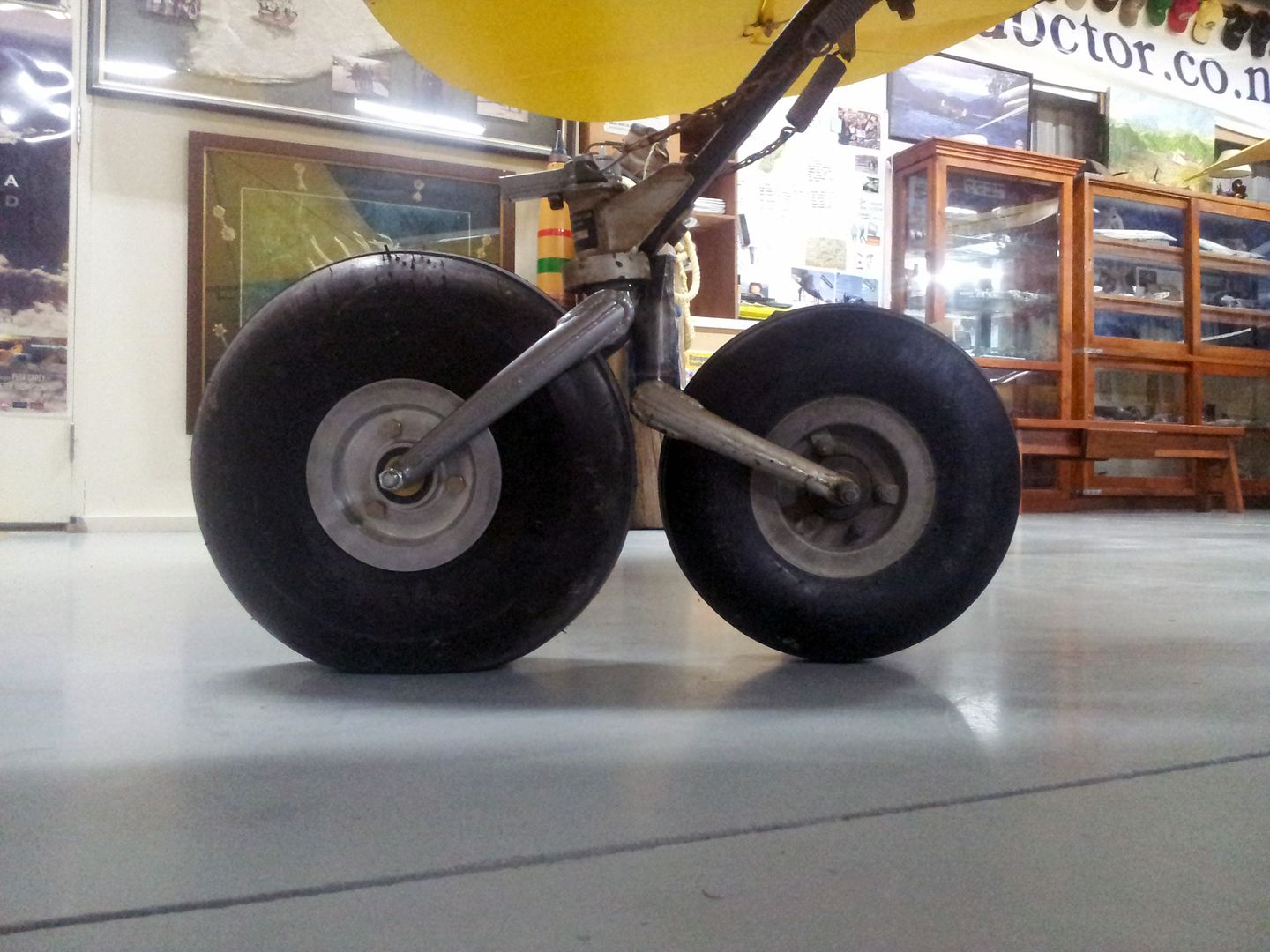
The weight difference between the 10" tail wheel and the Tundra 12" is 400g (less than 1 lb). That moves the CG aft by about 2mm (5/64 inch).

Switching out the assembly was easy to do, and took about 20 minutes. Although because my tail wheel body has suffered a good rock hit to the bearing housing, the outer bearing race is trapped inside. But because there is nothing wrong with the bearing, I decided not to replace it with the new one provided. It's nice to have a spare.

I haven't welded on the friction fitting yet. I do so few pavement landings, I don't think the shimmy will ever bother me. I can always fit it later, if my experience dictates otherwise.

The Tundra is noticeable a larger diameter and importantly much softer, it should roll easily over larger rocks and absorb more of the dynamic forces. I am certain happy with the increased footprint - evident in this photo below:
20150920_170839_zpsx0cbuoqm.jpg


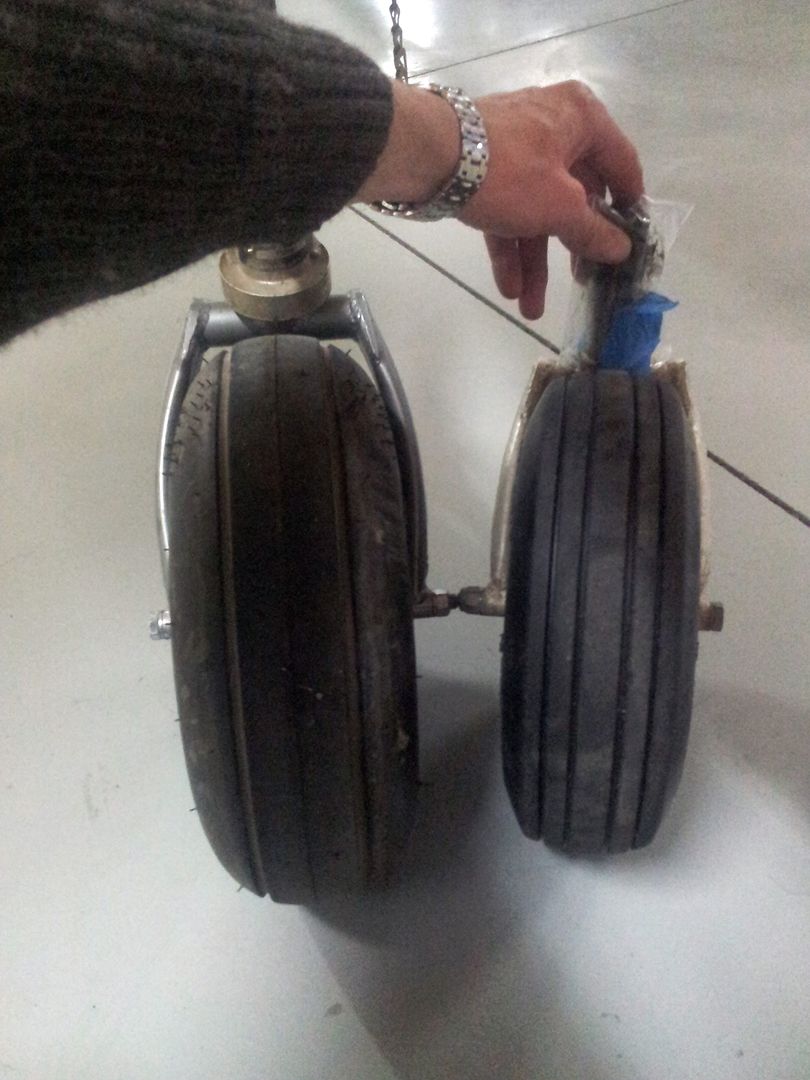
The wheel is also about an inch wider:
20150920_170952_zpsr5il7bd9.jpg


Personally, for what I am doing, I think this width should be satisfactory. The diameter is certainly as big as anyone should need. I wouldn't have been upset if it were even wider again, just because we recently managed to get properly stuck in quite soft sand - which cost me a lot of sand-blasted paint to pull her out (after we unloaded a lot of heavy gear).

I haven't had a chance to fly with it yet, appalling weather over the weekend.
 
(Untitled)

Curious what the width measures once mounted up and inflated. My tundra TW measure 4". I saw a Baby Bushwheel for the first time yesterday and the thing is way fat. Think the 400x4 is taller but at least an inch narrower.
 
Sorry I thought I had already mentioned it - it is exactly 4" wide.

The Baby Bushwheels seem to be closer to 6" wide, which would be impossible to sink into soft surfaces. I am thinking if I really try, I can still sink the Tundra tail wheel, but I doubt it would actually sink far enough to get properly stuck... the old 10" tailwheel would sink up to the axle quite often, sometimes deeper - which was enough to get it stuck (by which I mean it stops turning, and then you need power to lift or drag it out). Just terrible for the prop.

​As pictured the Tundra is at 20 PSI, I tried letting it down to 12, didn't offer much additional benefit in terms of floatation, but would greatly increase the risk of popping it... so 20 PSI it is.
 
The tundra tire was changed to a square profile tire to eliminate shimmy issues experienced in the past. The square profile is much more tolerant of camber change when aircraft is loaded or empty. The profile is 2in smaller in diameter but the same width profile as the previous tundra. This setup keeps the tailwheel more friendly on pavement while offering the same flotation benefits on soft terrain.
 
The tundra tire was changed to a square profile tire to eliminate shimmy issues experienced in the past. The square profile is much more tolerant of camber change when aircraft is loaded or empty. The profile is 2in smaller in diameter but the same width profile as the previous tundra. This setup keeps the tailwheel more friendly on pavement while offering the same flotation benefits on soft terrain.
Is the tire the only change? If so what is the newer tire and can it be mounted on the Tundra Tailwheel?
 
Back
Top