Magnetometer location and pitot tubes

Bradrock

Well-known member
Could someone please relay where they have mounted their magnetometer? I am about to skin my wings and would like to avoid making more work for myself down the line.
I'm not decided yet between Dynon or MGL, but they both need to be away from steel. So is the wingtip acceptable, or some interim location between ribs?

I have a Dynon AOA pitot tube. Have people made their own mounts or used commercially available Dynon pitot mounts?
 
I mounted mine near the wing tip, one bay inboard to keep away from the nutplates. Of course you need a little base to correct for the dihedral angle.

If you are going with a Dynon Skyview, their remote compass is different from mine. Lars Fellman in Auckland has installed one.

I used a commercially available pitot mount, but I made it detachable because it's hard to transport the wings with it riveted on. If I were doing it again, I would look into the benefits mounting it further back to correct for high AoA, although you also need to think about people walking into it. BH wings are much lower than a C180 for instance.
 
Last edited:
Dynon is mounted in second bay on left wing. My garmin is mounted on outside of rib on right wing tip toward the trailing edge of the wing to get space between led strobe and magnetometer. Both work well.
 
Resurrecting another thread.

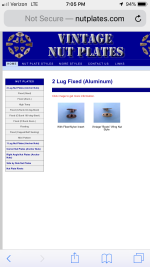
I am trying to figure out where to mount the magnetometer. The outer wing bay is a bit close to the strobes (LED) and the nut plates mounting the wingtips. If I mounted it one more bay inboard I would need to put an access hatch, which in itself is no problem but again the nut plates are magnetic. Are there any flush/nonmagnetic blind nuts to mount an access plate? Are the steel nut plates small enough to not worry about their magnetism?
 
First there are aluminum plate nuts that could be used. Having said that I did use mk1000 nut plates to fasten my wing tips. When I swung the plane to set the compass the nuts did not seem to impact the process at all. My Garmin magnetometer is mounted on the outside of the last rib under the wing tip slightly aft to get the magnetometer as far as possible away from my led nav strobe system. My led strobe doesn’t effect my compass either. I ran the nav strobe light wires ahead of the front spar and the compass wires behind the rear spar.
 
I have not found any aluminum nut plates, but rivet nuts are aluminum I suppose I could use flush rivet nuts, or just rivet the wingtips on with blind rivets.
 
I fabricated a mount that is on the outside rib on my left wing. I'm installing the Garmin G3X. Happy to post a picture if you would like.

I bench tested for magnetic interference by using just a simple compass right next to my strobe lights and nav light (LED). I saw no compass deviation when powered up. Not sure if that's the best test but seemed logical.

As for wingtips, I had planned to make little .125 aluminum strips that I tapped #6 within a relatively close distance to the magnetometer, but I see now the post about nutplates.com. I'll definitely check that!
 
I was going to it a bit inboard. But aluminum nut plates might push me toward making a small access panel, and mounting it to the cover. Easier access.
 
The minimum order for Nutplates.com is 50. A buck each. I am going to order 50 6-32 non-countersunk. I will countersink the skin and doubler for the little panel. I will probably only use a third or less than that. Anybody else want some, send me a private message.
 
I mounted my magnetometer just outside the last rib, not counting the tip rib.

I used regular #8 nutplates installed in the flange of my tip rib because I wanted plenty of strength for my extended wingtips. Haven’t had any issues with the magnetometer.
 
I mounted mine near the wing tip, one bay inboard to keep away from the nutplates. Of course you need a little base to correct for the dihedral angle.

If you are going with a Dynon Skyview, their remote compass is different from mine. Lars Fellman in Auckland has installed one.

I used a commercially available pitot mount, but I made it detachable because it's hard to transport the wings with it riveted on. If I were doing it again, I would look into the benefits mounting it further back to correct for high AoA, although you also need to think about people walking into it. BH wings are much lower than a C180 for instance.

I'm not as familiar with the Dynon, but with the GRT you should be able to calibrate the dihedral out and just mount it directly to the rib in some way. I'd imagine Dynon would have something similar.

I've always gone with putting it in the tip or on the last rib. Nutplates have never effected it.
 
Last edited:
I have another reason to put it on a access panel cover. If I put an access panel on the 2nd bay in from the tip, I think I can rivet the wings closed by myself, and work on any part of the wing down the road, myself.
 
I wouldn't try to rivet the wings by yourself. Pretty sure you will end up with a nicer looking finished wing with one person on the gun and one on the bucking bar.
 
I always assumed you would roll the lower skin back and have one person buck, and the other drive. Other than the 3rd and 4th rib from the tip, I can reach my arm in with a bucking bar and easily buck the first 10 rivets, and get the rest from the rear.
 
I agree with Rod, please find help to rivet the wings closed. Two things, it won't be possible to finish the job so you will need some help either way, and there's a good chance you will end up denting the wing skin or splitting a lot of rivets - it's slow going with two people, one would be torturous.
There is a good two days work closing the wings.
 
I lean towards the school of "A proper technique produces properly installed rivet." Meaning the shop head will be properly formed when
-the proper rivet is used,
-proper placement of bucking bar on the rivet.
-coinciding with a properly placed rivet gun set
-and application of the trigger, air pressure which applies the force to form the shop head.

As long as the reach is comfortable, and proper technique is used, the riveting goes just fine, and maybe faster than with two.

BUT.... "Splitting Rivets." I REALLY don t understand what causes a rivet to split. I have not yet experienced a split rivet. Help me please.

Lets get back to the workshop!!

I'm not sure either. The only thing I've seen, and done, almost always when solo is hold the bucking bar only half way over the shop side causing half the rivet to deform and the other half go the other direction. Drill time.

The amount of rivets I've messed up over the years solo with an air gun and bucking bar on pieces I could easily reach has me prefer two most of the time when not using a hand squeezer. I hand squeeze everything I can. Perfect rivets every time.
 
Hi Guys -

I'm thinking of putting in a Dynon system - I think the D10A ADAHRS has a magnetometer built into the unit, but then you need the remote magnetometer (SKU 100323-000) if you get interference in the original location. I'm building a simple "fair weather" VFR truck.

1) Has anyone had success with just the main unit? Or should I really think about mounting the remote compass at the planning stage? Wingtip OB sounds like my preferred location.

2) Has anyone run their own looms, or is it easier to just buy Dynon's harness (SKU: 100425-000) off-the-shelf?

Any info you can provide would be great, especially if someone just spells out an installation that has worked for them, and I can copy it shamelessly :-)

Thanks

James
 
James;
EFIS's use pitot static and magnetometer info for more than displaying speed, altitude, and heading. One of the very useful things they use it for is calculating winds. Knowing what the wind is doing all the time is a really nice feature. I am doing a simple panel as well, single EFIS and a tablet. But I would like the magnetic input to the one EFIS to be accurate, so I am mounting a remote magnetometer.

You can always try it without the remote first, and see how well it works. I am putting mine on one of the outboard rib bays, on a access panel cover. A hatch is easier to remove than the wingtips, even though it might be a bit more work to install initially.
 
Just very happily brought life to a Dual HDX system.
Entire system mounted between instrument panel
and firewall.

The bottom line is I will be ordering the remote magnetometer.

A plain old magnetized crescent wrench will be
detected approximately 12 to 18 inches from
the ADAHRS units.

Firewall mounted solenoids, master, starter,
aux battery contactors will swing the mag heading 30 deg.

A cell phone EMI is picked up at 12 in with about 10 deg
heading fluxuations.

Dynon is great equipment, very sensitive compass.
go with the remote!
 
I was told by Jason Smith of Aerotronics, the company who built my instrument panel with the 10" Skyview HDX, that Dynon previously sold the ADAHRS with the Magnetometer as a combined unit. Now, Dynon sells the ADAHRS and the Magnetometer as two separate units. I have installed the ADAHRS under the pilot seat, and the Magnetometer will in the most outboard bay of the starboard wing.
 
Thanks for the input Svyolo and 272, that's exactly the sort of "real world" insight I was hoping for. Great point about wind drift as well, that's handy to know. I'll go with the remote compass option.

I look at all those fancy big touch screens SV, I wonder if I put one of those in I'll spend too much time looking at the panel, and not enough time enjoying the scenery outside. Let me know how you get on with your fitout, a small 3-1/8" EFIS and a ipad will do me fine as well.

Thanks guys,

James
 
Any info you can provide would be great, especially if someone just spells out an installation that has worked for them, and I can copy it shamelessly :-)

Thanks

James

Some builders avoid running the magnetometer and wing tip light wiring in the same bundle. Keep some distance between them.
 
Some builders avoid running the magnetometer and wing tip light wiring in the same bundle. Keep some distance between them.

If installed in the wing, Garmin wants all the wiring in that wing to be shielded, and no local grounds. I did that as well as run the magnetometer wiring with good separation from the rest of the wire bundle.
 
I ran my lighting wires in the forward “D” section and the compass wires in the trailing edge of the wing. I do not have any electrical interference with the compass. there are two systems with each compass mounted under the wing tip, one under left wing tip and one under the right.
 
In the early days the magnet sensor was only available inside the adahrs. Subsequently, a remote magnet sensor was made available. Unless things have changed recently, my understanding is that the adahrs units all contain internal magnet sensors. When one installs a remote magnet box, skyview disregards the internal sensors and instead uses the remote sensor. When installing two adahrs units, only one remote magnet sensor is required, and only one can be used per skyview system. I ran all of my wires in the same conduit, and have not been able to attribute any adverse performance to that.
 
Back
Top