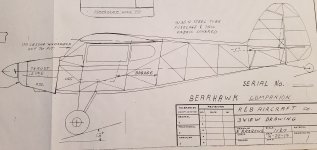
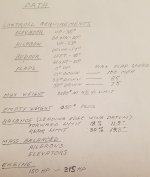
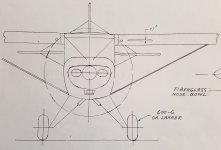
New Companion Model Details

If I was starting a Bearhawk today that might well be the model I selected. I say that because it will be rare that I use the rear seats. I love the centerline seating of the Patrol but it would be hard to get my wife to travel with me. The 200# gross increase over the Patrol and large baggage area make it very attractive.
 
What is the stall speed Mark? it looks like this could be built to Canadian AULA (Advanced Ultra Light Aircraft ) conformity if the stall speed is 39Kts (45mph ) at max take off weight.
 
Our LSA does meet the AULA category. Mike Silvernagle is building one right now for that category. The 2200 lb gross weight will not work for the AULA. Max gross is 1232 lbs. As I understand it. Mark
 
We have offered the kits for sale because we feel confident that the Companion's flying qualities are not exactly an unknown. The Patrol wing/airfoil has been flying on the Patrol and the Model B 4-place. Our intention is to do some flight testing on the first one finished up whoever/where ever that might be. But because the Companion derived from the Patrol & 4-place, Bob is comfortable that it will fly well. Perhaps some minor tweaking might be required as far as CG specs and the angle of incidence of the hor stabs. But all very manageable and not breaking too much new ground.

But certainly a fair question to ask. Mark
 
I was considering a patrol with a corvair powerplant when I saw the news release on the Companion. Is it feasible to install the 120hp variant in the Companion or are you limited to 150+ hp?
 
I think 120 HP would not be enough for you to get the performance expected from the Companion. 150 - 210 HP is what Bob recommends. It would fly with 120 HP, but take off and climb would not be what is expected from Bob's designs. The LSA is a candidate for the Corvair engine. But not the bigger planes with higher gross weight. Mark
 
The Companion is a modified 4-place fuselage. I believe the wing is interchangeable between the Bravo and Patrol. It's the fuselage lever which sets the flap angles.

So when I build one, I should be able to run an extra notch and get 50? (Or simply space out the detents to get there in 4...)
 
So when I build one, I should be able to run an extra notch and get 50? (Or simply space out the detents to get there in 4...)

It depends what you build, of course. The plans call for 50 degrees of flaps on the Companion and 4-place. I have no knowledge of the Patrol flap handle.

I can report that I modified my flap quadrant to get 57 degrees of flap out of my Bearhawk 4-place. The extra drag is a good thing for STOL ops.
 
I learned from watching videos that the flap position in flight is quite a bit less than it is on the ground, for the same handle position. The cable and the rest of the system allow for some stretch. Russ set his flaps so that the cable was tighter on the ground, deflecting the flaps some at handle position zero while on the ground.
 
Give me permission to think outloud for a minute or two.

Reference post #14. I am uncomfortable with the idea that the Model B wing is interchangeable with the Patrol. The two wings use the same airfoil. They may fit on both airframes. But the Model B is designed to carry more weight than the Patrol, and has other things that are different like the aileron bell crank.

But A menagerie of thoughts go thru my mind when I read about the Companion's Flaps 50 setting, the Patrol's Flap 40 setting, and the Four place's flaps.

-Should I make a change like that on my Patrol too?
-The Model B wing is not identical to the Patrol, But bearhawkaircraft.com says "The Companion uses the Patrol wing".
-So, Is the Companion wing really identical structurally or are its spars modified at all?
-Why does the Companion have a Flap 50 setting while the Patrol has 40 degree?
-Is the Companion flap identical to the Patrol, or is it beefier?
-The Companion flaps 50 speed is 75 MPH, the Patrol Flap 40 speed is 65 MPH. Hummmmm.
-A number of Patrol owners fabricated a longer flap handle pulling 40 degrees Flaps with 65 MPH limitation. How much more force will the Companion required to pull an extra 10 degrees?
-How much more force does 50 degrees apply to the rear spar? Which leads me back to bullet #3.
-Does the Companion have a longer flap handle to aid in pulling an extra 10 degrees.
-Bob has told me that "A lot of bad ideas float around on the internet." so hat would Bob say about it?
-If I pull 40 degrees at 65 MPH and somehow quantified that pull force, then slow down so that 50 degrees was the same force, it would be a good indicator I bet of forces applied to the whole wing.....maybe 50 degrees at 55 mph or even 50 mph.
 
The Patrol wing and Model B use the same ribs. The Patrol cap strips are smaller for the lesser gross weight, and the skins are thinner. They also use different aileron bellcranks.. The steel wing parts on the Patrol wing are also one size thinner steel in most cases. So the wings are identical in shape but a little stronger for the Model B for the heavier gross weight.

I will ask Bob about the difference in the 40 degrees vs 50 degree flap settings, and let you know what he says. Mark
 
The Model B flaps should go down close to 50 degrees according to Bob. The linkages and flap handle on the Companion are the same as the Model B as opposed to the Patrol. That is why the Patrol shows 40 degrees and the new Companion 50 like the Model B. According to Bob. Mark
 
With the Patrol flap set up the way it is, I don’t think you can get a safe angle of cable in and out of the pulley with 10 more degrees of activation. The way it is now with the arc of the lever on the rod end, it rubs on both sides of the last pulley from 0 to 40*.
 
Back
Top