Parking Brake or not?

Battson

Moderator
I thought I would split this out of the Brake Lines thread, so we don't get two discussions at once.

Not intending to steer the conversation away from brakes lines, but I have been wrestling with this decision for a while. Can you elaborate Jon? I've owned 3 airplanes without parking breaks and never missed them, but I also don't have the bush experience that you have, and that's how I hope to use my 4-place. I've only considered parking breaks something that holds the airplane still from the time you get out until you slip the chocks in. Obviously they increase cost, weight complexity. What am I missing?

Here comes my biased rationale:

The main benefit of a park brake is starting and stopping in the wind or on a hill. Getting into your plane in a leisurely manner, and simply releasing the brake and taxiing away. This is particularly true when you're on your own in some remote location. I cannot remember the last time I was at a perfectly flat parking spot on a windless day. But there are so many other reasons why light aircraft "run away". Slopes, prop wash, people leaning on it, etc.

Many of us will have seen an aircraft rolling away, usually when a wind gusts or when the owner parks on a slight slope. Often they are headed towards a parked car, hanger, or someone else's aircraft. Nobody wants to be "that guy". The argument for parking brakes is simple, its the same reason why almost every vehicle with wheels has a park brake. You wouldn't leave a car without setting the brake, and a plane is much more expensive than a car! Compared to chocks a parking brake is lighter, smaller, more effective, a whole lot less hassle, and so much easier to use - which means you're much more likely to use them every single time! It saves a heap of mucking around and it's convenient. It's painful to watch someone do the chocks thing in a stong wind or steep slope, all for the sake of a couple of hundred bucks.

I use my park brake several times on every single flight. Even at the holding point or during a run-up, I always use the park brake - it is so much more comfortable and relaxing having my feet resting easy on the pedals. It's much easier on the rudder cable assembly too, which have to resist your weight on the pedals. They also hold the plane parked for countless hours. Yes park brakes sometimes bleed down overnight, but the plane should be tied down long before that happens.

The parking brake device itself is tiny, super easy to install, weighs nothing, and so simple that they aren't prone to fail. They cost next to nothing in aircraft terms. I wont dwell on the mechanical side of the install, nor the maintenance and cost implications - I firmly believe parking brakes are a no-brainer in that regard, when I think about how useful mine has been.

The most common argument against parking brakes seems to be fear of landing with the brakes locked. There are always anecodes about this happening to someone's buddy. I cannot imagine why people would operate the park brake during flight. There is absolutely no reason to do that on purpose... Or by mistake - to lock the brakes, you have to push the brakes in (hard) and then close the brake valve at the exact same time - it's a two step process!! That doesn't happen by accident. What's more, in a Bearhawk you choose where the brake control is located on the panel. You can put it far, far away from any control you touch during flight. Due to the paranoia, mine is wired to a warning light so when the park brake is on there's a big red light in my face. I find that warning light unnecessary in hindsight, and I only added it because of the scaremongering about the "dangers of parking brakes" which I got told during the build. Poppycock!
 
I wish mine had a parking brake and someday I hope to add one. In the mean time, I keep a tie-down rope under the pilot's seat where I can reach it. On a few occasions I had to reach behind and under the seat to grab it, open the door and pitch it under the tire so that the plane would sit long enough for me to get out and chock it properly. ...I would much rather have a parking brake.
 
You make a very good argument for parking brakes.

What system are you using for the parking brake?

I used the Grove one because I was ordering from them anyway and combined international shipping, but that one is a little more expensive at $229. I told myself it must be better quality...
Jim mentioned a cheaper ~$130 Matco one in the Brake Lines thread.
 
Last edited:
Dennis and I both have Matco. Pretty simple installation and cheap insurance, so no excuse not to. A moderate wind, wether natural or man made, on a slanted tarmac and there she goes!! Not an excuse to not tie down if available, but better than nothing. Just don't forget to release them when you add power to leave. They really do work!!:rolleyes:
 
(Moved from the "Brake Lines" thread for better continuity.)

Parking Brakes:

This is something I will add to my Patrol as well. I landed at an airport where the only parking tie-downs were on a paved area, and the only open "parking slot" was on a fair degree of slope. I was solo on that trip, and the prospect of trying to get out, manually stop the plane, and get the wheels chocked so I could tie her down was pretty daunting. And all because of not having any parking brake! It was a complete nightmare – worst case scenario. Everyone on the field was gone to lunch, so no one was there to help, though I called on Unicom several times.

Eventually I mentally rehearsed everything I would have to do, then just went for it. The plane started rolling almost the minute I released the brakes, and I barely got it stopped before it ran into the plane parked in front of me. Pushing it back up that hill by myself was not a fun task, either. It turned out OK, but just barely, and if I had tripped, or the slope been steeper – it could have been an expensive disaster! Any plane I build will have parking brakes... Period.

The Matco dual-valve at Aircraft Spruce is $132, weighs just 0.28 pound, and can be controlled with either an extended lever or a push-pull control just like the cabin heat. (ACS has push-pull cables for about $35, or pre-labelled "parking brake" cables for about $90. Either way, ) You route from the each master cylinder (pressure side) into the Matco valve, then on to the separate brake lines as usual. I doubt that it adds more than 1/2 lb total weight for the valve and fittings, plus maybe another 1/2 lb for the cable or lever. To activate the parking brake, you apply the toe brakes as normal, pull the parking brake knob (or lever if you go that route) to "set" the parking brake, then release the brake pedals. The valve simply holds the hydraulic pressure your master cylinder has established. To release, just apply the toe brakes, release the parking brake knob, and you're done. I understand it's a good practice to release the parking brake after the plane is tied down, to avoid any "lockup" issue (freezing, corrosion, dissimilar metal bonding, etc.) between the disk and the brake shoe.
 
We used the Grove parking brake on our Patrol. Was not difficult to install and, so far it seems to work good. One apparent operational difference with it, than the one Jim described above is that to release the brakes you only need to push to knob in. No need to tap the brakes. This is nice because you don't need to get back in the airplane to work the brakes to unlock them, like when you are ready to push it in the hangar.
 
I'm installing a Matco parking brake in my airplane. In the last year or two they redesigned it so you can disengage it without stepping on the pedals first, though they still recommend stepping on the brakes before disengaging to maximize seal life.
 
My thought in holding the brakes before releasing the parking brake has more to do with "divided attention" during that time... Presumably, you're releasing the brakes because you're either getting ready to move the plane by hand, or you're ready to taxi. If the brakes needed to be "set" to prevent roll-off, making sure they are engaged before releasing the parking brake ensures the plane doesn't move without your explicit permission. The fact that it also helps preserve the seals in the parking brake valve is just "gravy" to me...

Good discussion - thought provoking for me!
 
I also think a parking brake is a good thing to have. I also think that you have one, you should use it. My Pacer didn't have one and I made due without it but I often had to be careful where I parked. I land on lots of hills for fun and could usually find a natural chock, since I didn't carry any. (Pacer trying to do bush stuff-no extra weight) I've installed the Matco parking brake on my Patrol, it seemed the natural choice when I was ordering Matco wheels and brakes.

One of the guys I fly with had his Scout end up in a pond when an unexpected helicopter showed up at a fly-in and hovered by. Not a good day. The Scout was almost new and I think it has a parking brake, but not sure. Anyway it was not a good day and could have been easily avoided, like so many things we have all seen or heard about.

In reading about fear of landing with the brake set, I can see it happening in helicopters, because its easy to pick up to a hover and take off with it set. Can't see that happening in a fixed wing so I've never been concerned about that (plus you can add it to your before landing check? GUMP, we don't have retractable gear but there is still something to be verified) While I don't see how you would actually set the brake in flight, I can see with the Matco that from the way I see how it works, its just a valve that blocks flow to / from the brakes, and is not spring loaded so if you were to move the control to the "set" position in flight, I'm pretty sure you would be disabling your brakes. Something to think of. I kind of figured this out when I was initially servicing and bleeding the brakes, I had a heck of a time with the first one, until I realized that I had the park brake lever in the set position instead of off. Once I turned off the park brake, it went very quickly. If you don't have days like that during your build, don't worry, I have enough of them for a whole bunch of us.
 
Hey Rollie, thank you for sharing your brake bleeding issues. I'm sure your not the first to do that and sharing that might save somebody some time and headaches. We learn from others experience, good or bad! At least we try to. D.
 
No Title

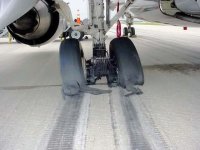
All this talk of landing with the parking break set has reminded me that even a professional airline crew can do it! I don't remember all the details but this was Republic Airlines emb 170 in Houston many years ago.
 

Attachments

  • photo3168.jpg
    photo3168.jpg
    122.1 KB · Views: 1
  • photo3169.jpg
    photo3169.jpg
    105.8 KB · Views: 1
Heck, Rollie, every Army helicopter (except one) I flew during my 8 years of active duty had the brakes "locked" for every landing.

It was "skids only" (no "rolling" gear) during my day. The OH-58, UH-1, and AH-1 all had fixed skid-type gear, but we still regularly practiced "run-on" landings as the emergency procedure for stuck rudder pedals, loss of hydraulics, etc. (I was an instructor pilot, and emergency procedures training – including full-touchdown autorotations – were practiced on almost every flight we took. If you flew with me, you knew that at some point during the flight, when you least expected it, we were going to experience an emergency of some kind...)

The one "wheeled" helicopter I got to fly was when folks from my unit participated in the Army's acceptance testing for the AH-64 Apache, which had "conventional" rolling gear (even a tailwheel!). Seemed really odd to me at the time to have wheels on a helicopter. I wondered how often they would get "stuck" in rice paddies, mud bogs, etc. with so little "contact area" compared to the skid-type gear. Guess the larger size tires handled it fine, and it hasn't been an issue of note...
 
Hey Jim, good to know there is another Army pilot building a Patrol! Its funny, I flew all the ones you listed, Primarily guns, and didn't fly the 58 until I got out and took a job at Rucker for a few years teaching combat skills as a contractor. I'm flying S-76's offshore now so on top of wheels, the gear retracts, which really seemed strange at first on a copter. Maybe I'll see you at a fly-in sometime.
 
Very Nice! I would love to try that at some point but can't justify skis right now with the pathetic little 25 inch per year average snowfall we get. There is maybe a week a year with enough snow to land on with skis and I haven't seen it too deep for bushwheels yet where I live.
 
Rollie said:
"Very Nice! I would love to try that at some point but can't justify skis right now with the pathetic little 25 inch per year average snowfall we get. There is maybe a week a year with enough snow to land on with skis and I haven't seen it too deep for bushwheels yet where I live."​

I learned from reading in the Backcountry Pilot (BCP) forums, that apparently the depth of the snow is fairly immaterial as to whether or not you can land safely without skis. It's completely dependent on the type of snow you have. Apparently, even a single inch of slightly wet, clumpy snow can quickly build up a "dam" in front of the wheels and result in loss of control or even flipping the plane over. With much of my "fixed wing" flying being in Texas, where we've received only about 1/10" of snow so far this year (and that was more ice crystals than "snow"), I have zero experience landing on snow-covered turf (and only a few landings on snowy / icy hard-paved runways.

Most of the BCP guys advocate strongly for the "wheel through" skis like Tyler's above if you're going to land anywhere you can't "walk the snow" before trying to land on it... And Tyler's plane looks REALLY COOL on them, to boot. Love to see more pictures of the installation details and how the "retract" mechanism works... Great pictures!
 
I would really like a parking brake and did use the Matco valve on two previous projects. While I never did have a problem, I do not think that there is any way to install a valve that could not cause a problem somehow. I think that is the reason I have never seen a car where the emergency brake is tied into the hydraulic brake system. There is always a completely separate system.

I finally decided just to omit it from my Patrol and rely on chocks and tiedowns.
 
I think if you don't leave the parking brake "set" for prolonged periods of time, it reduces the chances for problems.

The procedure I like to follow is:
  • set the parking brake
  • tie the plane down / chock the wheels
  • release the parking brake
 
Very nice
Can I ask why the ski tip bungees are attached to the cowel?
On the champ I fly we hook them to the bolt on the front of the landing
gear.
I plan on skiing mine and was wondering if I should weld an anchor point on the front of the gear leg.
 
We decided that the geometry was better up there. Keep in mind that these skis move forward when "retracted". If you attach too low, the ski tip won't be able to move forward easily. I am planning to do a Beartracks write-up and can cover details there.
 
Why are you listing stuff you have for sale in the middle of a thread about parking brakes? You'd do better to list them in the "for sale" section, with a separate thread for each item. And you would generate a lot more interest if you included your asking price and where the items are located (for shipping purposes). Good luck!
 
I have the Matco Parking Brake Valve in #164 and it works just fine. Use it frequently. The one thing I will add: The job of the valve is to hole the brake hydraulic pressure. Early on I did a test to make sure it was not disconnecting me from the brakes. I closed the valve with no pressure on the brakes. I then pushed the brake pedals. The pressure went through to the brakes, but held when I released the pedals. Think of it as a one-way valve. If you land with the valve closed but haven't applied any pressure, the wheels will still roll. When you do apply pressure, the brakes will stay at the highest pressure applied. Not a good idea, but not necessarily disasterous.
 
Interesting reading people's thoughts on this. The previous owner of my kit had one installed and I took it out. Useless weight imo.

In all my years of flying there's not a single aircraft I've ever trusted the parking brake on. And every airplane, every training program and every company I've worked for has had the same mentality.
The large jets are the only aircraft I've used them on(holding short and before the wheels are chocked), and even then, the parking brake shall not be used unless you are physically at the seat. They are not to be trusted is the key theme. We walk away only when chalks are in, holding and brakes are released.

Never walk away from your airplane unless it's chalked or tied down. In the bush this means carry tie downs and anchors. The parking brake doesn't stop the wing from making lift. Chalks work if your Vr is above 60kts or so.. maybe 90 to be safe.
 
I’m putting in the Grove. I often need my parking brake
on my Citabria when fueling in a windy location or when the ramp is sloped. Can’t imagine dealing with chocks instead.
 
Easy to say "never walk away from your plane until the wheels are chocked", but there are places you may want to land where there is enough slope that your plane will roll downhill unless you hold the brakes (which makes it challenging to get out of the plane to chock the wheels). That's where the parking brake comes in REALLY handy. Well worth the 2-3 ounces of weight it adds, in my opinion. Sure beats having to wait for someone else to happen along and assist you with chocking the wheels – especially if you're in the back country. Batson might wait for weeks out where he flies! I waited nearly 15 minutes on a 105F ramp one day, and that was at a pretty busy GA airport in Texas!
 
I have a mechanical parking brake on my Champ that pulls on the cable operated drum brakes. I start 'em by propping them, so I will have a parking brake on my Bearhawk. Your rate of climb may vary.
 
Oh good lord, I hope you have more than the parking brake to keep the airplane from moving when hand propping. I can't imagine trusting my life to one.
 
I wrote that I use my parking brake on my Champ. I didn't feel the need to elaborate on my technique since its a parking brake thread but it involves more than the parking brake. Been propping the same Champ since 1970 with no scary occurrences so must be a safe technique or I'm lucky or both. If I'm interrupted during my procedure I go back to the beginning of my checklist and start over. If ya'll got a good technique to share I'm listening.
 
Patrol28 I just had to comment on the fact that you've been hand propping a Champ since 1970. I think that is amazing you've owned the same aircraft for so long. Not very common. My family has owned the same Ryan Navion since 1949 purchased by my Grandfather for $9,500 new. Actually we sold it 2 years ago because my Dad is 82 and has had several cancer occurrences and lost his medical. We hated to see it go, but it was not something I wanted as a personal aircraft as it would only be nostalgic and did not serve what I wanted. For whatever reason, I am the only pilot member of my family that is addicted to taildraggers!
 
Thanks for the comment Rob. Navion was the first low wing airplane I rode in as a young man. Very cool airplanes. My dad bought our Champ in 1961 and I soloed it in '70. Unfortunately neither one of my two sons are interested in flying so not sure what I will do with the Champ someday. Owned many airplanes but the champ is the family heirloom. The Patrol will be my escape from the certified airplane kingdom.
 
Wondering how Matco parking brakes are working for the group. During checklist inspections I found my resevor was empty. Looks like the parking brake seals leak, possibly due to cold temps. Seals may have deteriorated. I'll be looking at this more closely to determine the cause.
 
Wondering how Matco parking brakes are working for the group. During checklist inspections I found my resevor was empty. Looks like the parking brake seals leak, possibly due to cold temps. Seals may have deteriorated. I'll be looking at this more closely to determine the cause.

I've noticed my Matco valve is prone to seepage. If I put any lateral load on the arm fluid will slowly ooze out of the seals. Though putting pressure on the brakes seems to reseat the seals and stops the leak. I'm undecided if I'll do anything about that or just leave it be.
 
Thanks Dave, I don't feel so alone now.
I don't think I have any lateral load on the barrel, but it is possible the pull cable may cause pressure. I'll look at that.
 
Found my leak. Brake lines were binding a little, consequently loosened the fitting on one cylinder. I'll be changing line locations too eliminate the problem.
 
Back
Top