Approximate number of hours to scratch build to the equivalent quick build kit

Stefano

Future Builder
Hello, again. I am doing my analysis on scratch-building the 4B. Here are some of what I have discovered:

1) There has been a change of ownership in the kit and parts company. The lead time on a quick build kit is 14-18 months at a price of $86,000. The new owner has a goal of reducing the lead time to 12 months. https://www.youtube.com/watch?v=N1Spfs8QkYE&t=809s

2) There has been a significant price increase from the former $72,000 for the quick build kit. This is not supported by general price inflation or the specific increased prices in chomoly steel tubing or alum sheet as far as I can tell. However, these price increases are supported by the growth in demand. In the above video link, the new owner seems to indicate that he wants a boutique business model meaning he prefers lower demand from higher prices (compared to a high growth model with lower prices). The market antidote to boutique high prices is competition. I don't know if Bob Barrows would want multiple parts/kits builders or just the one, though.

3) A hybrid kit/scratch building is an option based on Goldberg's prior business model. The new owner has changed the BearhawkAircraft.com web site and does not have the "store" section working yet. So the old parts and subkits catalog and prices have to be found using the waybackmachine. I am assuming that all of these parts will see similar price increases to the quick build kit if they will be available like the old business model. With high demand and long lead times, the new owner may opt out (or de-prioritize) of selling component parts and subkits.

4) In a Kitplanes article written by Jared Yates, he notes that "Before my factory visit, I differentiated Bearhawk scratch builders from Bearhawk kit builders. But after the visit, I realized that all Bearhawks are built from scratch." He goes on to note that the quickbuild kit airplanes have a higher resale value. That would not only mean more money to buy the kit, but also more money to buy greater property insurance annually and greater interest to bear on the higher priced plane (even if we are paying cash and consider the interest an opportunity cost). https://www.kitplanes.com/quickbuild-behind-the-scenes/

With this info, I am left to wonder how many man hours it takes to build to the equivalent level of a quickbuild kit. The Mexican workers will likely have less combined number of hours to build with their experience and jigs. So my question to the scratch-builders here, how many hours did it take you to build to the equivalent level of a quickbuild kit?
 
Your post is much more of an opinion piece than a question, so I'll skip all of that.

But to try to answer your last paragraph, it depends. There are SO many variables between builders that I don't think an average number could be formulated that would be accurate. There have been a number of figures given for scratch-building over the years and none to my knowledge have been close to the same for every builder and they are usually given in years. For example I have over 4000 hours in my project and I bought the quick build wings. I started back in March of 2008!

There is a number of posts on this forum where others have asked the same question. I entered "Time to scratch build" and got a number of returns:

https://bearhawkforums.com/forum/be...2253-time-to-scratch-build-a-4-place-bearhawk
 
It's pretty cool that the Bearhawk world gives us the option to build from plans or a kit. Can you point to any other homebuilt type that has both an active QB kit production and a plans-only building option? Can you call up Vans and initiate a plans-only build for an RV10? Take advantage of this opportunity to find an option that suits your needs. I agree that as of the past few years the analysis of time vs money does need to be reevaluated for just about all aspects of life. The kit vs scratch balance does change.

It has been a while since that Kitplanes article but my intent with the line you quoted was to also emphasize that there is better tooling and more experienced labor in the factory than the usual homebuilder would ever have access to.

Where I live, the value of the plane doesn't exactly translate to the value it is taxed on. The resale market has become a little bit nuts for all GA in the past few years, and the value of flying Bearhawks has risen extremely fast.

I should reiterate that I don't now and haven't ever spoken on behalf of the kit company, but as an outside observer, I can see that there is a lot of investment opportunity in the kit company. In addition to the very large investment that was made to make the kits available to us up until now, there have been some expensive things that have been left undone, or not done yet. I would bet a bucket of rusty clecos that the price increases you see are not reflecting significantly higher margins filling someone's pocket. They are reflecting market realities, and many significant investments that will give the company a solid foundation to continue to grow from.

To say it shorter, I would allege that prices last year were falsely low when considering the true cost of maintaining a healthy and sustainable/growing business. The increased prices are more reflective of the true cost. Offset the sticker shock with yet to be known fascinating and valuable developments in the brand.

​​​Let me again emphasize that I'm sharing my own opinion and speculation here, as always.

​​​​​​
 
Thanks for taking the time to respond, Alaska.

Your post is much more of an opinion piece than a question, so I'll skip all of that.

I hope you didn't infer that I was voicing a negative opinion. That was not my intent.


...I have over 4000 hours in my project and I bought the quick build wings.

Thank you for that info. I am sure that builders count the hours differently. E.g., I view learning time as educational and outside of the project. If I take expensive classes to learn any skill it takes both my time and wallet. Learning to scratchbuild for me will be more about learning time on my own and not so much from the wallet. I suppose one could also argue that if you are having fun -- I hope to be -- then some of that time is recreational and not toil. I was hoping that responses to my question would give me some of that kind of feedback, too.


There is a number of posts on this forum where others have asked the same question. I entered "Time to scratch build" and got a number of returns

I know what you mean. It bothers me sometimes when forum newbies ask questions that have already been answered. So, I did search before I asked. My question was a little different. Mine was about doing a more direct comparison of scratchbuilding to the point of what you get with the quickbuild kit. I know that there is still plenty of work to do from that point to a finished project.
 
Jared, I enjoyed your Kitplanes article. Also, thanks for your lengthy reply.

It's pretty cool that the Bearhawk world gives us the option to build from plans or a kit. Can you point to any other homebuilt type that has both an active QB kit production and a plans-only building option?​​​​​​

That is exactly what I searched for. There are only two on my short list. Two separate missions. Bearhawk and Mustang II. The Mustang II will take more modifications to suit me and affording two planes may not happen in my lifetime. Yet, I like the folding wing option and the ability to fit both planes in one T hangar. You mention Vans. The RV-7 and the Mustang II used to be priced about the same for their standard and quickbuild kits. Now the RV-7 is double the price and they have the demand to get that price regardless of their recent management troubles.


I would bet a bucket of rusty clecos that the price increases you see are not reflecting significantly higher margins filling someone's pocket. They are reflecting market realities, and many significant investments that will give the company a solid foundation to continue to grow from.

To say it shorter, I would allege that prices last year were falsely low when considering the true cost of maintaining a healthy and sustainable/growing business. The increased prices are more reflective of the true cost. Offset the sticker shock with yet to be known fascinating and valuable developments in the brand.​​​​​​

I wrote that wordy preface at the top of this thread to try to convey that I understand that the market has changed over the last few years. After watching the YouTube video that I included the link for, I come away with the impression that the new owner, Virgil, is a good person and will do a good job with his new business. I am in my 60s and have owned businesses in my life. Mine were all of the boutique type with a model of low volume and high prices. It was impossible for me to overprice, since the competitive market made that decision for me. I agree with you, Jared, that having up to 18 months lead time to deliver a QB kit means that the prices were too low. I disagree with you that the costs for labor, steel and aluminum has doubled in the last five years. Those are easy to look up. There is nothing unfair about high margins, especially if it reduces the kit lead time significantly.

In 2019 the price for the QB 4B kit was exactly half what it is today. https://web.archive.org/web/20190114020923/http://bearhawkaircraft.com/bearhawk-kits/

Again, that is not because of anything negative or bad that Mark or Virgil did. I would advise them to do exactly what they have done. The "problem" is strong demand and for that I blame YouTube! :)

I am just trying to understand the cost difference between buying a QB kit in both dollars and time. I can calculate a good approximation of the dollar difference. I am clueless on the time and that is why I asked on this forum. Any help here would be greatly appreciated.
 
I’m at the beginning of the journey myself, so I may entirely wrong. But I’ll add my $.02.

I think the big question you have to answer is do you want to build or fly? In my case the idea of learning all the skills needed to scratch build is where I get the real enjoyment and satisfaction. At this point, I hope my enthusiasm will carry me through the project.

if you can’t find the joy in making 1 small part then looking to the next small part, and are constantly thinking/ dreaming of flying you may need to give the quick build a higher priority.

I’m personally hoping to have my -5 done in about 5000 hours. For now, I’m enjoying the process of making templates. Bending aluminum should start soon!
 
Hello Robin.

I think the big question you have to answer is do you want to build or fly? In my case the idea of learning all the skills needed to scratch build is where I get the real enjoyment and satisfaction.

I want to fly and build. Renting or buying a used relatively inexpensive EAB such as an RV-4, 6, or 12 in the interim is doable. Like you, Robin, I love the idea of building my own airplane, and I am looking forward to building a 4B to get the ideal plane. The question for me is how many hours and at what price.


I’m personally hoping to have my -5 done in about 5000 hours. For now, I’m enjoying the process of making templates. Bending aluminum should start soon!

Congrats on the start of your big adventure! 5000 hours. Will that include learning time and research time? Or is that extra?
 
Congrats on the start of your big adventure! 5000 hours. Will that include learning time and research time? Or is that extra?

I’m thinking that will be actually making stuff for the plane. I started doing the research 2 years ago and never kept track of time. Same with some of the education. Conservatively I’m going to guess when it’s all said and done it will add another 2000 hours.
 
I think Bob said he builds an airplane from scratch in 2 years, full time. He knows what he is doing. When I say that, it is not just knowing welding and metal working, electronics, plumbing, but how they are done on airplanes. If you don't know any of these things, you will have to learn them as you go, or give up.

So if you really know what you are doing you might, at best, be able to get to QB stage in 12-18 months. If you lack multiple skillsets, or knowledge of how they apply to aircraft, add whatever multiple X times is your best guess.

Many of those silly enough to want to build an airplane have many of the required skills, including myself. However I had no experience applying those skills to airplane building. If I was going to guess at a multiple for myself, it would be 3-4X.

My next project might be a scratchbuild Wittman Tailwind. Hopefully I will get the multiple down to 2X on that one.
 
I’m building a patrol from scratch and feel I’m about the quick build stage, wings more and fuselage a little less. Have 4 years on the project this month and about 2000 hours, hopping to be flying in not much more than another 1000. I have built 2 other planes from kits so maybe a little advantage.
 
Given that something like one third to a half of the hours spent are on other than airframe fab, the QB option might cut build time by closer to 25-30% overall. Also depends on how fast/how efficiently you build.

Helps to have a project or two under your belt. My build buddy is less than six months in and despite full time job and other demands on time is deep in wing assembly and welding up his skinning jig. I’m trimming ribs and getting ready to shoot primer on wing spars, caps, and ribs after about 17 months.
 
Hey Stefano

I bought the rib and spar kit from Mark G already formed, as well as the pre-made landing gear and fuel tanks. I am currently 4300 hours and 12 years in and am at the paint then final assembly stage. I have already wired and tested (preliminary) the IFR/G3X panel and have hung the engine and plumbed the fuel/oil systems. I figure I have another 250-300 hours to go. I think I was around the 2000-2500 hour range when my 4pl was at the Quickbuild stage. However, that is a moving target as the kit has gotten WAY more complete over the past few years.

I don't think anyone other than Bob or Colin Campbell could scratch built a 4pl/5pl Bearhawk in anything less than 3000 hours. It is a BIG airplane and there are a LOT of parts. I had built a Vans RV-8 kit before (standard kit, not Quickbuild) so I had a lot of previous knowledge/experience in aluminum/riveting as well as the engine/avionics. I had no metal/welding or fabric covering experience.

I realize that the Quickbuild kit that Virgil puts out is expensive. It has to be given what you are getting and the cost of materials. My advice (and it is worth what you are paying for it :-) is if you LOVE to tinker/build/experiment/re-build, scratch build your airplane. But don't forget that you will probably not be flying for 5-10 years unless you have lots of spare time. If you really LIKE to tinker, just scratch build half of the airplane and buy the other half Quickbuilt from Virgil (like Paul). If you want to fly just as much as you want to build, swallow the pill and get the kit. You will be flying a lot sooner, you will still hundreds/1000+ hours of building to do, and the airplane will be straight and excellent quality.

Regardless of which way you go, you won't get out of the WORST FRIGGIN' part of the whole project: fiberglass finishing....can you tell what I am doing right now? Ugh...
 
My project is similar to AlaskaBearhawk's, in that I scratch built the fuselage and bought the quick build wings. I have been at it even longer and am sure I have more hours in it than he does. I did move twice, had a couple bouts of cancer, and built my hangar which have added years to the project. I'm in the final stages, mainly avionics wiring left to do. I am pretty sure I would have never finished it if I hadn't bought the wings. There is a lot of expense in both time and money that many don't consider. For instance welding consumables, gas, welding rods, tungsten if tig welding etc. If you are making all your parts instead of purchasing there are lots of fixtures and tooling to build. Making the tooling usually takes as much or more time than making the parts.I believe there is probably a 4X or more expenditure in tools for scratch building vs kit building. Welders, metal breaks, metal shears. Some of these items not totally necessary but make it much easier. For fun talk to a machine shop with the equipment to accurately bend the spars and get an estimate. Most of them don't have a brake I would want used on the expensive aluminum. I actually started building before kits were available. I don't regret the route I went and have enjoyed most of the process, but wouldn't do it again.
 
Last edited:
Can you point to any other homebuilt type that has both an active QB kit production and a plans-only building option? ​​​​​​

Bede's BD-4C is one. You can get plans and build it from plans, you can get a kit and build it from a kit, and you can get a builder assist quickbuilt for fuselage and wings.

Now, I know that many consider Bede's kits much less of a kit, and more of a drop-shipped raw material from Aircraft Spruce, but in the end, majority of fabrication is done by Bede (for parts that need to be fabricated), and most of the work is just cutting, bolting together, bending, riveting and just a little bit of welding. In the end, 2,000 hours isn't unreasonable for a moderately skilled homebuilder, which isn't any different from a typical kit (Van's, Bearhawk, etc.).

I do agree with the main point, there aren't really that many homebilt aircraft out there where you have such a range of options, from plans-building from scratch, to quick-built components.
 
To address the title question:

I understand the expected time to complete a QB kit is around 1000 hours ideal case, but let's just say 2000 hours for a little realism and easy math. That's finished and ready to fly.

I have been told that scratch building the wings to the same level of completeness which you receive the WB kit wings, takes around 2,000 hours
For the fuselage, I have been told it's a further 2,000 hours to get it to the same level as the QB kit.
Then you want to allow another 1,000 to 2,000 hours to finish it to a flying level
So with easy maths, the scratch build should be around 3x the work.
 
Thanks, everyone, for your valuable information. I appreciate it.

From old threads on the forum to this thread, I am seeing 2000-3000 hours to build to the QB kit level of completion. Since I won't include learning/research time in my calculation and since I intend to buy those component parts that are the most difficult and time-consuming to build, 2000 hours is what I will prepare for. I realize that will be about the half-way point in my total project.

Since the QB kit is selling for $86k before shipping and sales tax, I will use $92k as my actual cost to buy it. If I budget high at $32k to scratch-build (with some purchased component parts) to the QB point in the project, that leaves about $60k in savings to compare to my extra 2000 hours of build time.

That looks like $30 per hour. But I have to make quite a bit more than that and pay my taxes to have a net income of $30 /hr.

The only other issue left is how much longer will I have to wait to be flying my 4B. Given a kit lead time of up to 18 months, I would need to average about 26 hours per week on the project up to the QB level to break even time-wise. That is possible in the beginning, but not probable for the entire 18 months. Still, 6-12 months delay is fine with me given the savings.

 
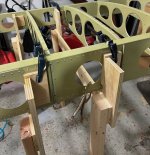
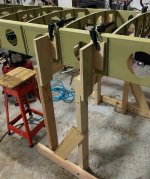
You can scratch-build pretty fast if desired... this is Carlo's build right at six months from receipt of plans... and this included engineering the wet wings. Full time job with an aviation advocacy group as an A&P-IA plus 4.25 other airplanes to take care of (2.25 his/2 spouse) and that recently acquired wife. I remain in awe.

The real reason for the shots? The alternate build jig knocks a lot of time off building up the spar and rib assembly, plus gives really excellent access (which makes riveting way easier). The skinning jig is vertical, and is being welded up of 1/4" industrial shelving and rack stock.

Click image for larger version  Name:	IMG_0490.jpg Views:	0 Size:	2.25 MB ID:	89210 Click image for larger version  Name:	IMG_0488.jpg Views:	0 Size:	2.31 MB ID:	89211 Click image for larger version  Name:	IMG_0487.jpg Views:	0 Size:	2.25 MB ID:	89212 Click image for larger version  Name:	IMG_0489.jpg Views:	0 Size:	2.45 MB ID:	89213 .
 
Last edited:
To be honest, I did take the comment about Virgil Irwin raising prices, i.e "boutique model" of doing business as a negative only in the sense of price gouging. I can suppose that, but from what I have seen so far of Virgil and his approach to the company I don't see that as a reason for price increases. I would lean toward what Jared had said.

Also, my project hours are actual work hours. I never logged any time on my kitlog other than direct work on the project. That figure is probably on the conservative side because I'm sometimes embarrassed to log how long it actually took me to accomplish some of the tasks. I probably have at least half again the total hours in training and internet research. But, I have learned so much that it was worth it. Was it always fun? No. There were certainly times I was frustrated by my own inabilities and I just had to lock the door to the shop and walk away for a day or two. When I would come back I usually had what I call a BFO (Blinding Flash of the Obvious) and could solve the issue and move on. But the days of relative smooth sailing tended to outnumber the bad and it is satisfying, especially as my skills improved.

It didn't bother me about the noob thing. Sometimes I just miss stuff and I need a reminder as to what to look for. Lord knows the amount of noob questions I posed on the old forum and the new that today would seem silly to me. But from where I was at the time it seemed like I was looking at the summit of Mt. Everest from the base.
 
Last edited:
One thing to consider maybe is that the factory parts and assembly are sometimes different from plans built. Compare, for instance, factory nose ribs to plans nose ribs. Or factory skin stiffeners versus plans which do not include these. I wonder what other differences there are between factory and plans. In general, I think the factory parts could be considered superior to plans built parts.
 
That may be the case for the Bearhawk factory parts, but most definitely NOT for the Cessna, Piper, and other light aircraft manufacturer parts I've see on the airframe side of things. My goal has been 'better than factory' based on those supposedly 'blessed by the manufacturer' airworthy parts.
 
One thing to consider maybe is that the factory parts and assembly are sometimes different from plans built. Compare, for instance, factory nose ribs to plans nose ribs. Or factory skin stiffeners versus plans which do not include these.

Hi Frank. Could you be more specific about these two examples? What is the difference between factory vs plans nose ribs? Where are the skin stiffeners added that are not included in the plans? Has there been any known problems with the plans-made parts that the factory parts solved?
 
Plans nose rib flange stop before reaching the nose and is trimmed. Factory nose ribs have a flange across the nose, and is not trimmed.
Plans lightening hole flanges are a straight 30 degree press. Factory lightening hole flanges are different from plans, look more like Vans lightening hole flanges.
Three skin stiffeners (to address canning) are now standard on all factory wings. So far, Bob has only drawn a single skin stiffener as an option on Patrol plans.
These are the only differences I am aware of. There may be more.
Regardless if one method is better or not, scratch building to the quick build stage would not be exactly "equivalent."
 

Attachments

  • photo16111.png
    photo16111.png
    190.7 KB · Views: 0
  • photo16112.png
    photo16112.png
    786.3 KB · Views: 0
  • photo16113.png
    photo16113.png
    909.1 KB · Views: 0
I suspect the rib difference is due to the fabrication process. I think the factory ribs are hydroformed by a third party.
 
Regardless if one method is better or not, scratch building to the quick build stage would not be exactly "equivalent."

I see. Scratch-building and buying some parts may close the gap? I found this thread with some other solutions to the oil-canning problem:
https://bearhawkforums.com/forum/bearhawk-general-discussion-news/67123-wing-skin-thickness

Interesting about skinning the wings warm. I live in a climate that has hot dry summers. It may be best for me to plan to skin the wings in July-August. Maybe even throw an electric blanket over the skin?
 
Last edited:
I had somebody in the local EAA chapter mention skinning the wings "warm". I can't wrap my head around that. Once the holes are drilled, QB or scratch built, I would think the shape is set in stone. The ribs might move a bit, but not the spars/skin interface.
 
I asked Bob about the skin stiffeners. He said he's not seen any cracking or other problems on his planes due to the canning/flexing of the wing skin. I asked if there were drawings for the wing stiffener option (other than what's already available for Patrol plans) and he said he'd get back to me on that.
 
Is the same wing planform and airfoil used on the 4B, Companion and Patrol? (Not including differences from wing tips and VGs)
 
Is the same wing planform and airfoil used on the 4B, Companion and Patrol? (Not including differences from wing tips and VGs)

Yes, and the Model 5 is included in that group as well. Structurally, the 5 and the 4B wings are the same and the Companion and the Patrol wings are the same.
 
Back
Top