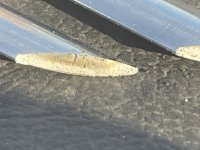
Broken Tail Flying Wire

robcaldwell

Model B Quick Build Kit
Yesterday I experienced a broken tail wire while inflight. I did not know the tail wire broke until after I was shut down and began refueling…

The incident happened while in level cruise flight and on auto pilot (2 axis). There was a sudden “pop”. My nose pitched slightly down and to the left. I had no idea what had just happened.

I immediately disconnected AP and reduced power slightly. The airplane felt ok as I touched the control stick left, right, up & down a few times. I changed course and turned to my destination, about 15 miles away (KIPJ). With the wings level I turned the AP on again, still trying uncover what happened. The AP pitch began hunting to maintain altitude. It was very minimal, but the nose was ever so slightly nodding. Even with the AP off, I could not trim and hold altitude. I entered the downwind and made gentle turns to base and final. With 3 notches of flaps, it was one of my best landings!

I taxied over to the fuel pumps and found my right upper streamlined flying wire had broken. See the attached picture.

Mark and I spoke on the phone. He stated this has occurred before, in the same location on a LSA. But never on a 4 place that he is aware of.

This left me stranded at KIPJ, and Mark is expediting a new wire to me now.


FOR DISCUSSION….

Mark mentioned harmonics as a cause to this failure. I’ve read a few threads here about vibration of streamlined H stab struts and tail wires, and broken tail strut threads.

https://bearhawkforums.com/forum/saf...321-tail-wires

I’m curious what others think about the overall direction I am considering with the tail/flying wires.

I am beginning to believe that streamlined wires are more prone to vibration over round flying wires. And the drag reduction benefit of streamline wires over round wires does not outweigh the failure potential.

I am not sure that I could ever position a fixed streamlined wire into the wind such that it would never vibrate. There could be a point in deck angle where no vibration occurs, but a slight trim adjustment will change the AOA of the wire (up or down) now creating an adverse vibration. I cannot imagine this occurring with a round wire.

As I mentioned, Mark will be sending me a new replacement streamlined wire to get me flying again, and to fulfill my Oshkosh obligation which I am very much looking forward to!

I wonder if I can dampen the streamline tail wires for the interim...

But long term, I am considering going to round wires (or possibly cables) only for the added safety aspect. If drag ever becomes a concern, I may consider fairing the round wires using something like this. https://antisplataero.com/products/u...ine-fairing-14

I’ve also read some discussion here from Isilverone and others about using velcro strips, or turbulator tape on the bottom of the H stab struts to reduce vibration. I will be looking into this as well with my new found sensitivity to tail vibration and cure for any and all vibration.

I would also like to know more about swagged cables for tail wires. Especially for the uppers and as a replacement for steamlined wires. If anyone has experience making and using these, please comment!

Thank you so much!

Rob


wAAACH5BAEKAAAALAAAAAABAAEAAAICRAEAOw==


wAAACH5BAEKAAAALAAAAAABAAEAAAICRAEAOw==
 
Last edited:
Yikes, glad it only had minimal control effect for you. Thanks for the anti splat link, wasn’t aware of their products and like the fairings
 
Glad you're back flying Rob. You might be onto something with the aerodynamic wires. Could you tell us how many hours the aircraft had before the flying wire failure?

Do you recall the tension on the flying wires ? (As per Bobs specs/ Not very tight vs very tight :rolleyes:)

This has been a discussion point on several occasions with my own aircraft. Currently mine are "quite tight", even after I've reduced tension somewhat. Sorry I don't have the actual tension.

I'm wondering if one factor affecting the flying wire longevity could be if they're tensioned against the lower horizontal stabilizer strut, and whether this might have contributed to failure of the struts that occurred on several aircraft. This might be done intentionally when rigging to "rig out" an out of square horizontal stab for instance. Mine was out of square when assembled and couldn't be easily corrected.

I believe that one Bearhawk also broke the bolt that holds the flying wires through the top of the vertical stabilizer.

Perhaps we could gather data points here from others that have had a broken flying wire, or broken a strut (the two failures might have a correlation).

In addition, has anyone broken a lower flying wire, or is it only the upper wires that are breaking ?
 
Last edited:
To put this in context I believe Rob is the first person to have a tail wire break on a 4 place. With lots of planes flying. Generally, wires break because the tension is too low or too high, or a crack got started and grew until it failed the wire. I had wires break on my LSA twice, but Bob determined it was the rigid way the homemade ends held the wires. After replacing the homemade ends with AN665's and tabs like used on the other models - there were no more problems.

Generally - when something happens to just one plane - it usually does not convince me that something is wrong with all the planes. When something happens twice (like on my LSA) then obviously something different needs to be done.

Curiously - the wire that broke twice on my LSA was the right upper wire also. In almost the exact place as Rob's wire broke. I suspect that is a high vibration area. Mark
 
One other thought - I recently had a small vibration through the elevators caused by the pitch trim tab hinge having play in it. I could feel the vibration through the airframe, although it was barely perceptible. It was easy to fix the play (discussed in another thread) and that removed the vibration.
 
For whatever it’s worth, I followed Dan Shilling’s (Subaru powered 4-place in Alaska) lead and used round control cable with swaged end fittings made for me by Aircraft Spruce. Draggy, but cheap. 500+ hours w/o problems.
 
  • Like
Reactions: Nev
I don't really have anything to add from a BH perspective of streamlined wires. But I do know there are thousands and thousands of streamlined wires flying on float rigging, biplane rigging, etc, etc and have been for years. If it was a common point of failure I would think they would have been replaced long ago with something else. Just a thought...
 
I focused my Engineering degree on failure mechanics and fluid dynamics, so I have a little knowledge here; plus experience with several similar issues on our Bearhawk 4-place.

robcaldwell
If you can send a detailed photo of the cracked surfaces, we can tell you a lot more about the cause of the failure. I am talking close-up macro photos, almost microscopic detail - in good light.

Round wires are every bit as likely to vibrate, probably more likely than streamlined wires. The streamlined ones are more likely to crack though, because of their geometry and the way they are made.

If you have the tension wrong, the flying wires can vibrate like crazy. It's about harmonic frequencies. Think about a guitar string, that's your flying wire.

Too much stress on the wires reduces the "minimum flaw size" required to start a crack - and every piece of metal has flaws. The stress this can come from over-tension in the wires, or wires which are flighting against the rest of the structure. These are ideal conditions for cracking to occur quickly. High frequency vibration with lots of force applied.

Any surprise change in pitch associated with a little 'pop', always assume you've lost a strut or wire on the tail and limit maneuvers until you can confirm what's happened.
 
Last edited:
In addition, has anyone broken a lower flying wire, or is it only the upper wires that are breaking ?

A lot of rocks have bounced off my lower wires (round) and they have barely been majorly damaged. The important thing is to dress out any minor damage to prevent cracking. One hard hit should be fine.

The geometry of a streamlined flying wire and the way they are made makes them a little more prone to cracking, compared to a round wire which is more crack-resistant, but this should not be a concern. Streamlined wires are very common in so many aircraft types and rarely crack. The problem here is probably related to an unusual flaw in the wire, combined with the way they've been set up. If Rob shares some photos on the fine details, we can make some better judgements.
 
Last edited:
Thank you for posting the specifics, Ray.

When you says "pin-to-pin", I assume you are referring to clevis pin to clevis pin.

I have compiled the details and part numbers to construct this assembly. I will be ordering these today.

Stud End   Thread ¼-28   $8.35 Each
https://www.aircraftspruce.com/catalog/appages/ms21259.php?clickkey=16787
MS21259-5RH 
MS21259-5LH
 
Wire Cable = 5/32”   1x19   $2.19 / ft.
https://www.aircraftspruce.com/catalog/appages/controlcable.php?clickkey=9629
SS 05-04500
 
Terminal Assembly   Thread ¼-28   $24.00 Each 
https://www.aircraftspruce.com/catalog/appages/an665terminals.php?clickkey=8137
AN665-34R
AN665-34L
 
Battson Using my iPhone, I was able to capture some grainy pictures of the broken ends of the streamlined wire. There is an obvious crack(s). This would have been difficult to identify during preflight as the crack was located on the bottom (underside) of the wire.

25E10267-5F0E-4F52-8F4B-E15A3A8062F7.jpg


5B56B100-F822-4713-A412-60522D671976.jpg


C1E618AE-278A-4C05-BEAC-6DC41DD73580.jpg
 
Because of the high cost of streamlined flying wires I elected to make my own round wires using the same vendors as American Champion Aircraft and also the New Waco guys. Basically I started with 1/4” 4130 round stock and had it centerless ground down to the root diameter of the 1/4”-28 thread. I then had right and left hand threads rolled on the ends. Rolling produces a much better thread than cutting. All work was done by the above mentioned vendor I only had to supply it cut to the correct length. I sent a sample to Bob he said they looked really good. I calculated that with a batch order price per wire would be around $55. Note that American Champion only uses 3/16” round wire even on their fully acrobatic airplanes and don’t seem to have a problem with wires breaking. These wires actually have relatively low stress on them but possibly lots of fatigue potential from vibration. I calculated that during full utility loading each tail surface sees about a 350 lb maximum downward force. I would have to review the actual force on the wire but it is well below its yield strength.
 
Last edited:
OMG who made those wires.... They almost look they have been drawn, I would have expected cold-rolled...?
 
Last edited:
robcaldwell
Sorry - busy time here so I will start with a brief post.

Summary:
A large manufacturing or material defect inside the steel, combined with aggressive harmonic vibration of the wire, were likely the cause. Think guitar string with a big crack in it.

Detailed analysis:
Those wires failed by 'high cycle fatigue'. Normally it would start at a geometric stress raiser (i.e. sharp leading edge of the wire), but in this case the crack has definitely started at the top of the wire as we see it pictured. The striations show the crack worked its way outwards and downwards, and it did so very quickly. This is a strong indication that the wire failed due to aggressive harmonic vibration causing bending in the up-down direction (transverse to the chord plane).

We see a large vertical shape inside the wire - a flaw, likely caused by the cold drawing process I guess - this 'flaw is unquestionably where the fatigue crack started, spreading outward from there. There are tell-tale 'scour' marks on the outside of the wire, I see, hinting at the flaw hiding inside. For cold rolled steel flying wires, the outside of the wire should be quite uniform dull grey with a tiny dimpled or pin-holed look from the rollers (unless they have been polished out). Those wires of yours appear to have been cold drawn though, they appear to have a uniform shiny linear look - but again, there should be no 'scoured' areas. I have been told by an expert that cold rolled gives a more reliable flying wire, but I cannot discuss the reasons or validity of that.

Suffice to say there was large flaw in the metal with a sharp edges, which greatly raised the stress around that microscopic edges of the flaw. Either bad steel or untidy manufacturing processes probably created the flaw. This appears to have created local stresses inside the flying wire which exceeded the yield strength of the stainless steel at a microscopic level around the crack, every time it vibrated (each cycle) up and down the crack would grow a tiny amount.

I would need photos with light sources from different angles to be sure, or photos taken from different angles - but it looks like the wire had effectively cracked right through when it finally failed. I guess it was cracked 95% to 98% of the way through before it finally broke. This means the tension on the wires was not a major contributor to the failure, apart from allowing harmonic vibration to occur. Most of the cracking was caused by bending / vibration.

Recommendations:
  • Replace the wire with a good quality part
  • Inspect the remaining wires for unusual "scour" patterns on the outside surface, if found - try and polish them out to see how deep they run. If 30 minutes and wet 2000grit will not remove the scour marks, consider replacing the part or starting an intensive monitoring program - suggest dye penetrant to search for potential cracks every 25 hours (don't spill on the fabric!)
  • Adjust wire tension to prevent vibration, remember they are a connected system of four wires, which need to be adjusted together.
  • A visual preflight inspection including a firm wiggle on the wire would likely have identified this crack before it broke in flight. Better to break it on the ground by your own hand, than at 10,000ft in turbulence.
 
Last edited:
I forwarded the pictures of the broken wire to Bob Barrows and also to the US distributor of these wires. She will forward the pics to the manufacturer. Bob also thought Jonathan's write up was accurate and could find nothing to disagree with. Bob has requested the manufacture give us a method to test wire tension without the builder owning a tensionometer. Taking into account the exact length of the wires - how much deflection of the wire at a certain amount of pounds of pull in the very middle of the wire. Hopefully the manufacturer will provide some guidance. If not Bob will calculate something. Mark
 
Thanks so much for the profound thoughts and insight, Jonathan! I have received the replacement streamlined wire from Mark and returned my plane back home. However, I have also ordered replacement 5/32 1x19 SS cables from Spruce. They will come with MS21259 stud ends installed and pressed in place at their facility. Top wires only. I will maintain the current Steen round bottom wires in place, and inspect as you suggest. New top wires (cables) will arrive tomorrow and I will install before the trip to OSH.
 
A few of us in NZ had wires made by Russ Ward at Old School Aero. I asked Russ if he could make a recommendation for tensioning the wires made by him and he responded with the following :

The tension should be about 350lbs

This is derived from the formula F = (4DT)/L where F = pull force, D = deflection, L = length and T = tension.

4x.5 x350/42 = 16 lbs on a fish scale.

So a 12mm deflection should read about 15-16 lbs on a fish scale,
They have been known to break if left too loose.


Not sure if this helps or if it can be applied to wires made by other manufacturers.
 
K&S aka "Hardware Store" aluminum sells some pretty slick airfoil shaped aluminum tubing that would cover those flying wires nicely. I believe someone also sells them in carbon fiber.
 
Burl's aircraft(owns the TC to the Aeronca Sedan) in Chugiak, AK has the machines to put rolled threads on round wires if you're looking for another vendor. I think it was about $50 a wire for 1/4" SS wire when I had him do mine.
 
I did the same using cables, but I skipped over the fork and pin and simply notched the link to accept a welded tube that is threaded. This way the threaded end threads directly into the link. There is a picture around somewhere on the forum if you search for it.
 
My son is considering buying a CH-300 homebuilt… so I’ve been reading up on the history of that plane.. it has suffered from aileron flutter in certain circumstances… this has been fixed but there were some interesting reports leading up to the fix

one report was that the pilot felt no vibrations on the stick …. But looked out the window at the aileron fluttering up and down 1/4 inch …

these wires are invisible back there and a lot could be going on in certain circumstances

placing a go pro back there watching areas of interest.. could shed some light on what’s going on
 
Last edited:
  • Like
Reactions: Nev
Yes, you can see the tail wires out the windows of the 4-place, and you will see them vibrating.

You will not necessarily feel the vibration through the controls or the airframe, you probably have to look for it.
 
Hello Gents.
Ive seen AM/FM radio antennae on cars and trucks that are round wire with a spiral protrusion wound around spaced 1 or 2 inches along which deters the antenna from swinging back and forth in the wind, especially with a layer of frost on them. If you’ve ever seen a set of Citizen Band radio antennas on a semi truck waving back and forth as it goes down the highway, this is what I’m referring to. Wouldn’t this work as well to deter harmonic resonance in flying wires?
Brian
 
That insightful. I have an antenna with a spiral and wondered why.

Harmonics and flutter are similar if not identical. Things have to be right for flutter to happen and it's mysterious. Sing the right note and the champagne glass breaks. Any other note wont effect it. That spiral wire must change things on the antenna. I saw velcro on a tail wire at OSH this year that stopped the flutter/vibration. A change in shape, tension, length, a wire's angle of attack, or who know what, can induce or eliminate harmonics. One thing I lean towards believing is that our wires strength meet all design parameters, but high fatigue from harmonics will teach us a thing or two. We'll get it figured out.
 
My experience may be of some interest, though it was on my RANS S-7S. The stock tail bracing setup is round, not streamlined, stainless "aircraft" rod. Years ago,, back when RANS was using 3/32" 7x7 cabling for the task, on my first S-7, I got the bright idea, after seeing an ad in a hang gliding magazine, to buy some PVC streamline fairings that simply snapped over the cables. Drag is drag, less is better I figured, even at 85 MPH.

First flight, I felt a vibration in the stick, opened a door and looked behind, and they were buzzing! Took them off, moved on. 20 years later, I see Anti Splat's ad for rod fairings, bought a set, glued them on. After about (I'd have to check the log book) 20-40 hours, I landed back home after a long XC over very remote country, and noticed my left side, lower rod had broken off, and was swung back against the tailwheel. Now, this was the same rod that I had bent in a mountain landing when a rock bounced off it and went clear thru my hor stabillizer, putting a slight bend in the rod. I remember taking it off and eyeballing, deemed it repairable, and gently straightened it out with a rubber mallet. Flew with the repaired rod 500 to 700 hours, but it broke only after installing the fairings. After my first experience of flutter years earlier, you can bet I videoed the Splat fairings, and they looked fine, no buzz in the stick, and also no speed increase whatsoever, but I wasn't really expecting much, I'd be happy with the same speed and a bit less fuel burn. Edit: the slight bend in the rod was mid span, no where near the threaded end fitting, my thinking at the time was that the fitting end had not been stressed.

I took off all the Splat fairings, repaired the broken rod with 3/32" cable, and have flown it about 100 hours since, and expect no further issues. My theory is that the slight bend stressed the fitting, and maybe (or not) the fairing somehow stressed it a bit more. The threaded ends are quite brittle, I put the unbroken end in my vise and tapped it sideways a bit, then back the other way, and SNAP, it broke. Did the same with a AN 3 bolt, it took many more, much more extreme bends, before finally breaking. The good news is....losing one hor stab bracing rod didn't send me into a death spiral, it flew fine, I'm done experiementing back there.
 
Last edited:
Wanted to add one data point to this thread. I was out flying two days ago and noticed my left side tail flying wire was vibrating quite noticeably. Changes in airspeed had no effect until down to to 70 knots. I discussed with the local engineer and we made a very slight adjustment to the angle of the wire, barely noticeable. Flew again and couldn't observe any vibration so hopefully it's fixed. I'll be keeping a close eye on the wires during preflight.
 
I have no experience building with these airfoil shaped flying wires, but I immediately correlate this to another circumstance that I think is a good visual explanation of what is happening. If you've ever seen an 18-wheeler on the highway with a flatbed truck with cargo strapped down with the 3-4" strap going over the top of the cargo, you'll notice they twist these cargo straps on each side. BUT, every once in a while they forget one and leave it un-twisted. The un-twisted strap will always violently flutter at highway speeds. I attribute this to the strap trying to find the correct angle of attack, but the force of the wind pushes it past the correct angle, and then back the opposite way too far over and over again (hence, violent flutter). Applying this to the flying wire theory, these wires are likely never perfectly positioned as an airfoil. At best they are only perfect at one given airspeed (hopefully at cruise). So the possibility of flutter seems almost inevitable at any tension.

Now given the ideas about the velcro and the am/fm antenna having a twist around a round wire stopping the flutter, that makes a lot of sense.

Correct tension, along with a quality made airfoil shaped wire likely negates all issues of flutter and cracking, but it still seems that round control cable would be the best against preventing any flutter at any angle, given that the twisted steel cable acts in the same manner that the am/fm antenna with a twist would. What's most interesting is that I've never given airfoil shaped flying wires a second thought until reading this post.

Casey
 
Certification is psychotically expensive because you have to test and prove bad stuff DOESN'T happen, over lots for hours/cycles.

In the experimental world less/little testing is required.

Vibration/noise/harmonics are signs of impending failure. Doesn't matter if it is a bicycle, car, or airplane. Noise and vibration are always destructive.
 
I used 5/32 1x19 ss wire with swaged ends, per Bob. No problem in 150 hrs and no need for any adjustment. Also very cost effective.

Thanks Jim and others above for contributions. jim.mclaughlin924 do you have a means of adjustment on the ends ? I'm thinking that it might make a good backup for us here in NZ if someone breaks a wire, while we're waiting on a replacement part.
 
Back
Top