Heavy Duty tailwheel mod - photos

Battson

Moderator
After more than 300hrs of intensive backcountry flying including countless landings on riverbeds, unimproved airstrips, and places which weren't meant for 4-place aircraft - we wore out our tailwheel retaining bracket AKA hat bracket.

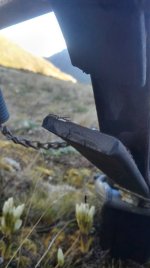
The bracket was understrength for this kind of work. It steadily deformed under the load, and had snapped one of the bolts in the process through bending stress. The bracket loosened off enough that it was allowing the springs too much room to free-play and bounce.
There was a lot of corrosion too, and combined with the bends in the metal bracket, I worried about Stress Corrosion Cracking.
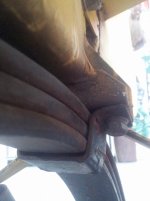
Click image for larger version  Name:	20150706_150430.jpg Views:	1 Size:	769.2 KB ID:	32581

We decided on an very simple upgrade, at the cost of three hours work.
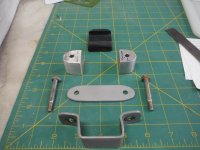
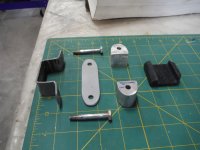
We used a mild steel plate and some thin AN washers as spacers, these are the sacrificial parts; and two pieces of a NAS bolt for the retainers - which should last a long time.
We were certain to leave enough room for a slight amount of movement, so the leaf springs can slide over each other. Overtightened, the leaf spring would become much too springy and transfer more stress to the fuselage.
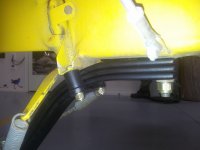
Click image for larger version  Name:	20150708_101924.jpg Views:	1 Size:	950.1 KB ID:	32582

You can see where I had to relieve the cylindrical parts to allow the tailwheel steering horns to travel. The cylindrical parts are indexed against the leaf spring, to prevent them rotating.
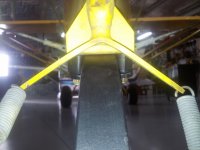
Click image for larger version  Name:	20150708_102014.jpg Views:	1 Size:	934.6 KB ID:	32583

If you haven't drilled the holes in the fuselage bracket yet, then you could reduce the size of the barrels somewhat.

The whole assembly needs to allow a little room for the spring to move around (vertical axis) IF you are going to be landing or taxiing on very rough stuff. On flat surfaces it doesn't seem to matter. The original bracket works fine, and there seems to be no need to leave room for the springs to move.

This time I have used rattle can etch primer, so I can repaint the parts easily and regularly. The two pot paint system with undercoat was strong, but was not durable and easily chipped from stones / debris impact; the two pot system is harder to reapply.
 
Last edited:
Looks good, what are the cylinders made of?
They are used NAS bolts (big ones) which came off an Ag plane undercarriage, machined down to suit. They have to be discarded once worn out, so I got the large bits of steel for free.
AN bolts would also work fine.
 
Hey Jonathan,

Because most of my landings are unimproved strips, I'm facing similar issues. I was wondering if this is still your method or maybe you have improved on it?
I'm considering a similar mod.
 
Hey Jonathan,

Because most of my landings are unimproved strips, I'm facing similar issues. I was wondering if this is still your method or maybe you have improved on it?
I'm considering a similar mod.

Hey John,

Yes I've had this mod installed for the last 525 hours now, it's been completely trouble-free. No changes required. I would say that the steel plate has developed a very gentle bow, through use. A little heat treatment would be good to stiffen it up - but I haven't really got the time or inclination. The AN4 retaining bolts have never come loose.

I didn't mention it above, but I rounded off the edges of the plate where they meet the spring to avoid point-loads. I would recommend that.
 
My version of Jonathan's good idea..........

Found out the the Carbon Cubs used the same u-shaped bracket that the BH plans and kits use. They switched to round aluminum bushings. I didn't have any Ag-Cat bushings handy so I decided to go with shaped aluminum blocks too. I went with flats on the spring for more bearing surface area.

I also made a UHMW bearing pad. Did this for a couple of reasons. One, to increase the tailwheel spindle angle. Every now and then, when I'm max loaded and land a little faster, get a bit of shimmy. May help, may not. Also, I'm scratching for every 1/16" of over the nose visibilty that I can muster. Landing on some of these narrow runways that I try would be easier with better over-the-nose visibility. I'm still honing my tailwheel up braking to walking speed.

Just to be clear, the stock tailwheel spring bracket in the plans and the kits is fine for most users. Maybe the stinger has replaced the leaf springs in most kits, not sure. I'm kinda going to the outer edges of the design Bob had in mind for the Bearhawk. Not as far as Jonathan, yet. For example, on the over-the-nose visibility, Bob designed the aircraft with 6" tires. We start raising the nose with bigger tires and duh! If I were to give a short-time tailwheel, newby BH driver some advice, it would be start with 6" tires. Seeing is important in the early stages for early detection and correction for maintaining directional control. Good visibility facilitates smaller corrections, sooner!!!! Stepping off soap box now.


Old and New Parts-

wAAACH5BAEKAAAALAAAAAABAAEAAAICRAEAOw==
Click image for larger version  Name:	Tailwheel Spring Mod (2).JPG Views:	0 Size:	1.52 MB ID:	65723Click image for larger version  Name:	Tailwheel Spring Mod (2).JPG Views:	0 Size:	1.52 MB ID:	65723

Installed with full rudder deflection -
Click image for larger version  Name:	Tailwheel Spring Mod (2).JPG Views:	0 Size:	1.52 MB ID:	65723

Thanks again Jonathan. test in the am!


​​
 
Last edited:
Since you asked for a report back Jared............

After two flights and 11 stop & go's I can tell the difference and I likes it!!! The only Bearhawk handling experience I have is with my BH 4A. So, I may not have the expertise to do a competent evaluation and will only relay my limited experience and observations.

I got my AW in mid-September and have +215 hours or so on her now. Bunch of slow flight, off-field stuff. Between me learning to fly the BH and the off-field stuff I try, lets just say the tailwheel components has been subjected to more than the usual abuse. Again, the strap bracket per the plans is fine for manicured grass, hard surfaced runways and more skilled PIC's.

The issue with the u-strap,IMHO, is you have to get 4 bends exactly right to have a tight fit. That is hard for me. Throw in multiple abusive, rough surface landings and turns and I was seeing my top leaf spring move side to side about 1/2 - 3/4". This allowed the whole leaf spring to "twist" in short radius turns and hand, weak back parking. All the leafs are now staying tightly stacked and I'm not getting that tailwheel "twist & drop" on tight turns now. There is improved response on the landing roll-outs to rudder inputs. I didn't know I had a "deadband" in the rudder/tailwheel inputs till I made this change. Kinda like I got power steering now.

NOTE & DISCLAIMER: If you look back at Jonathan's pictures, it looks to me like he went with 0.250" strap on the bottom. Just scaling of the 1/4" bolts??? I went with 0.125", 4130. I'm always trying to lean to the light side. The original U-Strap was 0.090" per my plans. I won't declare this a tentative success until I go through at least 100 landings. with a bunch of off-field in that. I'm not a structural engineer and I haven't stayed at a Holiday Inn since before COVID hit.:p I defer to Jonathan's experience on that.

Having more fun with the BH than I deserve!!!

Fly safe.
 
Last edited:
My version of Jonathan's good idea..........

Found out the the Carbon Cubs used the same u-shaped bracket that the BH plans and kits use. They switched to round aluminum bushings. I didn't have any Ag-Cat bushings handy so I decided to go with shaped aluminum blocks too. I went with flats on the spring for more bearing surface area.

I also made a UHMW bearing pad. Did this for a couple of reasons. One, to increase the tailwheel spindle angle. Every now and then, when I'm max loaded and land a little faster, get a bit of shimmy. May help, may not. Also, I'm scratching for every 1/16" of over the nose visibilty that I can muster. Landing on some of these narrow runways that I try would be easier with better over-the-nose visibility. I'm still honing my tailwheel up braking to walking speed.

Just to be clear, the stock tailwheel spring bracket in the plans and the kits is fine for most users. Maybe the stinger has replaced the leaf springs in most kits, not sure. I'm kinda going to the outer edges of the design Bob had in mind for the Bearhawk. Not as far as Jonathan, yet. For example, on the over-the-nose visibility, Bob designed the aircraft with 6" tires. We start raising the nose with bigger tires and duh! If I were to give a short-time tailwheel, newby BH driver some advice, it would be start with 6" tires. Seeing is important in the early stages for early detection and correction for maintaining directional control. Good visibility facilitates smaller corrections, sooner!!!! Stepping off soap box now.


Old and New Parts-

wAAACH5BAEKAAAALAAAAAABAAEAAAICRAEAOw==


Installed with full rudder deflection -


Thanks again Jonathan. test in the am!


​​

This thread is great. I've had trouble with that bracket bending from early on, and to date have just been bending it back into shape every 50 hours or so, but I'm sure it's going to crack and break at some point so I was looking at how to make it a lot stronger. I really like your, and Batson's work on this.

The aluminum blocks, did you make them yourself or are they parts off a carbon cub? If you made them, you mind posting dimensions/a drawing?
 
I must say Eric Newton’s solid round bar “spring” looks simple and effective and would better absorb a side load on rough terrain it seems.

Are many using it?
 
I must say Eric Newton’s solid round bar “spring” looks simple and effective and would better absorb a side load on rough terrain it seems.

Are many using it?

I'm not familiar with it. The B model has gone to a round bar from what I understand, are you just talking about the B model or did Eric change his A to a B style tailspring?
 
The Mode B round tail spring is awesome. I put one on my BH but it required an adapter and beefing the tail post.

What Battson and John have done is a much easier solution that seems to perform well.
 
I must say Eric Newton’s solid round bar “spring” looks simple and effective and would better absorb a side load on rough terrain it seems.

Are many using it?

I looked hard at it, and orginally wanted one when I bought my kit a decade ago.

The only real downsides for the round spring AKA "stinger" in my view are:
1. If it breaks, you have a major issue - possibly a loss of control
2. It's hard(ish) to retrofit
3. Reduced visibility over the nose

Apart from that, it's all upsides through my eyes.

P.S. I believe most ag aircraft designers used leaf springs because of point #1, and multiple thinner springs is probably better than a couple of thick springs.
 
Last edited:
According to Bob - all the metal tail springs (flat or round) very much tend to bend when over loaded. Rather than break. Mark
 
The aluminum blocks, did you make them yourself or are they parts off a carbon cub? If you made them, you mind posting dimensions/a drawing?

I made the parts myself. The are made on G&BS machine (grinder & belt sander). My Bearhawk is scratch built and the dimensions that I used would probably not work for any other BH.

I started with 1" x 1" 6061-T6 blocks.
I made that black UHMW wear/friction block. It is .250" thick where it sits on fuselage foot. If you didn't use a the UHMW block , 0.750" should work for the height of the block.

Next, I drilled the 0.250" bolt holes in the center, .500" (2D) from outside edge. The rear of the blocks have to be rounded or chamfered for clearance at full rudder deflection with the rudder horn. I chose to radius both the front and back just for looks. I just went at it with a grinder with aluminum wheel and then a belt sander to finish. Those were the two most used tools while scratch building. Got a lot of hours on them.

There were several test fits after which the inside flat face was sanded for a tight, close fit on the spring.

hope that helps some?
 
Last edited:
Fatigue cracking on a tailwheel spring pictured here on the Bearhawk (circa 600hrs heavy use) - with a leaf spring you can fly away from this problem.
With a stinger this would be more problematic, although who knows how much it would take to crack a stinger.
 

Attachments

  • photo9606.jpg
    photo9606.jpg
    840.2 KB · Views: 0
Well I bought a 4a, and had this strap. Took off the tailwheel and completely rebuilt the Scott 3216 and baby bushwheel. While off, I had two bushings like above machined from T6-6061 aluminum 1.25” round stock with a .75” flat face against the leaf spring. AN4 hardware, and a 1/8” lower steel strap. All painted in epoxy and drying now for assembly this weekend. Looking forward to the “power steering.” Haha. But I fly mostly off airport and river bars, so wanted the spring system to be as tough as possible. Thanks for the description and reviews!
 
Back
Top