Bearhawk Aircraft Bearhawk Tailwheels LLC Eric Newton's Builder Manuals Bearhawk Plans Bearhawk Store

Announcement

Collapse
No announcement yet.

Cold Weather Flying

Collapse
X
 
  • Filter
  • Time
  • Show
Clear All
new posts

  • Cold Weather Flying

    Hey All...

    I have read multiple articles about cold weather flying in other forums, but I'd like to know what has been effective for the Bearhawk.

    It has been very cold lately, compared to other years. Temps haven't been much above -18C/0F for a number of weeks now, the coldest was this morning. It was -31C/-24F...BRRRRR! But, the weather is crystal clear and it's killing me to sit and wait for some warmer temps. Last time I went flying it was -12C/10F. My oil temp never went above 167F and CHTs were all in the very low 300s, with the power pulled back they were in the high 200s.

    In general, my personal minimums for "unplanned landing" events is an OAT of 0F. Any colder than that, coupled with the possibility of injury, trying to survive doesn't sound too appealing. Also, if there is any wind at all at the airport, just getting the airplane ready is a real chore. The EZ-Heat engine oil pan heater works great, so does the cockpit heater. On a positive note my cabin heater works great and things stay warm inside, in spite of some air leaks. Those aviation pioneers flying open-cockpit biplanes in Alaska 100 years ago had to have been tough as nails. Ok, so that's the me being a weenie part.

    What have others done to help the engine stay warm? Our Civil Air Patrol C172 has a winter kit, essentially two plastic baffles that close off the inside half of the left and right nosebowl inlets. If I remember right the cutoff temp for them being installed is a max OAT of 20F. My oil cooler is mounted on the firewall, pilots side, with a 4in scat tube running from the back of the baffling at #6 cylinder.

    Any input is welcome!

  • #2
    I know quite a few people run their SuperCubs with a pet-cock valve in the oil cooler line and cable running to the cockpit, so that they can manually vary the oil flow going to the cooler. I have no experience flying in that cold of weather but it sounds fun until it suddenly isn't. Even getting fuel would be challenging I would think, since your engine will have cooled quite a bit before you are done. I would also worry about my cylinders being that cold because of lead scavenging, resulting in fouled plugs and guides if done on a regular basis. I also imagine you would want some sort of airflow over the engine, even if just a little, to make sure you don't end up with a hotspot that wouldn't normally accumulate heat, if you completely close off the cowling. I suppose there's a reason people only ever think of Alaska in the summer...

    Comment


    • #3
      Oil Cooler Valve & blocking plate I have the valve in the oil line running to the cooler. Actuating it moves the temperature about 15F but I rigged it so some oil always flows thru the cooler. When the OAT is in the 40's I install an oil cooler block off plate and then I see the oil temp in cruise rise from 170F to 205F with the valve closed. I block off about 50% of the back of the cooler. My understanding is blocking off the front has more impact. (The rear on my oil cooler install is quick and easy to install & remove.)

      The Oil Cooler Valve install removes the Vernatherm and installs the Spring and Plunger. I am able to have very good cooling with a small Aeroclassics 7 row drawn cup oil cooler (its the smallest, plane vanilla cooler, nothing special....) on my 180 hp IO-360 engine.

      I am almost done fabricating my own insulated engine cowl cover. In Michigan Winter I figured needed something to be able to fly somewhere and stay for a while then come back and start the engine without preheat. The cover should greatly slow down engine cooling on the ground. The next step will be to plug it in to a small Honda Generator so I can stay overnight stay then preheat in the morning.

      Regarding fueling....I have been watching my engine heat during refueling due to excess heat in the summer. I am quite confident that I can refuel in below zero F and still have very good CHT and Oil T for start. I've done it in the 20's. I can refuel in about 15 minutes.

      I want to know how cold CHT is too cold. I dont have that data point.
      Brooks Cone
      Southeast Michigan
      Patrol #303, Kit build

      Comment


      • #4
        Originally posted by Bcone1381 View Post
        I want to know how cold CHT is too cold. I dont have that data point.
        Savvy Article here talks about lead oxy-bromides not being scavenged properly below ~350°, leading to stuck valves. I am not sure where that comes from beyond Mike Busch, but it makes sense, but maybe searching will yield a Lycoming source reference.


        Comment


        • #5
          I can't speak to the Bearhawk in particular, but I've got a bit of experience working as an A&P on GA planes up in Fairbanks (hit -50°F last night). It's a bit of a trial and error process on each particular plane. You can start out by putting a single strip of duct tape from top to bottom across each cowl inlet. Do a quick flight and see how it does. If not enough, make it double wide, etc... that should give you an idea of how big to make the winter front. Or just use duct tape like a lot of people up here do...

          My 180 had the winter kit like you mentioned on the 172. The cowl flaps helped immensely in this scenario because you need one amount of cooling for take off and far less for cruise. The cowl flaps and the cht engine monitor allowed me to fine tune the temps.

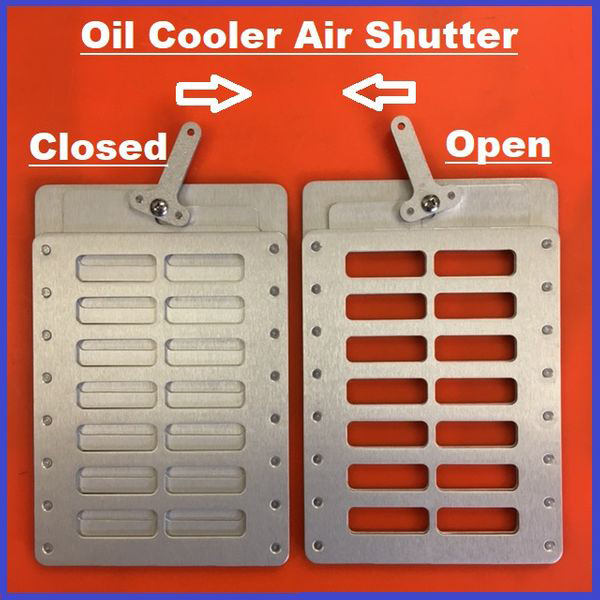
          Then I put aluminum tape in front of the oil cooler and removed little pieces for warmer days. A better option for the experimental crowd is this oil cooler shutter, linked below. Have used that with great success in other planes (all experimental, of course...). Most effective on the front of the cooler.

          Anti-Splat Oil Cooler Air Shutter This product will add full control of air entering the oil cooler, thus giving the pilot some degree of control over the oil temperature. This basic product was offered for several years by another manufact


          As for filling up with gas, just throw the engine cover on as soon as you get out of the plane. The engine will stay warm for a couple hours like that. If you wait 10 or 15min it may be too late, especially if there is the slightest breeze.

          Also, put a 1/4" hole in your breather line near the top of the cowling, in the warm area. You can stick a punch in the hole and bend it so the bent part will deflect the oil from escaping. If your breather freezes up (w/out the hole) the crankcase will pressurize and blow out your nose seal. Leading to oil on the windshield and a forced landing. You can also cut a V shaped wedge in a rubber hose, if that's more convenient.

          Just my $0.02...

          Comment


          • alaskabearhawk
            alaskabearhawk commented
            Editing a comment
            Thanks for the great input! It hurts just walking outside in temps like that, let alone trying to fly! I did look at that plate by Anti-Splat and it looks like a good option. I would hesitate to go with that only because it blocks some of the flow even at wide open. Maybe it doesn’t matter, but that’s my thinking.

            I do have a whistle hole in my breather pipe, so that’s been taken care of.

        • #6
          Hey Paul,
          I had similar problem the first winter I flew the BH in our Canadian winter temp.
          Oil couldn’t get to 180 (max was 165) and cht between 250-275
          My solution was:
          - add a valve to control the air flow to the oil cooler. It works for fall/spring time temp, but not sufficient below < 0C. Nevertheless, this was a good addition for spring/fall and even cold summer days. It allow you to control the air flow to the cooler with a simple push-pull cable. My oil cooler is also mounted on the firewall, pilots side, with a 4in scat tube running from the back of the baffling at #6 cylinder.​ See photo below
          - When December comes, I completely block the air inlet to the oil cooler scat tube. Simple as an aluminum piece taped at the air inlet, behind cyl6. I typically see 175-185 oil temp at -15c
          -To improve CHT, I partially block the cowling exit air using 0.032 aluminum sheet. This sheet is in between the 2 exhaust pipes. It’s screwed to the cowling and the bottom of the boot cowl. 4 screws total, easy to remove when comes time to remove the cowling. The sheet is perforated with a matrix of 1in. hole. I figure that 25% of the total exit area is blocked. This has a direct effect on CHT. They run close to 325-350 at -15c.

          No wither flying for me this year, busy on my float install ;-)
          Hope this help.
          Mike.


          20190322_132536.jpg

          Comment


          • #7
            Thanks Mike, that helps quite a bit. Those are very elegant solutions and I’ll give them a try. I found out from a local Glastar builder that he has the butterfly valve controlled by a TCW servo. He flies long distances at A150/A160 and needed a solution for low OATs at altitude.

            A couple of days ago it was M37C at the airport!

            Comment

            Working...
            X