Operation Notice from Bob about Fuel Tanks on Systems with Fuel Pumps

jaredyates

4-Place Kit Builder
Staff member
Operation Notice

The Bearhawk Fuel System as shown in the Bearhawk Book is designed for use without a fuel pump.
If a fuel pump is used, extra care in flying is required so that neither main tanks become unported, as a fuel pump would rather suck air than fuel.
If one tank is very low and the other is not very low, set the fuel selector on the fullest tank and fly the plan as not to unport that tank.
A header tank (3 gal) could be used to solve this problem, but fuel in the cockpit can be a safety issue. (Vent the header tank to both main tanks)
 
I kind of think this is a bit of an overly broad disclaimer, and it might cause a lot of confusion.

Also, if you think about it, what is the difference between being in an uncoordinated bank, and un-porting one side, and being in a climb or descent, and un-porting one or both fore and aft fuel pickups? I don't see any.

If you are going to run multiple fuel pickups, either with a "Both" setting on a fuel valve, or fore and aft fuel pickups in the same tank, the fuel system (or the input to the fuel pump) must be continually fed by gravity. If you are sucking fuel into the pump, I can't remember the correct term (scavenging?), and you are running multiple fuel pickups, you risk sucking air if a fuel pickup gets un-ported.
 
Well it's the easiest solution from a designer's standpoint that's for sure. But yeah, confusing for those who use any kind of pump and very broad, and yeah same effect in pitch. I think we pretty much ferreted out the sucking pump as the necessary culprit in unporting mishaps.
 
I thought all 0-360s and O-540s had a mechanical fuel pump. Am I mistaken? I’m sure I could be since my knowledge is quite thin in this area. Does anyone run without one? Thanks
 
Neither need one if you can gravity feed 150% of the fuel burn at takeoff power in the least favorable pitch attitude. That's what the AC calls for.

The carbs themselves don't need any fuel pressure, so as long as you can get fuel to them they work.

There are people here that don't run fuel pumps.
 
I thought about this for a couple of days and I think Bob is correct writing this notice the way he did. There is no way he can come up with every permutation of pumped engines and write a notice for all of them.

I think if I was writing it, it would just say: The BH fuel system was designed to gravity feed a carburetor on an engine up to 300 hp. Each builder should conduct a fuel flow test according to AC 43 to verify their installed system is compliant. Any use of the fuel system for other than a gravity fed carburetor, is up to the individual builder to ascertain its' correct function.
 
Ya, to me, the fuel system seems like an ancillary item that is up to the builder, not the kit maker/designer. Almost like if they were recommending one way to wire an electrical system over another. He cannot possibly account for all the things people are going to want/come up with. Although fuel starvation is the #1 cause of E-AB engine failures.

Even with his design it seems like it's 50/50 whether you can get sufficient fuel flow based on the way individual builders interpret how it's supposed to be, fittings used, etc.
 
Last edited:
Thanks everyone. For my perspective, so I can measure the risks against something I’m familiar with, does a 172 have a mechanical pump? Say a 1970-1980 vintage with a lycoming 0-320?

Just trying to figure out if I buy an engine with a mechanical pump am I increasing safety by removing it? (Assuming I am meeting the 150% of max flow rule in the worst pitch attitude)
 
Assuming it's still an o-320 and not injected then no. None of the high wing carbed cessnas have pumps.
 
Last edited:
Good to know. I assumed otherwise. If you have a mechanical pump on your engine, is it safer to leave it on or remove it? Opinions?
 
Some Cessnas have a fuel pump but I can’t think of one that came that way from the factory. The ones that have them are like a C170 or early 172 that have an O360 installed in place of the O300.

As has been said, if your fuel system will flow 150% of the volume needed at max power and worst case AOA via gravity then there is no need for a fuel pump. If it will not then you’ll need to modify you fuel system to get that 150%. Most builders install a fuel pump since that is the easiest.
 
It’s funny because my Maule had a fuel pump but not a single reference how to use it in the POH. :eek: don’t think I ever used it.
 
I use the electric pump in my Maule M5-235C to bring the fuel pressure up to 5 lbs before start. Three pumps of the throttle then gives me all the prime I need. That's all I use it for because it is on the checklist I inherited from the previous owner.
 
I am quickly become addicted to this forum. 100% Refer to the requirements layout by the manufacturer of the fuel system.
 
It’s funny because my Maule had a fuel pump but not a single reference how to use it in the POH. :eek: don’t think I ever used it.

Every Maule I've seen has an engine driven pump with electric backup. If you need a mechanical pump a backup is required.

If you have(need) a mechanical pump the electric should be on for all takeoffs, landings and any other critical phase of flight where a short interruption of power while you get it figured out and the electric pump on would turn out bad.

Having recently experienced the failure of an engine-driven fuel pump in my buddy's Piper Cherokee 160, it made me really think about this whole "aux" fuel pump situation. We had been in flight for a while when he said "Oh, I never did my level-off checklist..." He ran the checklist, and one item was "Fuel Pump - OFF". He turned it off, and 3-4 seconds later the engine faltered and quit. He looked at me with big eyes, and I said "Well, you might wanna turn that fuel pump back on..." He did, and power was restored within a couple of seconds. In hindsight, the mechanical pump had failed at some point after the runup, and we had been running strictly off the electric pump for an unknown amount of time. That's what it's there for, of course, but it left us both feeling a bit "queasy"...

The checklist for his plane calls for the electric pump to be turned ON (and look for a rise in fuel pressure) BEFORE you start the engine (which automatically activates the engine-driven pump). You then turn it OFF for the pre-takeoff engine runup / mag checks (to ensure the engine-driven pump is working as well). Just before takeoff, you turn it back ON and it stays ON until you reach your cruise altitude – precisely to guard against the failure of that engine-driven pump – as we experienced. The electric pump kept the engine running for us – until he turned it OFF...

If he had never turned the electric pump off, we would have been blissfully ignorant of the failure of the engine-driven pump – at least until the electric pump failed! Or until the next engine runup was done – assuming he actually did that complete "before takeoff" checklist prior to every flight – even the 2nd or 3rd flight of the day. And prior to the events that day, he told me no use for doing the complete runup / mag-check, fuel pump check, etc. prior to every flight, and only did them for the first flight of the day. Now he has "seen the light" and performs that complete checklist for every flight!

So I'm now looking over the checklist I developed for my airplane (experimental, so no "factory" checklist), with an eye to ensure I'm able to 'validate' even the redundant systems in the plane somehow. My plane does NOT have an electric fuel pump. It's high-wing, so it shouldn't need one. Except for the fact that the header itself is below the seat, so it's an "uphill" run to the engine from there. I'd be OK feeding from the wing tanks, but once I hit the 2.5 gallon (1/2 hour) "reserve" in that header, I'm entirely dependent on the engine-driven pump. If it ever quits, so will the engine. Adding an electric pump is on my horizon... And my checklist will be modified to ensure I'm getting fuel pressure with the electric pump ON, well before starting the engine.

As the Rotax is shut down by turning off the ignition system (no mixture control to pull), I shut one side off, and wait 3-5 seconds before I shut off the other side. That's to ensure the P-lead is actually grounded by the "off" position on both circuits. By alternating which side I turn off first on each flight, I check both systems on a regular basis. Even on the Citabria that I used to own, I would occasionally shut down using the ignition switches instead of pulling the mixture, just to ensure those P-leads really were grounded properly. Cheap insurance for the day someone pulls the prop through – accidentally or on purpose...
 
Last edited:
Having recently experienced the failure of an engine-driven fuel pump in my buddy's Piper Cherokee 160, it made me really think about this whole "aux" fuel pump situation. We had been in flight for a while when he said "Oh, I never did my level-off checklist..." He ran the checklist, and one item was "Fuel Pump - OFF". He turned it off, and 3-4 seconds later the engine faltered and quit. He looked at me with big eyes, and I said "Well, you might wanna turn that fuel pump back on..." He did, and power was restored within a couple of seconds. In hindsight, the mechanical pump had failed at some point after the runup, and we had been running strictly off the electric pump for an unknown amount of time. That's what it's there for, of course, but it left us both feeling a bit "queasy"...

The checklist for his plane calls for the electric pump to be turned ON (and look for a rise in fuel pressure) BEFORE you start the engine (which automatically activates the engine-driven pump). You then turn it OFF for the pre-takeoff engine runup / mag checks (to ensure the engine-driven pump is working as well). Just before takeoff, you turn it back ON and it stays ON until you reach your cruise altitude – precisely to guard against the failure of that engine-driven pump – as we experienced. The electric pump kept the engine running for us – until he turned it OFF...

If he had never turned the electric pump off, we would have been blissfully ignorant of the failure of the engine-driven pump – at least until the electric pump failed! Or until the next engine runup was done – assuming he actually did that complete "before takeoff" checklist prior to every flight – even the 2nd or 3rd flight of the day. And prior to the events that day, he told me no use for doing the complete runup / mag-check, fuel pump check, etc. prior to every flight, and only did them for the first flight of the day. Now he has "seen the light" and performs that complete checklist for every flight!

So I'm now looking over the checklist I developed for my airplane (experimental, so no "factory" checklist), with an eye to ensure I'm able to 'validate' even the redundant systems in the plane somehow. My plane does NOT have an electric fuel pump. It's high-wing, so it shouldn't need one. Except for the fact that the header itself is below the seat, so it's an "uphill" run to the engine from there. I'd be OK feeding from the wing tanks, but once I hit the 2.5 gallon (1/2 hour) "reserve" in that header, I'm entirely dependent on the engine-driven pump. If it ever quits, so will the engine. Adding an electric pump is on my horizon... And my checklist will be modified to ensure I'm getting fuel pressure with the electric pump ON, well before starting the engine.

As the Rotax is shut down by turning off the ignition system (no mixture control to pull), I shut one side off, and wait 3-5 seconds before I shut off the other side. That's to ensure the P-lead is actually grounded by the "off" position on both circuits. By alternating which side I turn off first on each flight, I check both systems on a regular basis. Even on the Citabria that I used to own, I would occasionally shut down using the ignition switches instead of pulling the mixture, just to ensure those P-leads really were grounded properly. Cheap insurance for the day someone pulls the prop through – accidentally or on purpose...

This is why the backup is always on for a critical phase of flight. You don't want that happening at 400ft.

So you say you have a mechanical pump. If you actually need that pump for the engine to run in any way at all, you MUST have the backup. Even on a rotax. I'd get one in there ASAP. I wouldn't fly again until you do. Or consider that 2.5gal unusable, but I'm pretty sure the carbd rotax needs the pump to run properly regardless of the head pressure from tanks. I think the issue is putting enough fuel through the failed mechanical pump. They're like $100. If you're high wing or not is irrelevant in of itself. Plenty of high wing planes have pumps. It has everything to do with if you can get the fuel to the carb ALWAYS.
If you don't need the pump, I'd take it off.

Most commercial shops mag checks are on the runup and shut down checklists. On shutdown it lets you know if a mag is hot, or if one is bad and you can fix it before you go to fly next and now can't.
 
Last edited:
If you have(need) a mechanical pump the electric should be on for all takeoffs, landings and any other critical phase of flight where a short interruption of power while you get it figured out and the electric pump on would turn out bad.

See that has always been my assumption too, however I found it doesn't hold in all cases. I always check the POH. Some require boost pumps OFF at certain times.
For some reason I thought some Maules were like this. Or maybe I am thinking about the high and low pressure pump switches in the Cessna
 
Last edited:
I would think you're thinking of the Continental style fuel injection with a high and low and it does need to be in it's correct position. I cannot think of how a carb or Bendix FI would have an issue with a boost pump on, and very bad outcomes with it off.

Some Maule's run the TCM IO-360, and that would then be the case there, but the lycoming's seem to be most common.
 
Last edited:
I've been thinking about this......

Is the inference that unporting ANY of the four ports is going to cause air to be sucked to the engine? In which case, a few questions:

Should I put the aircraft in (say) the landing attitude and see what the minimum fuel in the tanks is to keep the forward port covered and then make that "unusable" fuel?

OR

Is it counterproductive to have 4 ports? Should I blank off the forward ports?

OR

Should I run LEFT/RIGHT instead of BOTH?

OR

Should I fit a header tank?

OR

Should I not really worry? - I'm sure there are plenty of IO powered Bearhawks flying quite happily.
 
  • Like
Reactions: Nev
I guess I'll comment, hopefully it helps someone:

For years we were told to build to plans and NOT to modify the fuel system, and that it was dangerous to do so, but many of us knew that the bearhawk fuel system isn't adequate for every engine installation, specifically for any type of fuel injection that required a return.

Now we see this notice, but it's not really clear, and doesn't explain why. Someone asked if it's ANY fuel pump, to which Mark says yes, and given that Mark no doubt asked Bob, that is the official answer, but I think it might help to go through the different types of fuel systems and explain why design choices might make the engine quit.

Carb:

A carb doesn't need any fuel pressure, it just needs fuel in the float bowl, and the amount of fuel it needs is exactly whatever the engine uses. For this reason gravity works fine. The FAA says that a gravity fed fuel system must flow 150% of the fuel needed by the engine at a nose up attitude. So, you simply raise the nose, do a flow test and that's it.

Here are the gotchas: The FAA also states that when you use a fuel selector valve with the 'BOTH' position to tie the two tanks together, you also need to tie the vents together so that the pressure above and below the tanks stays the same. The bearhawk doesn't have this. In theory, with both tanks vented to atmosphere, they should flow the same, and this shouldn't be a problem, but there has been two reports of engine stoppage when one tank is very full and the other isn't when the pilot was using 'BOTH'. It's pretty obvious that in this condition for whatever reason, one tank is feeding the other and staving the engine. If I was running a carb I would have a cross vent, or I wouldn't use the 'BOTH' position. Even my Cessna 170 is placarded to use single tank operation at cruise, and it has a cross vent. All that said, many have been flying for years with no cross vent on both. Given that the bearhawk doesn't have hard points and exact plans to mount the fuel system, every single one is slightly different, so nobody knows why some work great, and others have had problems.

Bendix (returnless) fuel injection:

The Bendix system needs fuel pressure in order to work, so it requires the use of a fuel pump, and due to redundancy, two fuel pumps. Most people run an electric boost pump that can flow fuel when it's off, along with an engine driven pump. They operate at around 20-30psi. Because the fuel system doesn't have a return, the fuel pumps cycle fuel internally to regulate the pressure. What this means for the rest of the fuel system is that fuel delivery to the pump only really needs to be whatever GPH the engine is consuming. For this reason I believe the bearhawk fuel system works fine for returnless fuel systems. The flow of fuel down the door posts isn't really any different with returnless FI vs a carb.

Gotchas: You must manage the boost pump and turn it on when you need it. Also, like with a carb, it would be wise to use single tank or add the cross vent, but I don't think this is as big of a deal when fuel pumps are involved as flooded input port at the pump would almost certainly cause fuel to be pumped into the engine. The biggest issue with returnless FI (other than additional weight) is the fact that you have an engine driven pump which gets hot with fuel circulating in it which also gets hot. This can cause vapor lock if you aren't running a fuel that is very resistant to vapor lock (avgas). There are no certified airplanes with returnless fuel injection that have STC for mogas.

Return fuel injection (EFI and continental):

In the case of EFI, they need a bit of fuel pressure to work, and all of the ones I've seen pump the fuel through the injector rails, then to a regulator which bleeds the excess fuel back to the tank. This means that the fuel demand at the tank is whatever the pump consumes, which for some pumps can be quite high, like 80gph-100gph high. Of course, whatever the engine isn't using is put back into the tank through a duplex valve, but what if a tank becomes unported? Well, that pump is going to suck air pretty fast because it's consuming so much fuel. One way to deal with this is to try to never unport, so always use the fuller tank or only use one port (which you would want in the center), or use a header tank and return the fuel there. Personally, I would absolutely be using a header tank if I was going to run EFI. The continental runs at a lower pressure and doesn't return as much fuel, so it might work, and we have one member here that is doing it, but he put in 1/2" fuel line on the aft door post and also uses a L/R/Off valve.


Because I didn't want a carb due to the uneven fuel distribution, and also because I didn't want to completely redesign the fuel system, I'm going to run airflow performance with the factory fuel system and a valve that is L/R/Off. Landing will require selecting the fuller tank and turning on the boost pump. I don't expect any problems, but it is more complicated than a carb. The pro is that I'll be able to use LOP at low power cruise to cut down on my fuel costs, and I no longer have any issues with carb ice.


This not the official word from Mark or Bob, but hopefully it fills in the blanks for someone trying to work through what to do.
 
Last edited:
Well, there is something new I didn't know. I assumed they cycled the fuel like a boost pump. Either way, if there isn't any flow, the fuel can get hot in there.
 
I looked into a bunch of fuel system schematics and cutaways several months ago. All the diagrams I saw for Bendix style engine driven fuel pumps show an internal bypass to return excess fuel from the outlet back to the inlet.

The EFII and AFM boost pumps have to return fuel somewhere. The are constant displacement electric pumps. It is built into the external manifolds they come with in addition to a check valve to allow them to be bypassed. Same with the expensive certified boost pumps.
 
Thanks for the info Schu.

So, I have a standard fuel injected system with a back-up electric pump and no cross vent. Would you therefore recommend running LEFT/RIGHT in the cruise and fuller tank for T/O and Landing or BOTH for T/O and Landing?
 
It seems prudent to me to have a limitation the says "Don't select BOTH if a significant fuel imbalance occurs". This sets the fuel system up to crossfeed from one tank to the other tank via the fuel selector. A crossfeed situation would not allow 100% fuel flow to the engine.

It also seems prudent to me to have little concern if both tanks quantities are essentially equal. Run it any way you desire as long as that limitation is honored and fuel is being supplied to the engine.
 
I'm going to run left/right and use the fuller tank because there are less ports to unport, because I'll certainly have much more fuel in one tank instead of both being low, and because I don't like how the bearhawk lacks the cross vent. I'll also probably use mogas in cruise from one side and land/takeoff with avgas from the other.

Battson runs BOTH, doesn't have a cross vent, and has hundreds of hours of trouble free operation.

I'm not sure what would work best for you. My solution requires much more fuel management, but I also plan on using fuel sensors with my EFIS as well as 30 minute alerts to check fuel to warn me if I'm being dumb. Battsons solution is dead simple, and very likely doesn't have issues with the lacking cross vent because as long as the pump inlet is flooded, it will pump fuel, even if there is some imbalance in the tanks.

Do you want to trade fuel management to have less unporting with a single, but fuller tank? That's up to you.

You could call Bob and talk to him too. I'm not the engineer. He may tell you you need a header tank....
 
I was an earlier believer that a fuel pump could suck air rather fuel, but I'm not so certain now. On my aircraft, as long as any one of the four fuel tank ports is covered with fuel, then the fuel will make its way down the line and flood the pump inlet. I've tested this, and (on my aircraft) I'm satisfied that it works this way. I wrote a post about it HERE.

As a result, I always fly in the BOTH position.

It's my belief now that a number of fuel system issues that resulted in engine stoppages may be the result of flying out of balance (ball out to one side or the other) for extended periods of time. If a fuel selector is installed with only a L,R,Off position, it may remove the chance of unbalancing the fuel inadvertently, but increases the chance of unporting a tank if out of balance. On my own aircraft, if I select either the L or R tank, it becomes much easier to completely unport that tank if I'm flying uncoordinated, and this would lead to an engine stoppage. For that reason I would only have a fuel selector with a BOTH position.

It's been discussed at length before, but I wanted to add links to it on this thread for obvious reasons.
 
Last edited:
I should add that the sight gauges will appear to show a significant fuel imbalance between tanks if the ball is not centered. The imbalance will appear to be in the direction of the ball. It's very easy to mistake this when no imbalance occurs. If left for a while, an imbalance will develop.

Takeaway point - fly with the ball centered.
 
Always fly in the BOTH position.

Takeaway point - fly with the ball centered.

^ DO THIS.

I've been flying on nothing but BOTH for a decade and 1,000 hours now, in every possible fuel configuration you can imagine. Zero engine stoppages, zero problems. Not even a "splutter". I do occasionally use L or R to rebalance tanks, but that is very rare and I always set a timer, to alarm when the correct quantity of fuel has transferred.​

I am firm believer in human error, making the fuel system or fuel management process any more complicated is inviting risk into your flying. Keep it simple, Sir.
 
Last edited:
Just to offer an alternative view, not to say that everyone has to do it my way, I rarely fly on both. For some reason it is very hard for me to keep tanks balanced and it is an unstable situation. If one tank is heavier, it will tend to fly low and the imbalance is made worse. I _ALWAYS_ frequently glance at my fuel site tubes, even now that I have a fuel totalizer. I've heard of numerous stories where something unexpectedly cause fuel to be lost. Depending on a totalizer will almost always get you into trouble if this happens. Having "all your fuel in one basket" makes the situation even worse. The result is people not realizing that they have fuel problem until it is _ALL_ gone.

My aircraft is equipped with both engine driven and electric pumps. I have intentionally and accidentally (due to slips) starved the system of fuel. It always restarts immediately. I run both when low on both altitude and fuel.

Monitoring and switching tanks keeps me involved with my fuel situation and avoids surprises. "Set it and forget it" leads to problems not being caught early.

That's what works for me. I don't require others to do the same.

This post (not the entire thread) is an example:
https://www.supercub.org/forum/showt...l=1#post836492
 
Last edited:
I've heard of numerous stories where something unexpectedly cause fuel to be lost. Depending on a totalizer will almost always get you into trouble if this happens.

I guess a Totalizer can only measure the fuel that passes through the transducer, so in the case of a fuel leak or missing fuel cap then it can't measure that fuel. Hopefully now that there is a much greater awareness of the fuel cap issue (and the simple fix), lost fuel caps should no longer be part of the Bearhawk experience. I do the same and regularly glance as the sight gauges as a gross error check, bearing in mind of course that they only indicate correctly if the ball is centered - and it took a while to get my feet moving. When the ball is not centered, the sight gauges will indicate that one tank is very full and the other is very empty.


I run both when low on both altitude and fuel.

I'm with you on that (I run both all the time). There's unintended consequences to consider if the fuel selector is in any position other than BOTH in a low fuel state.


My own experience is that flying in balance (ball centered) is the largest factor on the fuel system.
 
Last edited:
It’s fantastic that we get to build and fly our airplanes as we see fit. I enjoy the discussions relations to our choices and the camaraderie​ that comes from those discussions.

I’ve never had a plane with ‘Both’ and IMO it’s safer to have 5 gallons in one tank than 2.5 gallons in two tanks. Running a tank dry on a long cross country has always been part of my fuel management methods. I screwed up big time this past summer and wouldn’t have made it to an airport had I not ran a tank dry. Would have been better to not mess up the fuel planning in the first place but I’m glad the method I was taught in primary training saved my bacon.

https://www.avweb.com/features/avweb...fuel-tank-dry/
 
No instructor ever taught me this, my Uncle did, he routinely ran tanks dry in his Cherokee 6. I did this a few times in my Maule. Somewhere I have a large notebook full of printed Pelican Perch articles. So much common sense in those.
 
There's unintended consequences to consider if the fuel selector is in any position other than BOTH in a low fuel state.

I run both in cases of low fuel and low altitude more because I don't necessarily know which way I might be slipping and so that I don't have to pay it as much attention. There are times I go Whee's way and deliberately run one dry. I've never seen a problem with a quick restart, but if circumstances suggest it, I will use one tank and take care with which way I let the ball go.

It’s fantastic that we get to build and fly our airplanes as we see fit. I enjoy the discussions relations to our choices and the camaraderie​ that comes from those discussions.
:D

I’ve never had a plane with ‘Both’ and IMO it’s safer to have 5 gallons in one tank than 2.5 gallons in two tanks.
This is esp. true in an aircraft without both. This is our standard practice with our RV-4. It is what I do with the bearhawk if stretching fuel which is pretty rare given our 100 gal capacity.

Running a tank dry on a long cross country has always been part of my fuel management methods. I screwed up big time this past summer and wouldn’t have made it to an airport had I not ran a tank dry.
Why not? Same amount of fuel available.

I think the most important point is that if you are monitoring your fuel (...and your slip ball when low on fuel), then any method can work. Airplanes have crashed because someone ran a single tank dry at a very in opportune time. They have also crashed when they ran all their fuel out because they didn't notice that there was a problem when running on both. Neither problem will happen if you are actively monitoring fuel.

"Both" works well. Lots of planes don't have a both option and they are just as safe.
 
This "changing tanks regularly" approach to fuel management makes zero sense to me, in a high wing aircraft. It's nothing personal, just looking objectively at the risk level in each approach, there is a clear winner and loser. I also see no benefit to changing tanks, so what's the point in taking the extra risk.

That approach requires you to remember to do things, regularly, otherwise you get a surprise engine stoppage. Some people say it's a reminder to change tanks... It's a huge extra risk, not applicable in the other approach. Sure it works fine for lots of people and they have no problems, until you add in a lot of other workload or stresses - it's just a Swiss cheese risk model, an accident waiting to happen. It will work fine until the holes line up that one fateful day and humanity gets the better of you. We are all human and thus fallible, and people have been killed through fuel mismanagement so many times before. I don't think I am any better than they were, I am equally fallible.

At least on 'Both', it will keep running while there's fuel in there, no matter how bad everything else gets.

Also, "it always restarts immediately".... until the first time it doesn't, like when it happened to my good friend on short finals and the prop stopped spinning before he realised what happened. Fortunately he had enough energy to make the runway, just.

Also, if one is checking the fuel quantity all the time, what's the risk of having all the fuel "in one basket"?

If you are flying a Piper, then yeah - you have no choice.

It’s fantastic that we get to build and fly our airplanes as we see fit. I enjoy the discussions relations to our choices and the camaraderie​ that comes from those discussions.

One of the safety advantages of the high wing design is gravity feed to the fuel selector, I suggest pilots are in the business of managing and minimizing risk, and should have good reasons to expose ourselves, our families / friends, and our community to extra risk of harming ourselves or others. Especially when there is no clear reward for taking the risk.​
 
Last edited:
I agree with the points made and recognize that different methods can work and be just as safe as others.

To answer your question:

Why not? Same amount of fuel available.

Appropriately a gallon of usable fuel split between two tanks is within the margin of no usable fuel left at all. I’d argue that a gallon of usable in one tank is within those margins also but I’d rather it all be in one tank vs two. Maybe I would have made it on ‘both’ but based on my experience in my airplane I don’t think so. Either way, it was stupid and way too close.
 
  • Like
Reactions: Nev
I think it's really interesting that Nev and I think kestrel mention that the fuel system doesn't draw air because there is enough fuel in the lines to keep a pump flooded. I'll assume both of you are using mechanical injection or a carb as an EFI system might draw enough fuel fast enough to pull a bubble in to the system only to cycle it and spit it back into the tank.

My airplane isn't flying yet, but I have yet another take on this. I'm using airflow performance injection, but I put in a duplex valve:

https://www.andair.co.uk/product/duplex-fuel-selector-fs22-d2/

I'm going to install a tee right after the mechanical fuel pump, crush a rivet in one end, drill a .020 hole in it, and return it back to the valve then to the tank. I have some testing to do to make sure I'm only cycling 5-8gph back to the tank at all fuel pressures, then I need to make sure that my fuel system will flood the inlet of the mechanical pump at 125% engine consumption plus that 5-8gph with nose high attitude, but if it all works out, I'll have a little bit of fuel cooling the pump all of the time, as well as a place for vapor to go. This combined with a shroud around the engine pump should allow me to run mogas on an injected lycoming. I'll probably install a fuel temp probe and do a LOT of testing, but given the cost of avgas these days, it made sense to have a plan to run mogas.

If it works, great! I'll be able to run LOP and burn cheap gas. If it doesn't work I'll pull the TEE and press on as I would choose injection over running mogas anyway.

As for left/right/both.... I'm with Whee and Kestrel, besides, I have a computer warning me to look at fuel every 15 minutes and duplex valves don't come in the both variety.
 
"Trust, but verify..." I use a combination of sight gauge readings and fuel totalizer readings to cross-check each other, and sanity-check that against expected fuel burn (simple @ 5 gph in cruise).

Call me paranoid if you will, but I haven't run out of fuel yet, and only once got into my personal 1-hour VFR fuel reserves when I was on a long cross-country with much heavier than forecast headwinds. Landed with 45 minutes fuel remaining that time...

My RANS S-6 Coyote II has no fuel selector - just a simple fuel shut-off valve. It has two 9-gallon wing tanks (with pretty accurate sight gauges) for a total of 17.5 gallons usable in the wings. The system gravity feeds from BOTH tanks simultaneously into a Y-fitting behind the cabin, with that single combined feed flowing into a relatively large 2.75 gallon header tank (2.5 gal usable). That gives the plane 20 gal of usable fuel. When I top it off, I set the totalizer to 20 gallons. If I partially fill the tanks, I just add 2 gallons to whatever the sight gauges total. The 1/2 gallon unusable in the wings is countered by the extra 1/2 gallon usable in the header, and this way the math is a lot simpler for me... Especially when distracted with other flight activities.

Being a very low dihedral airplane, it is a very common occurrence for this design to draw fuel from one tank for a while before the other one starts to drop at all. I've personally only seen a 4-gallon differential, but others have reported one sight gauge reading "empty" before the other one started draining, and even in those extreme cases, they experienced no engine issues. In fact, there are no known instances of fuel starvation in an S-6 that had fuel remaining in any tank. So that's helpful for my peace of mind.

But coming from several low-wing designs that had no "BOTH" selector, I will admit to being a bit "antsy" until I see the level of the second tank begin to drop as well, confirming that there is no blockage preventing fuel from flowing. If I get over 1 gallon out of "balance", I will intentionally fly a bit out of trim to raise the "full" tank higher so it starts feeding. Once I see that level start dropping, I know I've got fuel flowing from both tanks, and I go back to normal operation (flying in trim). And monitoring... Always monitoring... Don't ever want to be "that guy"...
 
Whee, I understand your logic with this. Out of curiosity, after running a tank dry, do you then fly with the ball slightly toward the dry tank to ensure the remaining fuel is fully ported ?
 
This is a fantastic discussion. I like that others have their own methods, and they clearly understand the risks and have their own way of managing them.

In my mind it's very important that we come up with a safe way of managing fuel for people new to the Bearhawk. An SOP that doesn't require detailed systems knowledge.

My way of doing this during test flying was simply to keep the tanks at least half full at all times.
Keeping the ball centered at all times is the elephant in the room here. The Bearhawk has a very sensitive rudder, so until I was used to it the ball was all over the place - and so were my fuel tank quantities. Once I was able to fly consistently with the ball centered, I was then happy to run the fuel down to around 40 liters (10 Gallons) total (on BOTH).

This is one way. There are other ways to manage it, but it does need to be simple.
The overriding issue is the yaw sensitivity.

It's not a fuel system issue per se, it's the effect of yaw on the fuel system.

For a little light bedtime reading, more about it HERE and HERE.
 
Last edited:
For the benefit of new builders reading this thread, I want to reiterate that there have been several near misses and at least one fatality in Bearhawk aircraft due to apparent mismanagement of the fuel system and / or not flying in balance, apparently causing a tank to unport, per this safety message from Bob (original thread post).

Operational management of the Bearhawk fuel system (like all other aircraft fuel systems) is important to flight safety. The more complicated that activity becomes, the more likely accidents become. This has been proven time and time again in the aviation sector, at great cost.

I fully support the experimental process whereby people can do whatever they please. If people choose to modify the fuel system, that's got my support. We should be clear though, complexity comes with risk, and that tradeoff needs to be considered when making these choices.

Fuel injection systems with extra pumps and filters do complicate the fuel system, it's operation, and maintenance. They also offer a range of clear benefits in return for taking those risks, and it removes other clear risks such as carb ice. Implementing a fuel injection system with as little operational / maintenance complexity as possible, is a worthy goal. But it's not mandatory, and not as much fun as pure unbounded experimentation. We see the same choices presented when it comes time to operate the aircraft's fuel system.

Ultimately it's up to builders and pilots to decide.

I do think we need clear dialogue on this topic, as for years it's been mired in debate and uncertainty. This has definitely confused some builders who rely on this forum to help them make decisions.
 
No need to fly with the ball out of center. I ensured my fuel system flows enough fuel through the a single port to keep the pump flooded at all times.
 
For the benefit of new builders reading this thread, I want to reiterate that there have been several near misses and at least one fatality in Bearhawk aircraft due to apparent mismanagement of the fuel system and / or not flying in balance, apparently causing a tank to unport, per this safety message from Bob (original thread post)

...and people also die from running out all their fuel before they realize that there is a problem. I'm not making this up. I'm also not asking you to change your methods. ...but your posts keep stating that everyone not doing it your way is wrong and stupid.
 
...and people also die from running out all their fuel before they realize that there is a problem. I'm not making this up. I'm also not asking you to change your methods. ...but your posts keep stating that everyone not doing it your way is wrong and stupid.

Let's have a conversation about risk levels, rather than getting emotive about it.

I have been quite clear that I support your right to do whatever you choose and make whatever risk / benefit tradeoffs you prefer. I would like to hear the counterview.

I want clarity, to avoid misinformed decisions. This has happened already, with the safety of real people jeopardized and actual engine stoppages which could have been avoided were clear information available. I am not saying this is anyone's fault, but it is an undeniable result of the lack of clear information.
 
Last edited:
Is this the Bearhawk version of the primer discussion among Vans builders? It is at least more consequential and worthy of discussion than whether or not to prime. But I don't see a clear path to consensus.
 
Fair enough, to use better words I don't think there is a single easy answer of one fuel management strategy that will apply to all Bearhawks.
 
There will be many different system designs, each with it's own risks and advantages. I think the problem is, we are mixing them all into one discussion, and only those who are deeply studying the area understand what's going on. Clearly some people have a detailed understanding, which is great. However some will not grasp all the important points and we are seeing many people (outside the forum) struggle to make sense of it all.
 
Battson said:
I don't think we need consensus, and it would be a mistake to force it.

jaredyates said:
I don't think there is a single easy answer of one fuel management strategy that will apply to all Bearhawks

Battson said:
There will be many different system designs, each with it's own risks and advantages. I think the problem is, we are mixing them all into one discussion, and only those who are deeply studying the area understand what's going on. Clearly some people have a detailed understanding, which is great. However some will not grasp all the important points and we are seeing many people (outside the forum) struggle to make sense of it all.

I entirely agree with all three of these statements.

The problem I'm having is that more than one of your posts state that any conclusion other than yours is wrong.

I have complete confidence that my fuel system will deliver fuel and my engine will produce power if any of the 4 ports of which ever main tanks are selected as fuel at it. I've tested it. Others have done the same and with the same results. This is even true for Ed Meyers' EFII/System32 Patrol that pumps a lot more fuel through the lines. There may be fuel systems that won't do it. I'd suggest people test their systems to know, and consider redesigning them if they don't perform. If redesign isn't done, then plan and fly accordingly. For certified airplanes, this has been done for you.

​I have much less confidence that we know what happened to the Bearhawks that have failed to restart when fuel was believed to have made available to the system. I've never seen detailed information about their fuel systems. I don't know what the pilot didn't know they didn't know. If they had been monitoring their fuel, we wouldn't need to wonder. If they had tested their systems more thoroughly, they might have found a problem sooner. There may have been something about their fuel systems that caused the failure to restart. Though variation in circumstances needs to be considered, I don't believe in random behavior of systems.

I don't know how many may have had issues that were made worse by running on both until there was, unexpectedly, no more fuel that would get to the engine. Regardless, the number of Bearhawks isn't that large and the number of relevant incidences is very small. The statistics aren't there to state that one type of failure is clearly the bigger problem.

I also don't believe that using "both" is a substitute for monitoring fuel levels (fuel totalizers aren't relevant here). I am absolutely certain that you are proficient and conscientious enough that you monitor yours. But several of your posts sound a lot like "both" is a magic fix and that no one ever crashed because they failed to notice that they had a problem until they had no fuel left that would flow to the engine.

The other variation on "none left", is "none left that will feed". People have also run on both until the fuel in the tank that would flow was run out. Either a plugged fuel pick-up or a plugged tank vent left them with only one tank flowing. Some early RV's could end up with fuel pick-ups that rotated in the tank and no longer reached the bottom.

A Lancair 4P crashed and killed the ferry pilot because the tanks weren't internally vented properly and air couldn't escape the top of the tank. The tanks never took the amount of fuel they were supposed to and no one ever tested it.

Since I am certain that you monitor your fuel levels, I have no doubt that you would notice if only one of your tanks was delivering fuel. There are numerous ways to figure it out.

I conclude from all of this that either strategy can work well if you have tested and are paying attention to the systems. If you have not tested or are not paying attention, either strategy can get you into trouble. The fuel selection strategy is essentially a red herring.
 
  • Like
Reactions: Nev
Hmmm …. There’s a lot going on here. I’m not very bright so forgive me if I’ve missed something.

my view is that the matters being discussed can be broken into separate elements.

1 Fuel system design and fitness for purpose (read is there a need to alter or modify?)
2 Management of the fuel system
3 Operation of the aircraft affecting the fuel system

But also important is Battsons previous post;

“I want to reiterate that there have been several near misses and at least one fatality in Bearhawk aircraft due to apparent mismanagement of the fuel system and / or not flying in balance, apparently causing a tank to unport, per this safety message from Bob (original thread post).​“

This is exactly why we need a good reporting and recording and reference system in order that we can share the learnings from these events.

To address the fuel system elements as I see them.

1 The fuel system is absolutely fit for purpose in normal operating conditions. Nev has done extensive testing and me to a lesser degree to provide a sound understanding of what the Unporting risk poses to an injected engine. The B model Bearhawk with the factory supplied tanks has a very low amount of unusable fuel, less than 1 litre per side when I tested mine. The risk is not in Unporting one tank outlet, the risk is Unporting both outlets at once and that can be easily done if you are feeding off one tank and out of balance. The wing has a 1 degree dihedral so if you are out of balance/slipping you can have plenty of fuel in the far end of the tank and lots of air in the outlets. Running on both will mitigate this risk only until you empty the other tank.

2 People have different preferences of operation for different reasons, nothing wrong with that. What is essential is an understanding of the system and the factors affecting it. There are compelling arguments for burning tanks out and knowing what you’ve got left or for running on both, and knowing what you’ve got left.

3 If your ball isn’t in the middle your gauges won’t read accurately and if you’re on both you can end up with a serious fuel imbalance. We know from experience that if you lose a fuel cap the fuel escapes from that wing and the low pressure drags fuel across from the good tank. This is yet another reason for good pilot discipline in regularly checking your gauges!

I used to fly an aircraft that required a set of vice grips to be carried as the type was prone to the fuel selector handle breaking as you switched tanks. Also due to the position of the selector in the B model and my Orangutan gene not being quite strong enough it’s really not that comfortable for me to reach my fuel selector in flight, definitely doable just not enjoyable. So for these reasons the only time I touch my fuel selector is when I’m parked on a slope to stop X feeding. That doesn’t mean that if I’m going to operate close to my fuel margins I won’t choose to burn a tank out, I may depending on the circumstances.

I agonised over going from carbureted to injected due to potential fuel system issues, particularly Unporting, pump requirement etc, I got over all of that with testing and am now happy with that choice. But what I would say is that if you are thinking you can let your engine stop and switch tanks be cautious with respect to speed and height and with composite low inertia props. When my first engine failed on final I was shocked at how quickly the prop stopped turning.
 
I want to reiterate that there have been several near misses and at least one fatality in Bearhawk aircraft due to apparent mismanagement of the fuel system and / or not flying in balance, apparently causing a tank to unport

Do you mind me asking what was the accident due to fuel mismanagement / not flying in balance ? I don't think I was aware of this.
 
Something that I'd propose: how about if someone writes up a nice Beartracks article that sums up all of the nuance to this?

Welcome to use THIS one or any of the articles on the website Jared, They're all aimed at helping new Bearhawk pilots avoid the issues myself and others experienced..

(They're not there to persuade the more experienced guys to change their SOP's.)
 
Last edited:
Something that I'd propose: how about if someone writes up a nice Beartracks article that sums up all of the nuance to this?

The problem I see with this idea is that no one fully understands all the nuances, ie no one is qualified. You’d have a flawed summary. But as long as that summary aligns with the BH think tank then I suppose all will be fine.

Personally, and I think this plays a role in why people leave the group after finishing their builds, I find it disheartening when an experience is shared that may show an area of the BH that could possibly be improved but the builder/pilot gets the finger pointed back at them. Life is too busy, time to too precious to spend much effort in dialogue with folks who’ve already made up their minds.
 
Something that I'd propose: how about if someone writes up a nice Beartracks article that sums up all of the nuance to this?

whee said:
The problem I see with this idea is that no one fully understands all the nuances, ie no one is qualified. You’d have a flawed summary.

I already wrote a summary: It's post 16.

https://bearhawkforums.com/forum/saf...9404#post59404

I'm firmly in the camp of explaining the nuance and educating people. Bob's Operational notice says to install a header tank if you have a pump, but I think that ignores nuance as an EFI system moves WAY more fuel than a return-less mechanical system. It also ignores the nuance of building and installing a header tank.

So many times in this thread people mention that their system is injected and uses the stock fuel system and is validated to be safe, but rarely do they define specifically which injection they have. I'm worried that a new builder would decide on EFII or SDS electronic fuel injection and not understand that the safety of their aircraft absolutely depends on gravity supplying fuel to the pump faster than it can pump it, which is much faster than the total fuel consumption at wide open throttle.

As for uncoordinated flying. This is the thing Nev brings up a lot, but I don't find that to be a fuel thing as much as a flying the airplane well thing. If you fly the airplane poorly then you probably want to self impose a lot of limitations: Don't use more than 1/2 tank of fuel, don't use the last 1/2 of the CG, don't land on anything less than 3000', don't fly at night, don't fly in the mountains, don't fly when there is more than a 2kt crosswind, etc....

In summary, if you are new to bearhawks and you don't know what to do then pick one:

1. Build with a carb, use the factory fuel design, and fly the airplane well.
2. Build with a returnless mechanical injection system like bendix or airflow, use the factory fuel system design with a boost pump and engine pump, and fly the airplane well.
3. Become a test pilot, thoroughly educate yourself on how systems fail, do what you want, test the hell out of it, and fly the airplane well.
 
Last edited:
As for uncoordinated flying. This is the thing Nev brings up a lot, but I don't find that to be a fuel thing as much as a flying the airplane well thing. If you fly the airplane poorly then you probably want to self impose a lot of limitations
Yes I do go a bit :rolleyes:.

I enjoyed reading your observations on the previous post Schu, some excellent insights. I think you're spot on actually about being able to fly the plane properly. But I do think alot of people will initially struggle with the Bearhawks very sensitive rudder. It was something I didn't fully comprehend until mine was finished and flying, even though it's been commented on alot in various forum posts over the years. After 175 hours in my Bearhawk and 750 landings, it requires my constant attention, and nearly every pilot that I've taken for a ride has mentioned it to me.

My observation is that this has a direct effect on the fuel system operation.

I agree that the design is shorter and has more rudder to vertical stab ratio than I prefer, making it more sensitive to yaw as well as having less yaw stability compared to other designs. If you look at a 185 about 1/3 of the vertical is rudder and 2/3 stab, while the bearhawk is probably 1/2:1/2 like a cub or pacer.

There are things you can do about it, like stiffer rudder springs, or perhaps a ventral fin like the float guys use, but once you get used to it, your brain does the right thing so no big deal.

My 170A also does things that people don't like, such as adverse yaw, and it's pronounced enough you end up using opposite aileron to cancel additional roll while in a turn. It is what it is.

My solution to all of this is really simple. Get really good at flying the airplane, and for the times where I'm doing long cross countries and want to relax: 3 axis autopilot.

schu
 
alot of people will initially struggle with the Bearhawks very sensitive rudder.

That is an interesting characterization. I've seen that many first timers have issues with the adverse yaw but they sort it out reasonably quickly. Aileron movement requires rudder movement with it. I've never noticed the Bearhawk yawing or dutch rolling in turbulence. It seems sufficiently stable on the yaw axis. (...as well as on the others)

One of things that I love about the Bearhawk is the amount of rudder authority. This is very useful for crosswinds. However, the first time that I came over a tall set of trees and kicked to rudder to slip it, the yawing motion really caught my attention!
 
Some pilots have much greater experience with short coupled similar type aircraft, so will be very good at flying the Bearhawk right from the start. (I wasn't one of them).

It would be interesting to compare the propeller arm from the Datum of a few of our Bearhawks. The longer the prop arm, the more engine cowling area, and probably the less stable in yaw. I know Mark has commented on this before in the forum and said that Bob didn't recommend adding a longer prop spacer. I don't know this to definitely be a factor, but it could explain why some Bearhawks are more sensitive in yaw through built variation.

In this post HERE you can see 3 different prop arm lengths and engine cowling area. Bobs original aircraft would have been significantly more stable on the yaw axis.
 
I couldn't agree more. With respect to systems malfunctions, no one persons' experience means much of anything. One person might fly a C170 5000 hours with no engine issues, and his experience tells him the C170 is a perfectly reliable airplane. Another pilot has an engine failure on his first flight in the exact same airplane, and his experience tells him the C170 is a POS.

There are "best practices" in every industry to mitigate risk. "It hasn't failed yet, therefore it is safe" is not really adhering to the "wisdom of the herd". You can be the smarted bull in the herd, but no one is smarter than the herd.
 
I wanted EFI but wasn't 100% sure I knew how to make a fuel system to work. I ended up reading up on theory, and looked at the decades long improvements made to C180/82/85 fuel systems with Continental FI which returns excess fuel. I end up putting a 1/2 gallon header/collector tank under the right front seat. My return fuel goes there so the BH fuel system just needs to feed the engine consumption. I also added a vent between tanks. I vented from the inboard side of the tanks. 1 deg of dihedral is so little I didn't think it was worth the complexity to run the vent lines outboard.
 
I entirely agree with all three of these statements.

The problem I'm having is that more than one of your posts state that any conclusion other than yours is wrong.

Well, obviously that's not what I said. I've said I think it adds risk and that I don't see clear benefits.

If someone wants to explain how changing tanks regularly lowers the risk and offers advantages, compared to using both tanks most of the time, (using a clear substantive argument) that would be helpful.

I conclude from all of this that either strategy can work well if you have tested and are paying attention to the systems. If you have not tested or are not paying attention, either strategy can get you into trouble. The fuel selection strategy is essentially a red herring.

Totally agree with the first half of your conclusion, there are many workable strategies. The point was, I don't believe all are identical in terms of risk / benefit.

A "red herring"? While it appears to be an esoteric issue, Bearhawk pilots are having nasty experiences because of fuel system management; so we're discussing it. ​


If the pilot can't fly the plane straight and doesn't monitor fuel quantity, then I agree - they can run out of fuel earlier than they expected... but I mean... c'mon :p

Those are two very separate issues!

Aviation safety fundamentals - fly the plane, monitor fuel quantity. I don't accept that those are downsides of flying on 'both tanks'. We need to deal with those issues separately, and in the meantime the pilot might want fuller tanks. Selecting the fullest tank is no good, if you can't fly in balance.

​
 
That is an interesting characterization. I've seen that many first timers have issues with the adverse yaw but they sort it out reasonably quickly. Aileron movement requires rudder movement with it. I've never noticed the Bearhawk yawing or dutch rolling in turbulence. It seems sufficiently stable on the yaw axis. (...as well as on the others)

One of things that I love about the Bearhawk is the amount of rudder authority. This is very useful for crosswinds. However, the first time that I came over a tall set of trees and kicked to rudder to slip it, the yawing motion really caught my attention!

This is something we agree on :) I thoroughly enjoy the huge rudder authority. Slipping and control in crosswinds, just as you say.
Originally posted by Nev View Post
alot of people will initially struggle with the Bearhawks very sensitive rudder.
​
I don't think we want to overplay the rudder authority. Some don't get it initially, but more often people OK with it. We have a lot of data here, if you know what I mean...

People notice the controls are remarkably powerful, but not shockingly power.
I would not describe the Bearhawk as "short coupled" or "very sensitive" unless you are flying outside the approved CG range.
​
 
This is something we agree on :)
:D

I thoroughly enjoy the huge rudder authority. Slipping and control in crosswinds, just as you say.

It drives me nuts with some of the other planes I fly that the rudder doesn't do much at low speeds. After learning to fly in a J-3, I expect a rudder to cause yaw/slip! When I fly the C-172 (don't do that often), if you get it slowl, the rudder does very little and I can't get much slip out of it with full rudder. That's probably one of the reasons it won't hold a spin. I wonder of the older square tail ones are better than the newer swept style?

....and what does what I've posted here have to do with Bob's recommendations on fuel selection? :rolleyes:
 
I wish we didn't have so much geography between us all, I'd love to swap some stick time in various airplanes so that we can compare the various nuances.
 
If someone wants to explain how changing tanks regularly lowers the risk and offers advantages, compared to using both tanks most of the time, (using a clear substantive argument) that would be helpful.​

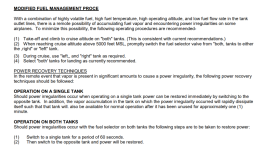
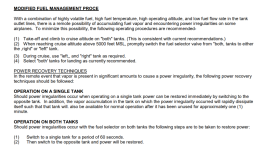
My bearhawk still isn't flying, but in my 170A the tanks are marked "No Take Off" when below around 1/4 tank. Also, it is placarded to not cruise with the 'both' setting. In fact the POH on a 1959 C172 says this:


172-fuel_orig.png

So, at least with my Cessna, if I use single tank operation and land at an airport with the fuel pump out of service, I can land with 1/3-1/2 a tank on one side instead of having both tanks at the "No takeoff" cutoff. Also, even through zillions of people have been flying them all over on 'both' for decades, there is a remote possibility of a vapor issue that can be resolved by switching to the other tank, which of course is only an option when on single take operation in the first place.

My GPS warns me every 15 minutes to switch tanks which means I am evaluating my fuel situation every 15 minutes of every flight which can catch other issues like a fuel leak.

So, in the case of my cessna (and I suspect there might be carb'd bearhawks in the same boat, but who knows) my argument is that having a completely separate fuel system to switch to in case of an issue, combined with at least one tank well above the 1/4 mark when landing in case I need to find fuel elsewhere, combined with a regular prompting to continually monitor my fuel situation is a reasonable case on why I believe single tank operation is safer than putting it on 'both' and pretty much forgetting about it.
 

Attachments

  • 172-fuel_orig.png
    172-fuel_orig.png
    408.1 KB · Views: 0
Heavy wing
When I was test flying my BH I noticed that in level flight the right aileron was reflexed slightly more than the left. Very long story short, it turned out to be the result of a heavy wing. Specifically 2.1 lbs of magnetometer and landing light in the left wing. It also showed up as a 12 lb higher weight on the left wheel at the W&B (a head scratcher), the result of my misplaced effort to minimize conduit runs. At that time we didn't realize the significance.

Steady heading side slip
To fly wings level required a very small right roll input. This generated extra drag on the left aileron with an accompanying left yaw and what is referred to as a steady heading side slip. Very frustrating. With wings level and ball centered, the aircraft would continually turn by a barely perceptible amount. With wings level and a constant heading the ball would be slightly out of center (the steady heading side slip).

The other frustration was that fuel would continually transfer (or draw unevenly) when in the BOTH position, in the direction of the ball.

It took a while to resolve the issue, and finally I was able to fly with the ball centered, wings level, and no accompanying fuel transfer. I mention this because it was my first experience with a persistent uneven fuel burn or transfer between tanks.
​
 
Last edited:
Nev I will ask in a post rather than a comment :)

What resolved the heavy wing? Can you go into more detail on the conduit run?
 
Nev I will ask in a post rather than a comment :)

What resolved the heavy wing? Can you go into more detail on the conduit run?

Kev D was a big help with rigging and reducing the heavy wing issue. A lot more info in the thread HERE, including how to raise the aileron hinge line with washers. I think the another solution would be to ensure both wings weighed a similar amount and I plan to explore this further. However I posted it here because it had a direct effect on the fuel system.
 

Interesting. Thanks for posting Schu!

It looks to me like Cessna designed an escape route for a vapor bubble that might form in the horizontal section of the fuel line. Liquid Fuel has a tough time getting around Vapor Bubbles that reside in a line.
 
Back
Top