Thank you all for the questions, I was able to call Bob this morning and get some clarifications.
First, the update has two main parts, the first being technique related and the second being the steel part. By all means, the first part applies to all of the planes. I don't know what happened from Grant's perspective and don't want to speak to that specific case, but generally speaking, Bob wants to point out that anything can be broken and everything has load limits. The concept of loading the tailwheel while it is sharply displaced applies to both the round and leaf spring types, generating both twisting forces and side loading forces. He says the leaf spring is better equipped to handle the twisting force, and the rod spring is better equipped to handle the side loading force, but both are susceptible to passing significant loads to the airframe in these cases. He imagines a scenario where the wheel encounters a rock or rut while travelling at some speed, creating a shock. Bob wants to emphasize that good pilot technique includes reducing force on the tail and taking it easy when making sharp turns in rough areas, and that applies to all of his planes and perhaps all tailwheel planes.
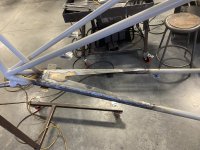
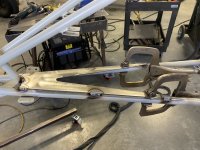
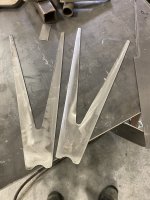
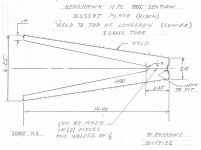
Regarding the second part (the steel), he only knows of the single case of damage, and wants to emphasize that while this is an easy mod to do in the factory for kits, or during initial construction for scratch builders, he doesn't think it is worth doing on kits that have already been painted, and certainly not on planes that have already been covered. He sees that this doubler is going to provide a very small gain, and while the cost of adding it during the bare-steel phases is equally small, it's not going to pay off otherwise. There are thousands of hours of successful tailwheel operation in both rough and smooth conditions, and there haven't been any other cases of this kind of damage yet. The longerons were initially designed with the knowledge that they would take some abuse, and they are beefier than many similar types of planes.
He says while the concept can be applied to the other types, the design would need to be adjusted. The angles will be different on all but the Companion, so the shape dimensions would need to be customized. For the thickness, he says on the Five he'd go up to .090 thickness, and on the LSA down to .060 due to the .035 longerons.
He says, "I don't want to promote everyone doing it, even on existing kits. There isn't enough justification to be going crazy over this, let's fly the airplane reasonably, because we've got thousands of hours of planes out there flying without it."




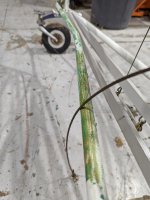
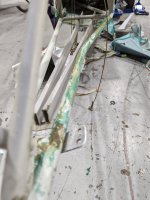
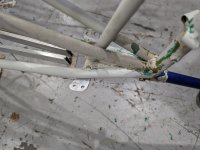


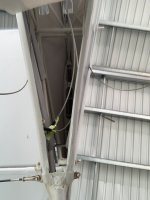




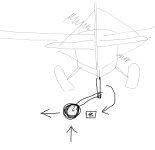
 ) of a Bearhawk viewed from behind, with the tailwheel sitting 90° off to the left side to illustrate and about to run over a bump. The result is a strong torsional force on the stinger being transmitted into the aft structure.