Bearhawk 4-Place Off-Airport Steering Technique and Tail Reinforcement

jaredyates

4-Place Kit Builder
Staff member
Here is a link:
http://bearhawksafety.com/4-place/august2022.html

Engineering Change from Bob Barrows

Due to one Bearhawk fuselage tail section being damaged in off-airport usage (gravel bar), we recommend the following:

When making sharp turns where the tailwheel is turned at 90 degrees to the tail spring, and the ground is rough, do your turn very slowly to reduce shock loading.

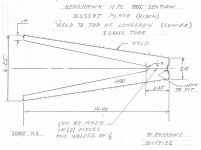
We have designed a reinforcement gusset to about double the strength of the tail section in this mode of overloading.
Click image for larger version  Name:	august2022.jpg Views:	0 Size:	759.2 KB ID:	76958
 
I wish this wasn't so vague. How did it fail? Did the longeron separate from the tail post?

I'm trying to figure out how this gusset makes sense with the description given. The procedure is to be careful with the tailwheel 90* from the fuse, which indicates twisting loads, but the gusset drawn doesn't really work on the twisting plane that much since .080 plate twists pretty well.

Looking more, how would this even fit on the top of the lower longeron given the cross tube in the way.

Wouldn't bushing the tail post make more sense?
 
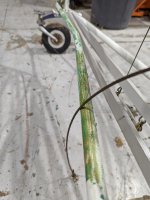
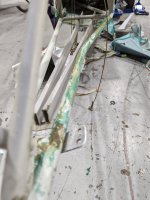
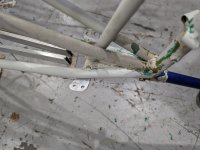
Based on the longeron damage on the Patrol project I bought, I think this mod should be considered for the Patrol as well as the 4 place.
 
  • Like
Reactions: Nev
Ummm …. I think this refers to my aircraft. If it does the damage was not sustained on a gravel bar. As it happened I had a very experienced Bearhawk pilot (read Battson) sitting beside me at the time saying the roughness of the strip was no problem. I believe he is correct for an A model leaf spring set up.
 
Thank you all for the questions, I was able to call Bob this morning and get some clarifications.

First, the update has two main parts, the first being technique related and the second being the steel part. By all means, the first part applies to all of the planes. I don't know what happened from Grant's perspective and don't want to speak to that specific case, but generally speaking, Bob wants to point out that anything can be broken and everything has load limits. The concept of loading the tailwheel while it is sharply displaced applies to both the round and leaf spring types, generating both twisting forces and side loading forces. He says the leaf spring is better equipped to handle the twisting force, and the rod spring is better equipped to handle the side loading force, but both are susceptible to passing significant loads to the airframe in these cases. He imagines a scenario where the wheel encounters a rock or rut while travelling at some speed, creating a shock. Bob wants to emphasize that good pilot technique includes reducing force on the tail and taking it easy when making sharp turns in rough areas, and that applies to all of his planes and perhaps all tailwheel planes.

Regarding the second part (the steel), he only knows of the single case of damage, and wants to emphasize that while this is an easy mod to do in the factory for kits, or during initial construction for scratch builders, he doesn't think it is worth doing on kits that have already been painted, and certainly not on planes that have already been covered. He sees that this doubler is going to provide a very small gain, and while the cost of adding it during the bare-steel phases is equally small, it's not going to pay off otherwise. There are thousands of hours of successful tailwheel operation in both rough and smooth conditions, and there haven't been any other cases of this kind of damage yet. The longerons were initially designed with the knowledge that they would take some abuse, and they are beefier than many similar types of planes.

He says while the concept can be applied to the other types, the design would need to be adjusted. The angles will be different on all but the Companion, so the shape dimensions would need to be customized. For the thickness, he says on the Five he'd go up to .090 thickness, and on the LSA down to .060 due to the .035 longerons.

He says, "I don't want to promote everyone doing it, even on existing kits. There isn't enough justification to be going crazy over this, let's fly the airplane reasonably, because we've got thousands of hours of planes out there flying without it."
 
He says, "I don't want to promote everyone doing it, even on existing kits. There isn't enough justification to be going crazy over this, let's fly the airplane reasonably, because we've got thousands of hours of planes out there flying without it."

Appreciate the clarification. I was dreading stripping and re-primering/painting that area. I doubt I could get as good a finish as the factory and that area seems like it gets beat on and weathered pretty good, I'm pretty concerned about corrosion there. Given the service history as Bob suggests I'm comfortable not going to the effort on my bravo fuselage.
 
Can I safely assume that for those of us awaiting our kits that this will be incorporated into the kit?

Dave
 
I see both longeron tubes are bent there, as well we several other tubes. I doubt this mod could have avoided that - the whole structure has been overloaded. It looks to me like that fuselage suffered a very serious hit - I doubt any level of practical design would have avoided that kind of damage.
 
For sure, only so much can be done... If you apply enough force, you'll bend or break something. However, there doesn't seem to be much structure to resist side loads on the tailwheel. The longerons span a fairly long distance from the tailwheel attach bracket to the next cluster. This aircraft was ground looped by its original owner/builder; I've seen a lot of other tube and fabric aircraft endure ground loops without sustaining such damage from the tailwheel side load.
 
As it happened I had a very experienced Bearhawk pilot (read Battson) sitting beside me at the time saying the roughness of the strip was no problem. I believe he is correct for an A model leaf spring set up.

After more consideration, my current thinking is this:

The impact we felt in the cockpit was softer than I'm used to, because the stinger is very good at absorbing impulsive forces from the side. The stinger soaks up the energy slowly, so the acceleration felt in the cockpit was less. However, the maximum force applied was clearly severe, despite the fact the force was applied relatively slowly (low acceleration).

I think the same hit would have felt much harder with a leaf spring. There's less flex in the leaf spring side to side, so less shock absorbing to the side. This means the pilot feels more acceleration, because you come to a sudden stop, even though the forces applied at the tail to create the stop, are considerably lower (i.e for the same level of felt impact on a stinger, the plane has to be moving more quickly when it hits something).

That'll be why my first reaction was nonchalance - it didn't feel that bad. But I was judging the stinger using a leaf spring reference point, apples and oranges.
 
Yes. Even though 90+% of Bearhawkers will never have their planes off airport in the kinds of places that could cause this damage - we are installing this gusset on all the Model 5, Companion, & Model B four place kits from now on. Maybe the Patrol kits as well if Bob gives the order. Mark
 
I wonder if that tailwheel didn't get to go 90 deg, because for whatever reason it was wedged, there was a rock just to the side preventing it from rotating - or debris made it unable to rotate at a rate that was demanded by the rate the tail did turn . There's nothing to say the tailwheel rotated to roll in the direction of the turn vs being dragged/forced up and over an obstacle perpendicular to the tailwheel rotation.... right?

So just to help understand the situation:
-what was the ground surface like? (you said it wasn't a "gravel bar")
-would you say you were beginning a turn after going straight OR were you already well into turning the tail around before the "impact" you felt?
-afterwards when inspecting... does the tail wheel pivot to change direction freely as well as roll freely?
-did you swing the tail around, with or without any attempt to "lighten" it?
-you talked about the aircraft previously going through a ground loop and how other's can do that without damage... if I'm inferring correctly.. would you please elaborate on what the existing damage then was to the tail prior to this incident, if any was noted/observed?
-how interesting was the flight home after this?


The gravel bar / ground loop questions revolve around who ever this happened to bkyser or Bissetg, and Battson...
 
Last edited:
The pictures I posted are of a Patrol that was ground looped. Those pictures are not of the 4 place that was damaged off-airport.
 
thank you bkyser! I know it has absolutely no weight, but just curious if you had a leaf/roud or t3/stinger tailwheel?

-I guess that means an add on.. it'd be nice to see pictures of what happened with Battson and Bissetg :D
 
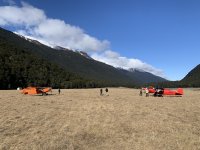
This is where the damage occurred, on the left hand side of the picture in the foreground is a hole or rut that neither Battson or I saw.

9AADF247-649C-464B-BBE9-EA5A7D0684E4.jpg

Below you can see the bend in the LH lower longeron, my advice was to straighten the tubes and add structure to share the load between the two lower longerons, Bob has approved me doing a diaphragm gusset with lightening holes between the longerons from the front cross tube and the rear cluster.

From an airmanship point of view coming to a stop on the airstrip and pushing the aircraft off is far better than taxiing on rough ground or doing a tight turn that has the potential to side load the stinger excessively.

7991C4A4-FD85-44CA-AE45-D1483A9D444A.jpg
 

Attachments

  • 7991C4A4-FD85-44CA-AE45-D1483A9D444A.jpg
    7991C4A4-FD85-44CA-AE45-D1483A9D444A.jpg
    1.4 MB · Views: 0
Last edited:
Very interested if any others have had damage to their tailwheel assembly or the rear structure. It would be good to see other data points.
 
The bump was felt part way though the the turn, I’ve put a pic of the location of the damage in the post below.
 
From an airmanship point of view coming to a stop on the airstrip and pushing the aircraft off is far better than taxiing on rough ground or doing a tight turn that has the potential to side load the stinger excessively.

For the benefit of others reading this (and none of this is Bearhawk specific):

Shutting down and getting out to push is a great idea if someone taxis into "no man's land". It's embarrassing but worth the price.
Taxiing straight ahead or making slow sweeping turns is extremely unlikely to cause any damage.

Particularly when small groups of aircraft are flying together though, shutting down to line each plane up on the end of the airstrip is impractical, so we usually swing the tail around under power with great care. Planning the turn before getting into the plane is important.

For those who are wondering how this damage happened:
In this case we wanted full length on this short airstrip. We had to taxi between two spinning props so needed to continue a little further than planned, to make room for the turn - taking us off the end of the airstrip. Then we were forced to taxi a little further still, to miss a hole we could see (getting into no man's land at this point). Finally we swung the tail around rather quickly and hit a different hole / obstacle we could not see. I had a good look at the area before the turn.... This is always the risk with grass airstrips - grass hides things very effectively, even snow-flattened dead grass. Each airstrip has so many hazards.

It's preferable to walk the airstrip (or know the airstrip intimately) and decide where to turn / taxi before starting the engine.

Off airport operations are all about ground handling, as boring as that sounds. Until you touch the ground, you aren't off airport.
 
That is correct, it’s important to understand that beefing up the aeroplane is not a substitute for good airmanship. Side loads on the tail stinger should be kept to a minimum.
 
Further to my repair above, the reason I’m doing a full diaphragm gusset with large lightening holes of .063 and not what Bob has proposed is not because Bobs solution isn’t a sound one, it’s just that having suffered damage in this area and repaired it, having the option to do a larger mod that spreads the load more for a small weight penalty seems like the right thing for me to do.
 
The first Super Cub I ever restored was a 1957 PA-18A. I was literally putting on the last wing inspection panel when a local rancher heard about it and came into the hangar...he purchased the airplane and flew it back to his grass strip in front of his house in western Nebraska. Upon landing, with family and friends there to see the new plane, he spun the aircraft around to tie it down but caught a metal "T" post that had been cut off and was hiding in the grass. He just caught the lower longerons about 12" ahead of the tail post and the fence post sliced through about 75% of the tubes...the Rancher just thought it was a bump...until he got out and the tail was bowed severely because the lowers buckled and the uppers bowed. He was hot rodding it or doing anything he hadn't done 1,000 times but just forgot that the stupid post was there. My takeaway was that of the above comments that airmanship and ground handling are equally important! Back country flying also should change the interval and type of inspections you do...in other words a pre and post flight might look at the tail wheel area a little differently...trying to detect damage before it propagates.

Andy
 
I am having a hard time with this one. I will look at my fuselage in the morning. At the moment, the only way I can think this can happen is with repeated, massive side loading. With vertical loading the lower longeron should be in tension. I can't see a way to load the tailwheel negative in the vertical to put the lower longeron in compression.
 
When the tailwheel is loaded with a large side force, a bending force (torque) is applied to the lower longeron. Tension and compression are not the whole picture. You need to consider the three axis of torque applied, as well as the three axis of forces, and then buckling calculations, rather than just linear force calculations, to resolve the stresses in each member.
 
Last edited:
If you haven’t yet covered your fuselage, support the rear fuse so the tail wheel is off the ground and give the tail stinger a wiggle from side to side and you’ll see how it works. Repeated massive side loading is not required.
 
I am having a hard time with this one.

You're not alone here, it took me a while to get my head around this. When the tailwheel is at 90° as in a tight turn, the normal weight of the aircraft is acting vertically downward on the stinger, but because the wheel is now off to the side it is inducing a torsional (rotation) force through the stinger up into the longerons.

In addition, if the wheel then hits a bump, it induces a lateral force pulling the stinger in one direction and transferring the opposite force into the longerons. However a lot of what would be a lateral force is also turned into a torsional force and added to that caused by the weight. Particularly if it's a sharper "bump" the resulting loading could be quite high. Whereas the leaf spring may have dissipated some of the torsional stress, the stinger doesn't do that so well.

Heres a novice drawing (not to scale and possibly with the authors new 29" ABW's on :rolleyes:) of a Bearhawk viewed from behind, with the tailwheel sitting 90° off to the left side to illustrate and about to run over a bump. The result is a strong torsional force on the stinger being transmitted into the aft structure.
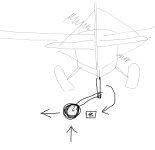
Click image for larger version  Name:	A731D58C-4179-4DA6-A3D9-1922C5EF289A.jpg Views:	0 Size:	120.1 KB ID:	77042
 
Last edited:
I think Nev had the same art class as I did :rolleyes:

Joking aside, the drawing and explanation make sense. I have been trying to figure out how this happened. Certainly a case can be made for lightening the tail when making tightish turns on unimproved strips.

It also seems from Battson that it was a bit of a perfect storm that created this one off issue
 
Last edited:
For what it is worth. imho not the tail post but the lower longerons SO yes But NO. Haha :-)
It may add more material thus weight.
 
I think Nev ertainly a case can be made for lightening the tail when making tightish turns on unimproved strips.

One thing I would say about this, it totally depends on the surface you're working on. Different approaches are needed for sand, gravel, rocks, and grass.

I never like pushing forward on the stick while taxiing off-airport, you're asking to damage the elevator or trim drive - this can happen in several ways. I prefer to turn slowly if possible, but it is not always possible.
 
I think Battson is right, forward stick while taxiing is fraught with risks of other sorts. I think if in doubt jump out and man handle it. It’s not like we are burning $$$ on start cycles. We all want to look out for ourselves and others so taking a little longer in order to protect our airframes shouldn’t be too onerous.
 
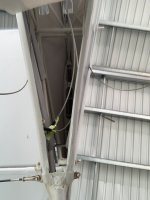
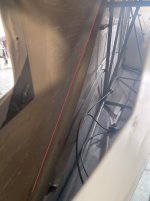
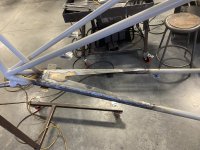
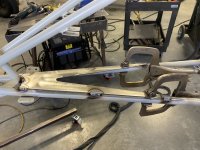
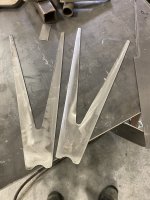
In case it helps anyone, I just welded in the gusset as cut to Bob’s specs for the 4 place. As I have a patrol kit the angle is slightly different but it works fine as is.

note : I cut two because I owe a guy. Only one per tail.
pb
 

Attachments

  • 60F51718-0C92-4DAB-9C86-0968B5D46592.jpg
    60F51718-0C92-4DAB-9C86-0968B5D46592.jpg
    2.2 MB · Views: 3
  • 49DCAC88-198B-460C-9588-50738E150D62.jpg
    49DCAC88-198B-460C-9588-50738E150D62.jpg
    2.1 MB · Views: 3
  • 627F6EF1-5F97-4B42-B956-592A863E9188.jpg
    627F6EF1-5F97-4B42-B956-592A863E9188.jpg
    2.5 MB · Views: 3
If I understand Mark Goldbergs' msg about his recent factory visit, this reinforcement wll be on all the kits shipped out this upcoming February...:cool:
 
If I understand Mark Goldbergs' msg about his recent factory visit, this reinforcement wll be on all the kits shipped out this upcoming February...:cool:

Yes that’s correct. This is just for those in process that plan to add.
 
Actually, that tail longeron reinforcement has been on kits in the last shipment and the one around the end of this tear. What will not be on the kits until February is the boot cowl improvement. Mark
 
Back
Top