Fuel Flow Discussion, Moved from Float Mounting

The reason the both position was introduce was because some pilots are very bad at doing coordinated turns and say a Cessna 180 (without header tanks)
will simply have the engine stop if you do that (cross control a turn). I demonstrate this to any 180 guy I check out.
They learn to fly coordinated much easier after :)
You are correct People are not good with Checklists and procedure that is where annual training comes in. Do all the emergency training you can think of once a year. After a few years it is super easy and will stick with you so when you need it it comes naturally.
If you live and fly long enough you probably will have it happen to you so be prepared.( Cessna fuel systems are infamous for venting issues) The only person who can save the day is the pilot in command. Personally I have no issue with just having a right and left position. None of our aircraft have a both position. What ever you fly know your system and learn to use it safely. Extra venting and Balance tubes can help.
At the end of the day it is you as pilot in command that is between you and your beautiful homebuilt rolled up into a ball at some undesirable location.
 
Last edited:
Lots of great info and experience. I got a lot out of this thread,

I only flew light GA for 80 hours in the early 80's. Almost all low wing. L or R only. I ran a tank dry once in 80 hours, nothing bad happened, luckily. I flew for a living for 31 years, and only had to manage fuel for 1 of those years as a flight engineer. 500 ish hours. In 500 hours I screwed up fuel management twice, which was about average. Again, nothing bad happened other than a bruised ego. The other 30 years it was all automatic. Never had a problem.

Apparently I am not smart enough to manage fuel. I prefer BOTH.
 
This has been a long thread and I have been watching it with interest. Wow! There are certainly a lot of things to consider! I am thinking of a situation that has not been brought up. (or at least if someone did, I missed it) Here goes:

Suppose you are flying on a long trip, and coming in to land with low fuel. You have a fuel selector with only left/right positions. You have selected the LEFT tank...let's say there are only 5 gals in that tank. (pushing your luck...probably not recommended) As you are making your turn to final you notice that you are way too high with full flaps already extended. So you go to a full pedal forward slip to lose altitude...it's how it's done, right? Right rudder, left aileron...it's fun, right? You notice that the ball is way over to the left...what might not be realized is now the fuel in that LEFT tank is doing the same thing as the ball on your slip/skid indicator. it is moving to the far left side of the tank. How long before both of the fuel pickups in that left tank are unported and you start picking up air?? Who knows. Maybe you won't have to hold that slip for long and everything will be fine. Maybe not. This is one reason (a good one I believe) for having a fuel selector with BOTH positions. I think the uncoordination thing is a big deal.
 
Can someone give a list of planes that have;
1) A fuel system that allows for "BOTH"
AND
2) Does NOT have interconnecting tanks?
AND
3) Requires a fuel pump for normal operations.

I'm sure I could do the research, but without a floatplane I am traveling by speedboat which cuts into my free time!

www.amazonsaltandlight.org
 
I've been in that scenario many times, same as thousands of other pilots. It's up to the PIC to use their brain and not cause an engine out. When slipping to a landing always make sure to select the uphill tank. Or don't slip. Luscombes have no both position, no flaps, and glide forever; slips are a regular part of landings. With a measly 25gal of fuel it is common to land with little fuel on board while on a cross country.

However, with a carbureted engine at idle you have quite a while before the bowl is dry and and engine quits. If your on a 2 mile final in a hard slip to get down to the runway you might need a little refresher training😉
 
I like the perspective Battson shared here. Recent experience has taught me how true it is that people are forgetful and prone to tunnel vision. Those two things can lead to very costly mistakes. A proficient pilot probably has sufficient excess brain power to easily manage fuel. A pilot that is minimally proficient might get task saturated just flying the airplane and can't handle managing fuel.

Adding a cross vent with a check valve like a Cessna is so easy I'm starting to think maybe I'll add one to my plane.
 
Can someone give a list of planes that have;
1) A fuel system that allows for "BOTH"
AND
2) Does NOT have interconnecting tanks?
AND
3) Requires a fuel pump for normal operations.

I'm sure I could do the research, but without a floatplane I am traveling by speedboat which cuts into my free time!

www.amazonsaltandlight.org

I certainly can't. I doubt such an animal exists.
 
No fuel venting system is going to be perfectly symmetrical: different lengths, different bends, bugs, etc. The recommended fuel caps for the Bearhawk have the potential to aggravate the situation if they are not both machined exactly the same AND installed/aligned exactly the same. That is a small airfoil on the top of the cap; turn it slightly and you switch from pressure, to less pressure, to suction. Thank Bernoulli for that. All of the external venting components are affected by the relative wind angle & velocity, so you will never have equal pressure in tanks that do not have an internal cross-vent. Fuel pump presence or absence is irrelevant to this issue.
 
In my first homebuilt I had 1/4” vent tubes with a bulb of screen wire protecting the entrance from insects. No cross vent tube. Ran on both for 400 hrs w/o a problem. However, I have often thought that the small Bearhawk cap vents could be plugged by a direct strike from a fat, juicy bug. While it hasn’t happened in 200 hours (running on both), this discussion has convinced me to install a cross vent tube at the next annual—just to be safe.
 
Put it near the filler neck. Debating whether to even finish with a tube poking outside, but then this would also be subject to icing. Once I get one in hand and can do some testing I may decide to just have it terminate inside the wing with a weep hole in the skin, of course zero fuel/vapors dumping inside a wing bay would be the requirement.
 
If I don't like how this one works I can just machine my own, just one more thing to design and test though....
 
whee, if you're on a 2 mile final and need to slip, you don't even need the engine at that point! haha.

For left/right say a 40 gal tank burning 10 per hour, you'd takeoff on the Best tank(might on might not be a thing depending on aircraft) lets call that the left. At a safe altitude, switch to the right, burn an hour, back to left, burn an hour, back to right, burn until the engine sputters, then land on the right with a full hours of gas and more fuel in a tank then if you split that 10 gallons into 2 tanks.
 
Such an airplane would not meet the old FAR 23(or any of the CAR's) and I doubt it'd meet the new one either. So I would venture one does not exist.
 
Last edited:
I like data and I like declared known best practices.....standards. Without data problems cant be defined. Can we get more data? Thank you those who fly Bearhawks who contribute. Can the silent of the 100+ Bearhawk owner operators help here?

If BOTH is selected then a significant imbalance between the tanks indicates an air pressure imbalance exists. Is this common? Can we collect data in order to discover if a fuel imbalance is common (when using both)? Can, a value be declared or a limitation set to define a significant imbalance? For example, The max imbalance allowable imbalance when BOTH is selected is 7 gallons.

Fact, It is possible to see the fuel tank pressure and how it changes and what factors effect the pressure inside a tank. It seems like folks could put a TEE at the top sight gage bung and hook up a VSI, Altimeter or a manometer.

Like I said, I like data.

Here is an accident report of N22GM. Next week I'll search more of the FAA data base, but I thought this one relevant.
https://app.ntsb.gov/pdfgenerator/R...D=20190327X81141&AKey=1&RType=Prelim&IType=LA
 
Last edited:
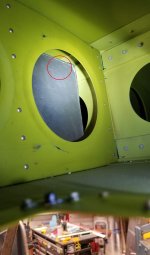
The owner of that plane told me after the accident that he felt the problem was the electronic ignition. He was not sure, but felt that since the engine did not stumble on its way to shutting off (it was just an immediate and sudden stoppage) that the problem was electrical. Mark
 
He had EFII on that right?
Theres a history of electronic fuel injection and improper wiring causing that to happen. It would suddenly shut off if it was the ignition or fuel injection.
 
Whee, were those experiences in your own Bearhawk? I'm thinking like Battson on this. His revamped experiment with the glass over head, straws on the bottom. This is a very interesting subject, as Im running EFI with returns to the wing tanks and no header tank. There are many different scenarios in these posts with few spelled out. The only things I can see that would cause more fuel in one vented tank is plugged vent, flying uncoordinated and possibly the differences in pressure at the vents due to the prop wash. A long prop like yours might cause less/low pressure on one side for your tank vent. A crossover tank vent would equalize both tanks. Just thinking, and considering here.
 
I would have thought, the gravity of the fuel in the fullest tank would overcome any possible difference in tank pressure.
 
As I keep reading posts, this cross vent would be a good safty feature if you should happened to plug a vent with bugs or whatever. And that also reminds me of them damn mud dobbers!
 
I read the NTSB report a couple of times before. It doesn't seem like the Feds want to spend much time analyzing EAB accidents. Not much useful information. I am pretty sure their description of the "Emergency Power Switch" is way off.

N22GM probably had a complete dual EFII system. It is very redundant (more than I actually require) Other than an electrical feed or fuel problem, the only single failure that makes the engine go quiet is the Crank trigger (Hall Effect Sensor).

Just not enough info in the NTSB report. Too bad. Thats what those reports are for. So the rest of us can learn something.
 
If you do not have both, then a header tank makes sense. the exact reason I am using a two Gallon header tank. I will not have a problem slipping my aircraft and un porting will not influence it. Having larger vent lines will make sure that the header tank stays filled at all times. put an opened beer can to your mouth upside down. then stab a hole in the bottom which is now on top. hope you can swallow fast. it will be down your throat before you know it. Make sure you vent the header tank well, I have two 1/2 inch vent lines, one to each wing tank. One will always be higher than the other because one is in the front left corner and the other rear right corner. any bubbles from air entering the fuel system because of un-porting the main tank will go up and out the highest vent line and breath back to the main tank, it will also make sure that the header tank stay full as you resume normal flight, if you crash and your aircraft's belly is ripped open ripping of your fuel selector, you will have your two main tanks spilling their fuel out at an alarming rate below the floor and have exactly the same problem I have using the header tank. this is a very interesting read, lots to consider.
 
Not to keep beating the poor horse but I was just browsing my Bingelis Firewall Forward book when I ran into a paragraph stating that any fuel system with tanks that feed simultaneously MUST have a cross vent to feed equally. I think I’m pretty well convinced at this point.
 
A lot of efi systems do not get installed correctly leading to loss of power. We can't really say here but it's quite common.
 
Bob has made some suggestions for flying your planes:

OPERATION OF BEARHAWK FUEL SYSTEM

Take off and land on Both at fuel valve selector.. Be sure
both tanks have fuel in them.

Cruise can be on left or right to insure both tanks have fuel in them.
Both can be used if flow is about even.

In rough air on landing stay high, do not drag it in if fuel is low.


Bob has no problem with any of us adding a vent tube between the two tanks. With a gravity flow system, he does not think it needed. But no harm for sure except the following point. If you do add a cross vent tube, you will have fuel coming out of the gas caps if you park the plane on a slope. Without the cross vent, you can just turn the selector valve to off.

Bob understands that having any fuel pump, especially the higher pressure pumps used with fuel injected engines - will suck air and not fuel if given the opportunity. He thinks the Continental fuel injection system might be a little worse in this regard than the Bendix system used on Lycomings.

He feels with low fuel level in the tanks, slipping or skidding (or even rough air) while on approach to landing can cause an interruption of fuel flow. If you think about being in a bank and slipping or skidding so the fuel in the upper wing tank sloshes outboard could un port the fuel outlets. Mark
 
Or they follow the installation instructions without an understanding of the design and how different platforms will affect it's performance.
 
I am considering install of the crossover vent from top of sight glass connections, with a small Parker shut off valve for parking unlevel. Crossover may not be needed, but shouldn't hurt anything either. I'll add it to check list. I do return more fuel to the right tank maybe a crossover will help with that.
 
I read about someone that had a valve on the crossover. I can't remember if it was certified or EAB. I think I might do the same.
 
Would putting the crossover vent attachments at the top outside corners of the tanks help with fuel inadvertently transferring?
 
Just an fyi, not all fuel sector's "off" will prevent cross flow. For example on a maule you have to put the selector in r or L to prevent cross flow. Off just blocks the port going forward but is just as open to both tanks as the both position is.
 
Then you have to think about how to purge fuel that gets into the low spots or you'll not be equalizing the pressure between tanks.
 
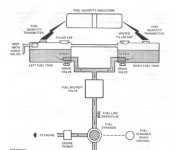
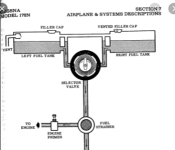
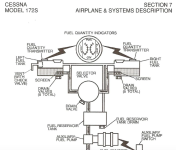
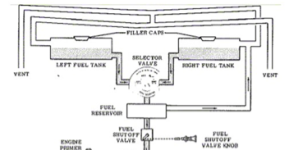
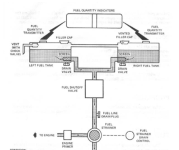
Here is a collection of fuel tank diagrams of certified aircraft I found on-line that I thought may help visualize this discussion.

Below is (with a 95% confidence feeling) a C-152. Lycoming O-235 engine. The C-152 merely has a shutoff valve, so its always on BOTH. One vented cap + a cross vent + a tank vent with a check valve.
Click image for larger version  Name:	Screen Shot 2020-02-06 at 11.00.26 AM.png Views:	0 Size:	167.1 KB ID:	52566

Below is a Cessna 174N with one vented cap. The C-172 N has a carbureted Lycoming O-320 engine.

I note two things here, the cross vented tanks and the vent line between the fuel supply line and the cross vent. I see this on all the later model Cessna's, C-172's, 180's, 182's, If parked on a left leaning slope, some fuel will drain from the right tank. If the vent line was run back to the right outboard of the right tank it would not drain out. What happens if the check valve fails closed? The R tank's vented filler cap should relieve a pressure differential.

Click image for larger version  Name:	Screen Shot 2020-02-06 at 11.00.26 AM.png Views:	0 Size:	167.1 KB ID:	52566


Cessna 172S. This is the latest model of C-172 that has a Lycoming IO-360 engine instead of a carburated O-320. Cessna designed the system with a header tank (fuel reservoir tank). Note how the header tank is vented. I don't see vented fuel caps on this application. What happens if the Left tanks vent's check valve fails closed? I think negative pressure would build up and the engine would fail with fuel in the tanks. I question if the schematic is accurate by showing the unvented fuel caps.

Click image for larger version  Name:	Screen Shot 2020-02-06 at 11.06.18 AM.png Views:	0 Size:	312.0 KB ID:	52567

Cessna 177 Cardinal with header tank. Cardinals were made with both carberated and injected Lycoming 360 CI engines. I'm not sure which one this set up was designed for. No check valve. No vented caps. Will fuel drain onto the ground if parked on a slope? I don't think so.

Click image for larger version  Name:	Screen Shot 2020-02-06 at 11.00.26 AM.png Views:	0 Size:	167.1 KB ID:	52566


Cessna 182S with a 230 hp Fuel Injected Lycoming IO-540 engine. Note fuel venting is all over the place. It has two vented fuel caps, a cross over vent, fuel supply lines vented, and a vent in each tank. This fuel system does NOT have a header tank.


What conclusions should we draw?
 

Attachments

  • Screen Shot 2020-02-06 at 10.47.39 AM.png
    Screen Shot 2020-02-06 at 10.47.39 AM.png
    58 KB · Views: 1
  • Screen Shot 2020-02-06 at 11.00.26 AM.png
    Screen Shot 2020-02-06 at 11.00.26 AM.png
    167.1 KB · Views: 1
Last edited:
So I think the conclusion is, if you have fuel injection - you NEED to install these vents to be on the safe side, or avoid unbalanced flight if you have a low fuel tank.

I wish I knew this before the plane was assembled! Going to be a difficult mod to get right without easy access.

That said, I slip all the time with low fuel, I have no cross vent and never had a problem with the Bendix system... because I never had a blocked vent. If the vent blocks, then I run the risk.

"To be on the safe side" is a great way to add unnecessary weight to an airplane.

​​​​​​Fuel injection doesn't inherently necessitate a cross vent. If you're worried about differential pressures there are simpler ways around that.
 
You mean like carrying two complete independent ignition systems, stabilizer struts as well as flying wires, tires larger than really necessary, a backup battery for electric ignition?
Sometimes you need an backup plan.

Clearly this is a real risk, we have two firsthand accounts right here. So anyone with fuel injection should be worried about differential pressures - especially high pressure systems.

If a mason bee lodging itself in a tank vent can bring the whole plane down, then I'll be installing a backup system.

What are the "simpler ways around that" - I am keen to hear what other options I have, which are simpler than a bit of tube between tanks.

The designer who made one of those decisions also said a cross vent isn't necessary. The risk is there fuel injection or not. But I'm sticking with gravity feed to the pumps so my solution would only be applicable to a otherwise gravity fed system, if you're sucking at the pump good luck and I don't see a cross vent affecting that anyway off the top of my head.

My solution is a check valve on each tank, ones that open at a pressure well below the pressure head of the fuel. Air gets in if your cap vents get clogged, doesn't let fuel out, doesn't remove your ability to isolate tanks on a slope, and won't let fuel settle in a low point for those wanting to go outboard side to outboard side with their cross vent (dihedral isn't shown in any of those fuel diagrams).

Not 100% on this solution but it's where I'm leaning.
​​​​​​
 
There is still confusion on this topic but I don’t know how to resolve it.

The issue has nothing to do with a pump sucking air. It affects both gravity feed carburetor systems and fuel injection systems. Matt’s failure was with Continental Fuel injection. The two times I experienced the failure it was in a Lycoming O360 powered plane. Bendix fuel injection might actually be more tolerant of this issue because of the types of pumps used.

The issue is having the higher air pressure in the airspace of one tanks vs the other. IDK how you equalize the pressure in the airspace of each tank without connecting them.

Putting a check valve in the cross vent line, like pretty much all certified high wing planes do, easily solves the parking on a slope fuel transfer issue. Worth nothing that most fuel valves connect the tanks together when in the off position so you need to put the valve in either right or left when parked on a slope to prevent fuel transfer even if you don’t have a cross vent. Or verify that you valve maintains tank isolation when in the off position. My SPRL valve connects the tanks when placed in the off position.
 
Correct, I only mention sucking pumps because I haven't looked into that at all, since it's not what I'm running. You can equalize the pressures by having them vent to the same open space.
 
I understand you are not a 'gravity feed' fuel system if you need pumps to keep the engine running. You are pumped. In that case, you run the risk of losing all fuel supply to the engine, if one vent is blocked.
 
My solution is a check valve on each tank, ones that open at a pressure well below the pressure head of the fuel. Air gets in if your cap vents get clogged, doesn't let fuel out, doesn't remove your ability to isolate tanks on a slope, and won't let fuel settle in a low point for those wanting to go outboard side to outboard side with their cross vent (dihedral isn't shown in any of those fuel diagrams).

Not 100% on this solution but it's where I'm leaning.
​​​​​​
The check valve idea is interesting, and I am especially tempted because the cross vent would need a check valve anyway.
However, I am not sure whether I would trust a check valve in my main fuel line - seems to introduce another potential engine-stopping failure point.
In the vent line, a failure of the check valve is less risky.
 
Last edited:
It affects both gravity feed carburetor systems and fuel injection systems. Matt’s failure was with Continental Fuel injection. The two times I experienced the failure it was in a Lycoming O360 powered plane. Bendix fuel injection might actually be more tolerant of this issue because of the types of pumps used.

I understand your machine had some other kind of vented cap, where the vent is not pressurised by ram air. It was unwritten, but I have assumed that unpressurised fuel cap must have played some part of the cause of the issues with your last plane. Set me straight if you see fit.

I think we've established that with a gravity system conforming with Bob Barrow's design and with his design of fuel cap, the risk is negligible. As ever, it appears Bob is exactly right, let's be clear on that. We have no evidence of failure in a system entirely as Bob intended it. Bearhawk Aircraft has always been very clear that we diverge from Bob's approved design at our own risk. So here we are.

With a conventional design, gravity feed system, it appears the chances of a failure seem almost impossible when you run the numbers. The engine needs so little fuel pressure to run and one of the tanks is always under some pressure, which reduces the risk further.

In post #81, I drew the conclusion that fuel injection means you need to install this vent. I think that was jumping two steps ahead when I meant to just take one. I think all we can say for certain is, some fuel injection systems are at-risk of this failure, the high pressure ones. We actually have no evidence to suggest Bendix systems are at risk.

Similarly, I didn't say that ONLY fuel injection systems are at risk. There are a million ways to design a dangerous fuel system, and only a small number of ways to make an inherently safe system.
 
The check valve idea is interesting, and I am especially tempted because the cross vent would need a check valve anyway.
However, I am not sure whether I would trust a check valve in my main fuel line - seems to introduce another potential engine-stopping failure point.
In the vent line, a failure of the check valve is less risky.

Yeah I was thinking a check valve in a separate vent line that terminates inside the wing with a weep hole just in case, I described it in a comment a bit ago. That would solve the clogged cap issue but the commercially available ones I've found have opening pressures slightly too high for a reversed vent case so I'm considering making my own.

Here's the one I was looking at https://www.mcmaster.com/5492k51

ETA: I think the risk for my system is low enough for the reverse vent case though, fleet history being what it is in addition to my analysis. My main concern is icing since two clogged vents will take you out of the sky.
 
Last edited:
I understand your machine had some other kind of vented cap, where the vent is not pressurised by ram air. It was unwritten, but I have assumed that unpressurised fuel cap must have played some part of the cause of the issues with your last plane. Set me straight if you see fit.

I think we've established that with a gravity system conforming with Bob Barrow's design and with his design of fuel cap, the risk is negligible. As ever, it appears Bob is exactly right, let's be clear on that. We have no evidence of failure in a system entirely as Bob intended it. Bearhawk Aircraft has always been very clear that we diverge from Bob's approved design at our own risk. So here we are.

With a conventional design, gravity feed system, it appears the chances of a failure seem almost impossible when you run the numbers. The engine needs so little fuel pressure to run and one of the tanks is always under some pressure, which reduces the risk further.

In post #81, I drew the conclusion that fuel injection means you need to install this vent. I think that was jumping two steps ahead when I meant to just take one. I think all we can say for certain is, some fuel injection systems are at-risk of this failure, the high pressure ones. We actually have no evidence to suggest Bendix systems are at risk.

Similarly, I didn't say that ONLY fuel injection systems are at risk. There are a million ways to design a dangerous fuel system, and only a small number of ways to make an inherently safe system.

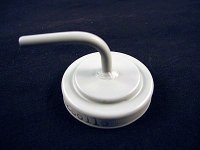
The caps were ram air pressurized. Same function as the Bob caps just a different form. The fuel system was built exactly as Bob specified except Bob caps were not available so a conventional cap was used. See pic of the conventional cap style cap.


U286116__92249.1368114694.1280.1280.jpeg - Click image for larger version  Name:	U286116__92249.1368114694.1280.1280.jpeg Views:	0 Size:	24.6 KB ID:	52609
 
Last edited:
The caps were ram air pressurized. Same function as the Bob caps just a different form. The fuel system was built exactly as Bob specified except Bob caps were not available so a conventional cap was used.

Picture seems to have failed?

Did they also have the o-ring seal to ensure the tank could develop positive pressure? As the air rushing over the tank could theoretically develop suction, if the vent blocked.

This is all getting quite theoretical and esoteric, it makes it hard to discuss!
 
I think I fixed the pic.

Theses "snorkel" style caps use either a cork or rubber gasket and their function is indeed to provide positive pressure inside the tanks.

I'd offer to induce the failure in my own airplane and video record it but since I have Continental fuel injection it would be of little value to anyone and the failure would probable get attributed an incompatibility with my FI. This summer I'll be testing an LSA. If I get feeling brave maybe I'll induce the failure in it and record it. But it is scratch built...:rolleyes:
 
Cessna fuel systems are pretty Googleable. It is amazing how they evolved over the years. They didn't get simpler. I guess over the years the fleet got so many hours they kept finding a new corner of the envelope where the system didn't quite work.

I think I do want some additional venting. Right now I think I will just go with the cross vent in the middle, maybe with a shutoff valve. Mostly because it is easy to implement. I am not sure it is the best. I really like the Cessna 182S venting, but at this point it looks too hard to do. Maybe next time.
 
Sure the engine isn't gravity fed but the pumps are, verses pumps that are sucking fuel. The pressure differential in the tanks isn't more than the pressure head at the fuel selector. There's no difference between a gravity fed pump and a gravity fed engine at that point, and one clogged vent shuts off that tank after a while. I don't know what would happen with a pump that is sucking fuel, but I think it could only be worse.
 
This is all getting quite theoretical and esoteric, it makes it hard to discuss!

Battson, what is not theoretical and esoteric to me is your fuel system in your aircraft has proven itself to be dependable. You fly in BOTH and you know what a normal fuel balance is. In the future if you see an abnormal fuel imbalance, then a fuel venting problem may caused the imbalance. Be suspicious of the fullest tank. Switching from BOTH to the LOW tank might be prudent.
 
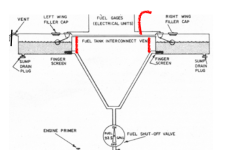
Something like this is pretty non-invasive. This suggests fabricating and installing a cross vent between the top sight tubes, adding a vent like Whee's fuel cap nozzle on the cross tube and placing it at the wing root faring, plus adding short vent lines between the rear fuel supply lines and the cross tube.

Alternatively the atmospheric vent for the tank interconnect vent could be run outboard of a tank and down through the bottom wing skin as long as the the atmospheric vent line rises above the highest point in the tanks.
Click image for larger version  Name:	Screen Shot 2020-02-06 at 9.14.45 PM.png Views:	0 Size:	113.6 KB ID:	52632
 
Last edited:
I can't think of any way to use check valves on the cross vent line. If you prevent cross feeding in both directions, then you prevent the pressure difference from equalising too.

Funny how the issues with a fuel system design are not obvious until you think about it critically, next minute they stare you in the face.
 
  • Like
Reactions: Nev
Until you park on a slope and then you have an automatic fuel drain, but I can't see any way around this.
I like the cap vents and the cross vent between fuel gauge lines
 
Wouldn't the Cessna 177 system prevent spillage from parking on a slope? The vent from each tank crosses over to the other side of the opposite tank before turning down; plus I think that little short branch connecting the two crossvents must be a "siphon break". On a slope, the fuel from the low side would only go into the vent until it was at the same height as the high side. Or am I way off? I'm a civil engineer, but structural; my hydraulics are weak.
 
One data point to mention is the size of the vent hole on Bob's fuel caps. He designed the hole quite small so that insects are unlikely to block them. I say unlikely because there are a lot of planes out there using Bob's fuel caps, and I have never heard of a case of insect blockage. But it is a possibility. Icing up the vent holes would seem like a bigger problem. Mark
 
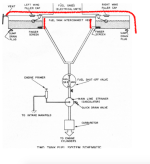
The image below is more invasive than the image in post #94. It shows a vent line running from the right outboard tank across and passed the left tank. Its pilot proof. If parked on a slope with full tanks fuel would only drain out of the lowest fuel cap.

A tank can be isolated with shutoff valves (Like installing one in the fuel tank interconnect vent). Although valves like that are far from pilot proof they should be installed so the are accessible in flight.
Screen Shot 2020-02-07 at 5.19.39 AM.png
 

Attachments

  • Screen Shot 2020-02-07 at 5.19.39 AM.png
    Screen Shot 2020-02-07 at 5.19.39 AM.png
    180.8 KB · Views: 0
Since this discussion was on my mind, I asked my A&P/IA if all high-wing certified planes have a vent line between the left and right tanks. All three of the mechanics in the room immediately nodded "Yes" and the IA said that there's a mandatory test in the annual and 100-hour checklists to ensure the vent is properly working. Just another data point for the discussion.
 
I see this thread got new life after being quiet for a few days. I read that two people have had engine failures. They state that the failures were due to venting issues. I wonder how they KNOW this. Is it possible that the problems might have been something else that was never discovered?

When I had an engine fail in a Cherokee, I thought it must be the pump so I changed it. I now think it was a vapor lock problem. Looking back on it, the conditions were right for vapor lock: hot day, low power setting so low fuel flow prior to failure, and burning auto gas. The reality is that I don’t actually KNOW positively what caused it. I quit burning auto fuel and never had the problem again but I might not have ever been in quite the same circumstances again.

My concern is that we are doing a lot of chasing theory with the possibility of adding risk with added system complication that might introduce other unintended consequences.

I still don’t see how this venting imbalance can possibly occur on a stock Bearhawk short of a blocked or improperly installed fuel cap vent. The only scenario I have been able to theorize is, as mentioned the other day, the possibility that with differing amounts of fuel in the tanks resulting in differing amounts of air above the fuel and with outside air pressure change, like altitude change, differing amounts air would be needed to equalize the pressure. I suspect this difference would be relatively small unless the altitude changes were pretty extreme.
 
  • Like
Reactions: Nev
I asked my A&P/IA if all high-wing certified planes have a vent line between the left and right tanks. All three of the mechanics in the room immediately nodded "Yes".

Makes sense, it used to be required by regulation but it isn't any more.

I still don’t see how this venting imbalance can possibly occur on a stock Bearhawk short of a blocked or improperly installed fuel cap vent.

You're right it can't, when everything is working correctly. If you run BOTH the fuel level will equalize between the tanks, and with proper venting altitude changes won't affect anything.
 
I see this thread got new life after being quiet for a few days. I read that two people have had engine failures. They state that the failures were due to venting issues. I wonder how they KNOW this. Is it possible that the problems might have been something else that was never discovered?

When I had an engine fail in a Cherokee, I thought it must be the pump so I changed it. I now think it was a vapor lock problem. Looking back on it, the conditions were right for vapor lock: hot day, low power setting so low fuel flow prior to failure, and burning auto gas. The reality is that I don’t actually KNOW positively what caused it. I quit burning auto fuel and never had the problem again but I might not have ever been in quite the same circumstances again.

My concern is that we are doing a lot of chasing theory with the possibility of adding risk with added system complication that might introduce other unintended consequences.

I still don’t see how this venting imbalance can possibly occur on a stock Bearhawk short of a blocked or improperly installed fuel cap vent. The only scenario I have been able to theorize is, as mentioned the other day, the possibility that with differing amounts of fuel in the tanks resulting in differing amounts of air above the fuel and with outside air pressure change, like altitude change, differing amounts air would be needed to equalize the pressure. I suspect this difference would be relatively small unless the altitude changes were pretty extreme.

Perhaps I should have used the same wording as the NTSB? "Probable Cause." First hand knowledge of two failures, detailed inspection of the aircraft after each failure, theory researched and developed, mathematical prediction of the conditions required for another failure, predicted failure occurred. Seems like a pretty solid "probable cause" to me.

You can't assume that because both tanks are venting to atmosphere that their vent pressures are the same. If the atmosphere was static then yes, that assumption is acceptable. The conditions at the inlet of each cap vent are dynamic on a flying airplane. Prop-wash, wing contamination, VG placement, uncoordinated flight are things off the top of my head that could affect individual vent pressure. Sure, most of the time the conditions will be close enough it won't matter but that may not always be the case.

As I said before, I do believe Bob's caps reduce to likelihood of this failure occurring because they seal well and the size of the vent hole is small.

I do wonder: If Matt or me and my family had died as a result of either of these failures would you all be so willing to pass it off as an anomaly that occurred due to not using Bob's caps or installing a fuel injected Continental?
 
  • Like
Reactions: Nev
Since this discussion was on my mind, I asked my A&P/IA if all high-wing certified planes have a vent line between the left and right tanks. All three of the mechanics in the room immediately nodded "Yes" and the IA said that there's a mandatory test in the annual and 100-hour checklists to ensure the vent is properly working. Just another data point for the discussion.

Luscombe 8, C206, PA18 are the ones I know of off-hand. But I do appreciate you thinking about this discussion and talking about it with folks you trust.
 
"Sure, most of the time the conditions will be close enough it won't matter but that may not always be the case."

I think most of us discussing this understand that, if our saying that it's not really possible to have an imbalance under normal conditions is being taken in the most strict sense.
 
FWIW,
Spoke with a mechanic friend about these caps. I see them often on Super Cubs. He said the STC for 180hp conversions require the pressure vent caps to meet fuel flow requirements.
 
I spoke with my mechanic friend about this. After a lot of noodling and discussion we decided it wouldn’t hurt to add a vent between the tanks. Then the debate centered on where to put the vents. We decided on the outboard side of the mains, at the top (tallest part). After this and Mark’s comment about his conversation with Bob and his thoughts I called Bob to run our idea by him. He agreed that it wouldn’t hurt to put in the vent and he said the outboard location would be his choice too, but at the top forward corner. He said the main thing is to be an aware pilot. He’s flown many hours and is always aware of what flight profile may cause a tank to unport in a low-fuel situation. Airmanship and awareness I guess. About the vents, I did read somewhere that venting between the sight gauges is a bad idea. I also commented on post #89 about the pressure caps.
 
On Murphy Rebels, they used to have the interconnecting vent connected through the sight gauges. After some problems, they issued a bulletin to move it to a separate port.
 
AKKen07 definitely better tapping into outboard tank ends if your still assembling the wings. I would need to remove the tanks, work in the closed up wing. But I don't like the idea of connecting the sight gages or having a valve either. Welding in bungs in tanks that have had fuel in them doesn't excite me at all. All things considered I think I'll let it be.
 
Thanks, I haven’t uncrated the wings yet, so lots of time to make whatever changes seem prudent.
 
How will the vent line be routed through the cabin? I guess you could place a bulk head fitting on each inboard wing rib? Then join the line on both sides after the wings are installed? With the vent line in the outboard forward location should prevent cross feeding in a wing high parking position unless the tanks were totally slap full, even then not much should transfer.
 
Jon - you have to admit, it's a big assumption everyone here is making. We have no firsthand sight or knowledge of the investigation and determination of the cause. It's only natural for people to question it. Nothing personal.
 
It might be tough to put a fitting on the outboard edge, at least on a QB kit. To give myself space for fittings on the inboard side, I put the tank fairly far outboard in the bay. It might fit better to put it on the forward side of the tank. I think I had about 1.7 inches or so from the front of the tank, to the spar. That also makes installing the whole tank a bit of fun. I think it would have to be a flexible line. The flexible line would have to be secured so that it doesn't chafe on the tank straps.
 
Below is the bulletin. There is a previous one that talks about the tanks needing to be interconnected. I can't find that one.
 
That is interesting, thanks for sharing!
Again, they have been unable to come up with hard test results to prove what was happening, and were forced to assume it was the sight gauge causing the issue. I have not thought about the problem hard enough to understand how interconnected sight gauges could cause the problem they were having - air bubbles in the main fuel lines. Seems very counter-intuitive, and I am getting a sore head already!
 
That's not the same problem as we've been talking about, either. They think their problem was from having the fuel feed at the bottom of the sight gauges, and their solution is to move the fuel feed to its own fitting. Bearhawk tanks are already that way.
 
Last edited:
This Safety Bulletin shows surprisingly similar symptoms to the Cessna AD from 1969, although they prescribe different fixes.
Murphy term it an “air locked” fuel line and suspect air somehow entering the fuel lines. Cessna suspected vapor lock from fuel essentially boiling in the lines at bends under specific atmospheric conditions.
 
Last edited:
Spoke with my mechanic friend again about the vent. Tentative plan is to weld bungs on the top/fwd/outside of each fuel tank. Put in a barbed fitting and connect the two tanks with clear tubing and watch how that goes. There is plenty of room for the fitting. The only potential negative is the tubing would have to go down a bit to fit through the front spar lightening hole. After that it's a straight shot to the other side. If it doesn't work just plug both tank ports and call it good.
 

Attachments

  • photo6875.jpg
    photo6875.jpg
    769.2 KB · Views: 0
There is only a degree of dihedral. I doubt it would be possible to have the line run slightly uphill to the center of the fuselage. There will probably be a slug of fuel most of the time in the middle, but I think it still works. I wonder what Cessna's implementation looks like.
 
If this is to be a permanent install I would use aluminum tube over most of the install. If you want to observe what is happening, put the clear tube in an area where you can observe the activity but where the tube will be easily replaced. The clear tubes I have found become hard, shrink and become discolored over time.
 
In which case, there is no known problem from Murphy Aircraft with using fuel sight gauges to connect the cross vent system.
 
Really nice video. I already had a couple of bungs welded to the inboard side of the tanks to use as fuel return ports. I added a header tank and want to use them for vents for the header tank, and to cross vent the tanks.. After looking at a bunch of fuel system designs I noticed Cessna had a preference for venting the tanks from the outboard side, vs the inboard. With only 1 degree of dihedral, this is only a very slight difference in height on the outboard. Obviously, higher is better, but in the case it isn't much.

Is there any other advantage to using the outboard location for the vents? I wonder if I could run a vent line internally in the tank, to the outboard edge of the tank, to the high point.
 
Cessna has a pretty elaborate venting system with check valves in the tanks, Vents going from outboard tank to opposite tank outboard side, etc, etc. The one issue I can see with interconnecting the tanks inboard is if you parked on a slope with full tanks. The tanks would be in essence one tank. With full tanks the downslope tank has a hole in it, namely the fuel cap vent. Mean ol' Mr. Gravity would have his way and the fuel would flow out of the downslope cap. The only way to mitigate that with the tanks interconnected like that is to install an inline valve in the interconnecting vent line and turn it off when parked. However, one more thing to remember to turn on and a potential point of failure.
 
Yeah, more complex, but sounds like Cessna's is as well. They have been doing this for a long time and have discovered all kinds of Gremlins over the years.
The other option might be to try to figure out how to put a vent pipe internally in the tank to the upper/outboard end, from the inboard side. Lots of tanks of have internal piping for many different purposes, including venting. "Standpipes" are a pretty common feature.
 
Cessna has a pretty elaborate venting system with check valves in the tanks, Vents going from outboard tank to opposite tank outboard side, etc, etc. The one issue I can see with interconnecting the tanks inboard is if you parked on a slope with full tanks. The tanks would be in essence one tank. With full tanks the downslope tank has a hole in it, namely the fuel cap vent. Mean ol' Mr. Gravity would have his way and the fuel would flow out of the downslope cap. The only way to mitigate that with the tanks interconnected like that is to install an inline valve in the interconnecting vent line and turn it off when parked. However, one more thing to remember to turn on and a potential point of failure.

It's a risk today - if we leave our fuel selector on "both" parked on a slope, then we still lose most of the fuel. Just part of the design.
I think parking on a slope is a strange enough event, that I always think "I better close that valve", and I have never lost fuel yet. I do lose fuel to freshly filled tanks on hot days though.

I can imagine, were I under a lot of stress or very distracted, I could forget to select the fuel to "off". But for normal ops, it has proven to be an insignificant risk for me personally.
 
Today I put 10 gallons in each tank for a total of 20.
at the pump inlet on Both, I had 23 GPH. Switch to left tank only, 23 GPH. Right tank only, 23GPH. I then went back to Both, the remaining 5 gallons was 15 GPH. Not sure why, head pressure I would guess. Previously I had only checked right and left, not both or both with near empty fuel.
 
Normally more fuel flow is seen with a BOTH setting. That has been my experience in all my planes. Not sure why you would not see that also Elden. Mark
 
Please clarify......I think you were doing a fuel flow test. And I think your GPH figures is a calculation of volume of fuel flowing into a bucket divided by time.

When you got the 15 GPH result, is it possible that you had uneven fuel levels in the two tanks?

I wonder........
1) When the tank levels are not even the fullest tank has the highest fuel pressure at the TEE of the fuel selector.
2) When the two tanks are interconnected when you select BOTH, then the differential pressure between the two tanks will want to equalize and fuel will cross feed through the fuel valve.
3) It seems to me that any flow across the TEE will reduce flow to the engine.
 
The 15 gph was the last 5 gal. that emptied the tanks. I have no intentions of letting the tanks get that low. It was just interesting that the flow was less.
 
I was also expecting more flow on Both. Possibly something after the fuel valve restricts more flow on Both. One Pump on, I have 43 gph. I ran the motor, all four injectors working and WOT, tied to my truck (brakes won't hold it) with no issues other than some fine tuning. It really barks now.
 
Are you using a gascolator? Looking at how restrictive they are I've been wondering if that's why folks aren't seeing a difference between single tank and BOTH fuel flow rates.
 
I am just becoming aware of a "near miss" involving a Bearhawk here, everyone is OK and the plane landed safely at an airfield.

Early reports are saying an engine failure after takeoff occurred during a short flight (only a few miles long) caused by one tank being half full and the other tank being almost empty. It sounds like the symptoms of the issues presented in this thread.

He was able to land and pump in more fuel to re-balance the fuel load and continue the trip without further incident.

I understand the pilot lost power just after takeoff, and immediately took the correct action of changing tanks which allowed him to restart the engine and continue to climb out. However he left the throttle wide open which prevented the fuel system from fully recovering, based on what we know here, which resulted in intermittent power surges throughout the remainder of the flight. Based on what we know, I believe that had he retarded the throttle the engine would have continued to run smoothly.

Note that this particular fuel system was not built exactly as Bob intended it, and it tends to draw from one tank faster than the other.
 
Last edited:
After reading through this whole discussion again a few weeks ago, I decided to add a cross vent tube between the two main tanks, similar to what Paul documented. Will post pictures when complete. Jon in Idaho was quite persuasive advocating that in his posts.
 
I am using a vent from the inboard sides of the tank because I already have the fittings welded there. I am pretty sure I will use a 12v shutoff valve to automatically close with the loss of 12v power. I will put a switch and light on the valve to ensure it functions.

Outboard is probably a better location, but inboard is better than nothing. Still using vented fuel caps.
 
Back
Top