
You are using an out of date browser. It may not display this or other websites correctly.
You should upgrade or use an alternative browser.
You should upgrade or use an alternative browser.
Stolspeed VG's
- Thread starter bway
- Start date

Battson
Moderator
Yes, see my post about the same topic here:
https://bearhawkforums.com/forum/flying-and-flight-testing/2251-who-is-using-vgs/page3
https://bearhawkforums.com/forum/flying-and-flight-testing/2251-who-is-using-vgs/page3

Bdflies
Between Projects
I read every word of Batson's essay! Great info!
Amusing story to share: A while back, I picked up a BRAND NEW Husky, with a friend. While at the factory, I mentioned that my plane, a Husky A-1, had VG's. Everyone around scoffed and snickered... "VG's", they declared, "only cover up flaws, in inferior airfoils and don't do anything on Huskys." I really couldn't summons much of a retort, since the plane had the VG's when I bought it. So, I didn't have a baseline to compare. I just knew it flew nicely. The amusing thing (to me) is that, the last two years, that I visited the Aviat display in Oshkosh, EVERY HUSKY ON DISPLAY had VG's. Evidently, properly done VG's can augment the performance of well designed airfoils, as well! As 'Commander Batson' discovered.
Bill
Amusing story to share: A while back, I picked up a BRAND NEW Husky, with a friend. While at the factory, I mentioned that my plane, a Husky A-1, had VG's. Everyone around scoffed and snickered... "VG's", they declared, "only cover up flaws, in inferior airfoils and don't do anything on Huskys." I really couldn't summons much of a retort, since the plane had the VG's when I bought it. So, I didn't have a baseline to compare. I just knew it flew nicely. The amusing thing (to me) is that, the last two years, that I visited the Aviat display in Oshkosh, EVERY HUSKY ON DISPLAY had VG's. Evidently, properly done VG's can augment the performance of well designed airfoils, as well! As 'Commander Batson' discovered.
Bill
Good information. As I reported in another thread, my LSA will slowly roll off to one side or the other when truly stalled. There is a bit of a burble that accompanies the stall, but not a lot. I was thinking about using the Stolspeed VG's on the outer 1/3 of each wing, only. I'm thinking that would allow aileron control deeper into the stall, and result in the inboard section of the wing stalling first. That should theoretically cause more buffeting as disturbed air would be flowing over the tail. A lot of certified aircraft use washout or stall strips to get the inboard section of the wing to stall first. The thing is, though, my LSA flies so well now that I don't want to mess it up. So, would the Stolspeed VG's be removable without messing up the paint if I don't like them? Thx, Bob
jim.mclaughlin924
Well-known member
I used them on my Rans S7 and was impressed. Stall speed decreased 4 kts to 28kts, no change in cruise, but a slower plane than the Patrol. I will probably mess around with them on the Patrol when finished. They can be fastened with tape, so you can play around with location before permanent install.
Interesting topic, I'm a bit confused tho'. I thought that VG's, albeit proven to work, the data shows that the improvement is closer to 3-7% for a given airfoil, so for a 37KIAS (already an anomaly since the variance in IAS has a margen or error of +-4KTS) would be closer to 1.1 KIAS (well inside the KIAS tolerance of +-4KIAS so almost negligible) as to the high water mark, or there about, 2.59 KIAS, is also with in that range, practically KIAS margin of error, so very hard to use as a proof point.
Another factor is this range of efficiency is very well define to several factors, Reynolds numbers, airfoil type, and AoA, so defining all there of those factor will define placement of the VG's on the airfoil upper surface, so you get the improvement with in an envelop of performance. So, at a given speed, and a given AoA, and a given location, the VG's have measurable performance gains, no argument behind the science and the data, my question is, will and average pilot reap the benefits of VG's, considering their low margin of improvements?
You need to be flying very near the edge of the performance envelop of the airplane, like a STOL competition as an example to reap those benefits. Sure, if you are flying regularly, you get a margin of error improvement as the exited airflow with keep laminar separation from happening.
So how des one find the right placements for the VG's, well a wing tunnel, or you could spay some cold wax on your wing (pledge)near the root, then make some flow viz solution (google it) paint it generously on the area with wax, go up and in a safe altitud, play with AOA and stall, if possible, record the high AOA ad you will see something like this:
The clear area at the front will show you where the VG's go, where they stat to apear is the area of separation of laminar flow, if you need the extra ~4KIAS on your approach
Another factor is this range of efficiency is very well define to several factors, Reynolds numbers, airfoil type, and AoA, so defining all there of those factor will define placement of the VG's on the airfoil upper surface, so you get the improvement with in an envelop of performance. So, at a given speed, and a given AoA, and a given location, the VG's have measurable performance gains, no argument behind the science and the data, my question is, will and average pilot reap the benefits of VG's, considering their low margin of improvements?
You need to be flying very near the edge of the performance envelop of the airplane, like a STOL competition as an example to reap those benefits. Sure, if you are flying regularly, you get a margin of error improvement as the exited airflow with keep laminar separation from happening.
So how des one find the right placements for the VG's, well a wing tunnel, or you could spay some cold wax on your wing (pledge)near the root, then make some flow viz solution (google it) paint it generously on the area with wax, go up and in a safe altitud, play with AOA and stall, if possible, record the high AOA ad you will see something like this:
The clear area at the front will show you where the VG's go, where they stat to apear is the area of separation of laminar flow, if you need the extra ~4KIAS on your approach
Battson
Moderator
To restate the above in a different way, 7% subtracted from 37 KIAS is 34KIAS, so the empirical evidence is supported by the theoretical. A range of tolerance for a given instrument and a statistically likely outcome based on a distribution of results after repeated tests are two different things.Interesting topic, I'm a bit confused tho'. I thought that VG's, albeit proven to work, the data shows that the improvement is closer to 3-7% for a given airfoil, so for a 37KIAS (already an anomaly since the variance in IAS has a margen or error of +-4KTS) would be closer to 1.1 KIAS (well inside the KIAS tolerance of +-4KIAS so almost negligible) as to the high water mark, or there about, 2.59 KIAS, is also with in that range, practically KIAS margin of error, so very hard to use as a proof point.
...
if you need the extra ~4KIAS on your approach
The difference between flying my friend's Bearhawk without VGs and mine with was a most enlightening reminder about their importance. I would never own a Bearhawk without adding VGs, they are the best and most cost-effective way to improve STOL performance. The extra kinetic energy at landing (velocity squared) means you need almost 20% more room to land without them fitted. Once again, the practice agreed with that theory when I was landing my friend's Bearhawk. It is more challenging aircraft to land well and land short. Those last few knots at touchdown make all the difference.
Last edited:
I'm just curious enough to spend the money and time to try the Stolspeed VG's now that I know they can be removed without damage. Anecdotally, a friend who has used them on two different airplanes said that they made both airplanes better. Neither of those airplanes were Bearhawk though so, I'll find out what, if anything, they will do for the LSA. This is not a priority though, so it may be a while. Bob
To restate the above in a different way, 7% subtracted from 37 KIAS is 34KIAS, so the empirical evidence is supported by the theoretical. A range of tolerance for a given instrument and a statistically likely outcome based on a distribution of results after repeated tests are two different things.
The difference between flying my friend's Bearhawk without VGs and mine with was a most enlightening reminder about their importance. I would never own a Bearhawk without adding VGs, they are the best and most cost-effective way to improve STOL performance. The extra kinetic energy at landing (velocity squared) means you need almost 20% more room to land without them fitted. Once again, the practice agreed with that theory when I was landing my friend's Bearhawk. It is more challenging aircraft to land well and land short. Those last few knots at touchdown make all the difference.
Two quick comments:
Empirical data is there, however, measurement in KIAS is a mistake to validate empirical data, factors or error are also important, so a highly sensitive equipment is needed to substantiate the claims. leaving all other variable factors aside from a empirical perspective (temperature, barometric, air density, humidity, air direction, airspeed) considering that at 0<50KIAS there is a tolerance or error or roughly 10% in the equipment used. This means that as you take measurements, the empirical value of those measurements must account for the error. To limit these, you take several measurements with in a 10 mins span (looking for stall entry values.) then average those and account for margin of error in a normalised curve, you will find that 4KIAS is with in that margin of error, you get Relative Error, so your delta of 4KIAS and 4KIAS+- of the equipments looks rather odd mathematically which is the point I was making: (4 - 4)/ 4 If you look at it from Relative Uncertainty, then 4/4 = 1 or 100% uncertainty of the data.
As far as your subjective valuation of with vs no VG, not much I can say other than there are percibable difference is the preasusure distribution of the wing, particularly on the tips where most of the improvements of the VGs come into play, keeping the laminar bubble from separation and re attachment (hysteresis) of this particular airfoil (and most airfoils of the type in their lower Re operation at the tips) so they do work to stabilise that aspect of the flight characteristic of the wing, giving you less input to adjust for small imbalance of aileron input.
I hope we are in agreement and pls understand that was not trying to contradict anyone. I have but the deepest respect to all the builders in this site, just sharing my thoughts on the subject from my own understanding of the technology.
Battson
Moderator
Two quick comments:
Empirical data is there, however, measurement in KIAS is a mistake to validate empirical data, factors or error are also important, so a highly sensitive equipment is needed to substantiate the claims. leaving all other variable factors aside from a empirical perspective (temperature, barometric, air density, humidity, air direction, airspeed) considering that at 0<50KIAS there is a tolerance or error or roughly 10% in the equipment used. This means that as you take measurements, the empirical value of those measurements must account for the error. To limit these, you take several measurements with in a 10 mins span (looking for stall entry values.) then average those and account for margin of error in a normalised curve, you will find that 4KIAS is with in that margin of error, you get Relative Error, so your delta of 4KIAS and 4KIAS+- of the equipments looks rather odd mathematically which is the point I was making: (4 - 4)/ 4 If you look at it from Relative Uncertainty, then 4/4 = 1 or 100% uncertainty of the data.
As far as your subjective valuation of with vs no VG, not much I can say other than there are percibable difference is the preasusure distribution of the wing, particularly on the tips where most of the improvements of the VGs come into play, keeping the laminar bubble from separation and re attachment (hysteresis) of this particular airfoil (and most airfoils of the type in their lower Re operation at the tips) so they do work to stabilise that aspect of the flight characteristic of the wing, giving you less input to adjust for small imbalance of aileron input.
I hope we are in agreement and pls understand that was not trying to contradict anyone. I have but the deepest respect to all the builders in this site, just sharing my thoughts on the subject from my own understanding of the technology.
I can understand your reasons for being skeptical. Clearly you've got a good grasp on the theory behind VGs.
That said, all evidence did point to a clear reduction in stall speed and increased margin of safety at a given approach speed. The acid test for me was the stall behaviour, approach / touchdown speeds, and landing distance. All evidence points to performance improvement, so that's the logical conclusion to draw. Only the outcome matters in the end, the exact numbers are indicative only.
The outcome is, after fitting the VGs, I could fly almost 10 KIAS slower on approach for the same margin over the stall AoA, which is a massive practical advantage. The reduction in stall speeds translates to shorter landing rollout in STOL ops.

patrickh99
Senior Moment
I installed VGs on a Cessna 340 some years ago. They definitely work; reduced stall speed, improved rudder function in single-engine ops, and improved roll control at slow speeds. I plan to put them on my Bearhawk.

Dave Roberts
Member
I agree with Battson 100%. I've had vg's on my bearhawk for about 600 hrs. Every thing Battson said is right on.
While I am quite satisfied with the performance of the wing on my LSA, it does stall with little to no buffet. The stall is very gentle , but if held long enough, it will eventually roll slowly off into a spin. It does this quicker as the CG is moved to the rear, but it is still pretty slow. When stalled in a hard slip, with the CG forward, it buffets a lot with no tendency to roll "over the top" into a spin. With the CG to the rear, it will roll over the top when stalled in a hard slip, but the rate is very slow.
I am wondering if installing the Stolspeed VG's on the outer 2/3's or so of the wings will delay the stall there while allowing the center section to go far enough into the stall to produce a buffet. What I don't want to do is mess up what I consider superior stall characteristics when the wing is stalled in a slip. Also , I don't want to lower the cruise speed. I think the Stolspeed VG's can be temporarily installed with double sided tape so that I can experiment without concern about removing them if I don't like the result. I'm ordering some today. Bob
I am wondering if installing the Stolspeed VG's on the outer 2/3's or so of the wings will delay the stall there while allowing the center section to go far enough into the stall to produce a buffet. What I don't want to do is mess up what I consider superior stall characteristics when the wing is stalled in a slip. Also , I don't want to lower the cruise speed. I think the Stolspeed VG's can be temporarily installed with double sided tape so that I can experiment without concern about removing them if I don't like the result. I'm ordering some today. Bob

Isilverone
Well-known member
Today, I removed the STOLspeed VG's from the horizontal stab of my Patrol. I hadn't installed them yet on the wings but will get on that this weekend. I cant get all technical with you but I will tell you that they create an unstable tail and I'm sure it raised my Stall speed by 5mph. My slow speed approaches felt very "Loose" and uncomfortable if that makes any sense. I put a total of 6 hours on them before removing them . I jumped in and flew for 4 hours today with them off and its sure nice to have my sweetheart back.

kestrel
Offering Bearhawk rides
Today, I removed the STOLspeed VG's from the horizontal stab of my Patrol. I hadn't installed them yet on the wings but will get on that this weekend. I cant get all technical with you but I will tell you that they create an unstable tail and I'm sure it raised my Stall speed by 5mph. My slow speed approaches felt very "Loose" and uncomfortable if that makes any sense. I put a total of 6 hours on them before removing them . I jumped in and flew for 4 hours today with them off and its sure nice to have my sweetheart back.
I'd be interested to hear the details of how they were installed. I love the STOLspeed VG's under my stab, in combination with a gap seal.
Isilverone
Well-known member
Correct me if Im wrong but I think your flying a 4-place?
I also have VG's and gap seals on my 4-place tail ( A model with slab tail) and love them. Im talking the Patrol
I also have VG's and gap seals on my 4-place tail ( A model with slab tail) and love them. Im talking the Patrol
Battson
Moderator
I'd be interested to hear the details of how they were installed. I love the STOLspeed VG's under my stab, in combination with a gap seal.
Kestrel, Isilverone - which gap seal are you using?
Isilverone
Well-known member
Not sure as mine were on when I baught it. Their a rubber “H†and fit really nice. I’ve been trying to find them online but no luck yet. Cubcrafters gap seals are way to wide to work on the A model Bearhawk. I really like what the Horiz stab VG’s did for my 4-place but you couldn’t pay me enough to put them back on my patrol
kestrel
Offering Bearhawk rides
Correct me if Im wrong but I think your flying a 4-place?
I also have VG's and gap seals on my 4-place tail ( A model with slab tail) and love them. Im talking the Patrol
Ahhh... Yes. A Model 4 place with slab tail.
kestrel
Offering Bearhawk rides
Kestrel, Isilverone - which gap seal are you using?
I'm using gaffers tape. A single layer applied across the top and laid down into the middle of the hinge. I find I need to replace it about once per year. Simple, cheap, works well. ...but I would consider a more permanent solution if I found a good one.

Question for those with 4-place BHs: What are you feeling that makes you like VGs and/or gas seals on the tail?
I put a profiled tail on my BH and can’t think a reason to change anything. I’ve very curious what I’m missing.
I think you fixed it with the profiled tail. With the flat tail at forward cg, we can run out of elevator before the wing stalls.
Isilverone
Well-known member
Whee, don’t put VG’s on the profiles tail. They suck. At least they do on the patrol. On my slab tailed 4-place, they added control authority in both pitch and yaw stability on low speed approach and in ground effect. Just my experience speaking so maybe not the same for others

whee
Junior Member
With the profiled tail fitted on a 4-place, flying near empty weight, you should still run out of control authority at the flare with the throttle closed.
Otherwise you are landing too fast
Maybe not if you don’t have a heavy 540 on the front😜
Battson
Moderator
Maybe not if you don’t have a heavy 540 on the front😜
Good point - could be worse I guess, I hear those TCM engines are even heavier - you can't trust those "book values".
kestrel
Offering Bearhawk rides
With the profiled tail fitted on a 4-place, flying near empty weight, you should still run out of control authority at the flare with the throttle closed.
Otherwise you are landing too fast
I prefer effective controls that let me fly the airplane where I want it. ...only an issue at the lightest loads.
Ray Strickland
Well-known member
I recently installed Stolspeed VG's on my A model 4-place wing only, w/ profiled hor stab & gap seals. Preliminary tests show 3 mph reduction in stall with clean, but gentle break w/o buffet. No reduction in cruise speed @ 50 percent power. Installed with highest part of VG in line with 4th row of rivets. Will keep them.

huntaero
4 Pl BHK scratch build
I was looking at these a while ago at Aircraft spruce https://www.aircraftspruce.com/catalog/appages/gapsealtail.php?clickkey=3018758

Gerd Mannsperger
Well-known member
For anyone who worries about the wing stalling all at once with VGs I did have that in a few application where the stall speed dropped noticeably but the stall became more abrupt.
The fix is to either move the VGs inboard of the Aileron back 1-2 inches in comparison to the outboard VGs Or a nice very smooth stall is generated by having the outboard section swoop forward.
I found 1" sweep forward from mid wing to the tip to be sufficient in most cases to give a very smooth approach into the stall with the tips flying well into the stall with very good feel to the aileron
throughout slow flight and right to the end. Properly set up VGs are a great enhancement to control and safety right in the most critical phase of flight ,
never mind the slower landing and take off speeds that is just a side benefit. I wish more people would recognize and see them for that instead of a stol mod.
The fix is to either move the VGs inboard of the Aileron back 1-2 inches in comparison to the outboard VGs Or a nice very smooth stall is generated by having the outboard section swoop forward.
I found 1" sweep forward from mid wing to the tip to be sufficient in most cases to give a very smooth approach into the stall with the tips flying well into the stall with very good feel to the aileron
throughout slow flight and right to the end. Properly set up VGs are a great enhancement to control and safety right in the most critical phase of flight ,
never mind the slower landing and take off speeds that is just a side benefit. I wish more people would recognize and see them for that instead of a stol mod.

Gerd Mannsperger
Well-known member
Same spacing between VG's but More forward on the outboard section a little may go a long way. Some wings do not need a set back at all.
You can just use double sided carpet tape to try out the swept or set forward designs base on what you prefer or try different settings..
I prefer the paired spacing much like the Mircro VG set up on cubs.
You can just use double sided carpet tape to try out the swept or set forward designs base on what you prefer or try different settings..
I prefer the paired spacing much like the Mircro VG set up on cubs.

Nev
Quick-build 4-place B #25
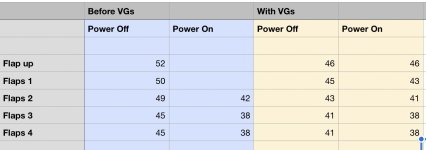
Yesterday I installed Stolspeed VG's on my 4-place B model and spent an hour or so repeating stalls both power on and power off.
In a nutshell (and at first glimpse) at 2200 lbs the power off stall speed has dropped about 5 kts for all flap settings. Power on stalls didn't show much change in the stall speed, but at this early stage I didn't see any wing drops. I was able to fly at around 45kts in level flight at 3000ft in full control. When the wing stalled with F3 or F4 the descent rate increased but the wings remained level.
I've got alot more to do in this area, this was just a first look.
In a nutshell (and at first glimpse) at 2200 lbs the power off stall speed has dropped about 5 kts for all flap settings. Power on stalls didn't show much change in the stall speed, but at this early stage I didn't see any wing drops. I was able to fly at around 45kts in level flight at 3000ft in full control. When the wing stalled with F3 or F4 the descent rate increased but the wings remained level.
I've got alot more to do in this area, this was just a first look.
Attachments

Last edited:

Bissetg
Well-known member
I’m really interested in where folks determine the best location for the VGs is. The figures I’ve heard range from 2.5% of chord to about 12%. Stolspeed I believe were recommending 7% but have revised that to 5%. Because my experience of VGs on wings is limited to a C210 and C172 which are covered by an STC that positions them at 2.5% I’ve gone for a forward position. I’m hoping my next engine lasts more than 18 hours so I can do some meaningful testing and report back but very interested to hear of others experience with a B model wing.
Nev
Quick-build 4-place B #25
I've installed mine at 5%, but having given it some thought now I don't think we'll see a lot of variation in the results as long as they're not too far aft. I found it interesting that my power on stall speeds remained very similar with or without VG's, seeming to indicate that most of the results are there once the prop is firing that airflow over the wing. The noticeable change was in the handling, and the ability to descent in a controlled manner (fully stalled), and recover by applying power.

Last edited:
I've installed mine at 5%, but having given it some thought now I don't think we'll see a lot of variation in the results as long as they're not too far aft. I found it interesting that my power on stall speeds remained very similar with or without VG's, seeming to indicate that most of the results are there once the prop is firing that airflow over the wing. The noticeable change was in the handling, and the ability to descent in a controlled manner (fully stalled), and recover by applying power.
I think the propwash also makes a lot of induced airflow over the tail, which can keep the airflow from separating there. This also allows for slower stall speeds in certain configurations. If the flow separates at the elevator, the nose will drop.

nborer
Well-known member
Great to see Nev's data on this. Nev, maybe you've posted it elsewhere but I haven't seen it... how is your airspeed calibration at these speeds? I'm not questioning the effectiveness of the VGs, just curious about the observed whole-aircraft lift coefficient at stall. For our club's 172N, indicated airspeed at stall with full flaps is 7 knots low, per the flight manual. Also, what was your CG? Stall behavior at forward vs. aft CG can be vastly different, and can be the difference between a tail stall vs. a wing stall. Can you comment on the differences in elevator? Are you full aft stick with one vs. finding you still have a little left over with another?
The difference in power-on vs. power-off could partially be related to differences in airspeed calibration at low speed (particularly if your static port may be effected by prop slipstream), but I wouldn't think that explains the bulk of it. A strong downward pitch at stall can be indicative of the tail letting go first before the wing stalls; a mush (particularly if you can still have some pitch authority) *can* (but not necessary *does*) indicate your tail is still working and your wing is indeed stalled. Power-on will probably have more effect on the tail. High-wing, low-tail airplanes have strong responses to change in downwash from the wing, and the power-on blowing effect could lead to locally higher wing lift and locally stronger downwash at the tail. There are probably some prop slipstream effects on the tail as well, but I'd think the wing and induced downwash would be a stronger effect. If only we could resurrect the NACA 30x60 tunnel...
The difference in power-on vs. power-off could partially be related to differences in airspeed calibration at low speed (particularly if your static port may be effected by prop slipstream), but I wouldn't think that explains the bulk of it. A strong downward pitch at stall can be indicative of the tail letting go first before the wing stalls; a mush (particularly if you can still have some pitch authority) *can* (but not necessary *does*) indicate your tail is still working and your wing is indeed stalled. Power-on will probably have more effect on the tail. High-wing, low-tail airplanes have strong responses to change in downwash from the wing, and the power-on blowing effect could lead to locally higher wing lift and locally stronger downwash at the tail. There are probably some prop slipstream effects on the tail as well, but I'd think the wing and induced downwash would be a stronger effect. If only we could resurrect the NACA 30x60 tunnel...
Nev
Quick-build 4-place B #25
These stalls were a basic look at mid weight, mid CG, and I've since done some at aft CG max weight to ensure they "pass" for the flight testing, but not enough to gather data as such. I've been pretty focused in other areas prior to finishing the test phase. My engineer used the word "pedantic" so I've probably done enough 
In a couple of weeks I'll do a few hours testing the VG's in more detail to get some usable data. I suspect that at this stage what I was seeing was the elevators "letting go" without power on, and the elevators "holding on" with power. I didn't check for position error yet but there will be some for sure. Sorry I can't be more help yet but I'll report back once I've done more.
In a couple of weeks I'll do a few hours testing the VG's in more detail to get some usable data. I suspect that at this stage what I was seeing was the elevators "letting go" without power on, and the elevators "holding on" with power. I didn't check for position error yet but there will be some for sure. Sorry I can't be more help yet but I'll report back once I've done more.

Redneckmech
BH Five Scratch Build
Perhaps your engineer considers it pedantic but everyone here appreciates your methodical approach!
Thank you for taking the time and effort to gather data before and after the installation and share it with the community.
Thank you for taking the time and effort to gather data before and after the installation and share it with the community.
Battson
Moderator
The shape of the aerofoil in a Bearhawk 4-place is different to a Bravo, because the curve of the wing is different - particularly in that area that VGs attach. This is a considerable variable, in terms of a wing - the shape is everything. I suggest people installing VGs consider which aerofoil they have, rather than going straight for a generic location - especially from the manufacturer, who offers one number to cater to all the common wing designs...
Aside from the above, I thought the location of the VGs generally was interesting to discuss. There has been a huge body of study done on this, and I am not an authority... maybe someone here is?
So far as I can tell, the best results are achieved in a relatively narrow range, a few percent of the chord. Lots of evidence to support that.
Too far forward:
The available data seems to show that vortex is strongest immediately behind the VG and deteriorates as it passes over the wing, losing it's effectiveness. One could assume that placing the VG forward moves the effective separation point forward, away from the part of the wing which generates the lift and where the separation occurs. This has been modelled in 2D cad and tested on various aerofoils, but it's hard to draw a concrete conclusion for the Bearhawk - although you can make good assumptions.
Too far back:
VGs need attached airflow across them to generate an attached vortex (VGs behind the separation point actually reduced lift compared to a bare wing, in some experiments). If the VGs are masked by curve of the wing, as viewed by the on-coming free stream airflow, they are not going to work as effectively. I assume this is because the airflow begins to separate before it reaches the VG. Some designs prevent this by making the VG taller, but that's another thread.
Considering the latter point, to me it seems clear that the shape of the aerofoil is likely to be important when selecting a suitable VG location.
Aside from the above, I thought the location of the VGs generally was interesting to discuss. There has been a huge body of study done on this, and I am not an authority... maybe someone here is?
So far as I can tell, the best results are achieved in a relatively narrow range, a few percent of the chord. Lots of evidence to support that.
Too far forward:
The available data seems to show that vortex is strongest immediately behind the VG and deteriorates as it passes over the wing, losing it's effectiveness. One could assume that placing the VG forward moves the effective separation point forward, away from the part of the wing which generates the lift and where the separation occurs. This has been modelled in 2D cad and tested on various aerofoils, but it's hard to draw a concrete conclusion for the Bearhawk - although you can make good assumptions.
Too far back:
VGs need attached airflow across them to generate an attached vortex (VGs behind the separation point actually reduced lift compared to a bare wing, in some experiments). If the VGs are masked by curve of the wing, as viewed by the on-coming free stream airflow, they are not going to work as effectively. I assume this is because the airflow begins to separate before it reaches the VG. Some designs prevent this by making the VG taller, but that's another thread.
Considering the latter point, to me it seems clear that the shape of the aerofoil is likely to be important when selecting a suitable VG location.
Last edited:
Mark Goldberg
Bearhawk Aircraft
There is a Patrol owner who did very extensive testing on placement of VG's on his wings. My memory of his testing results is not 100% clear, but I believe the best position was more forward than the recommended placement from the manufacturers. I seem to remember it was pretty close to where Jonathan placed his - even though they are different airfoils. Mark
Bissetg
Well-known member
I mentioned earlier that I’d post my findings with respect to Stolspeed VGs. The wing I am testing on is the 4B Riblett aerofoil. The first position I tried was 3.6% of chord. The result was disappointing, a loss of 4 odd kts top end and no reduction in the bottom end, there was an improvement in low speed handling but it came at a significant cost of cruise speed. I had an engine change during this process so removed the VGs and re established the base line clean wing performance figures. I then re fitted the VGs at 6% chord. This resulted in no reduction of cruise speed and 4 kts off the stall IAS in approach configuration of full flap and approach power. The aircraft is definitely better to fly slow and is performing very well. For my configuration and mission 6% seems to be the number.
JG had mentioned to me that he was considering changing his recommendation from 7% to 5%, 3.6% sent me aft hence I decided to try 6% and I’m very pleased with the result. Could I tell the difference between 5,6 and 7%? Who knows but I do know 6 produces a good result.
For what it’s worth I think the STOLSPEED VGs should be a standard fit given the cost benefit of them.
JG had mentioned to me that he was considering changing his recommendation from 7% to 5%, 3.6% sent me aft hence I decided to try 6% and I’m very pleased with the result. Could I tell the difference between 5,6 and 7%? Who knows but I do know 6 produces a good result.
For what it’s worth I think the STOLSPEED VGs should be a standard fit given the cost benefit of them.

Bcone1381
Finished Patrol
I understand the benefit you experienced....that it handles better at slow speeds, that it lowers stall speed, there is no loss of top end cruise speed.
I've heard (generally speaking and not Bearhawk/Riblet specific) that when a wing with vortex generators stalls, the stall event itself is more sudden and has less warning. I'm curious what your experience was with this event.
I've heard (generally speaking and not Bearhawk/Riblet specific) that when a wing with vortex generators stalls, the stall event itself is more sudden and has less warning. I'm curious what your experience was with this event.
Nev
Quick-build 4-place B #25
I've heard (generally speaking and not Bearhawk/Riblet specific) that when a wing with vortex generators stalls, the stall event itself is more sudden and has less warning.
I haven't noticed this with mine Brooks. Perhaps it is more abrupt, but on my B wing before I installed the VG's it was a very docile stall, so maybe it's a very relative thing, I did manage to get the wing to drop a couple of times before putting on the VG's, and I managed to get one wing drop out of it since. The pitch attitude is very high before it breaks, and it dropped to about 10° below the horizon and turned about 15° laterally. It was then fully controllable in all axis immediately after the break. I thought it was unlikely to be placed in this attitude in slow flight ops because I needed a lot of power to achieve it and really had to try hard to get it to break. I'm able to fly around at about 40kts TAS in full control.
I have to mention that the audio AOA feature in the Dynon is an amazing feature, and I would rate it even above the VG's for an increase in safety, awareness, and performance. I'm just a beginner in the slow flight arena, but between the audio AOA and the VG's I certainly feel a lot more comfortable.
Edit to add that in early flight testing the horizontal stabilizer was stalling before the wing, leading to the impression of a docile stall. With power on, the main wing can be stalled at a higher pitch attitude, and will usually drop a wing in a pronounced manner. It is easily recoverable and has sound handling leading up to the stall, especially with VG's installed.
Last edited:
Bissetg
Well-known member
Hi Brooks, I too have heard that mentioned. It’s not my experience with the Bearhawk or the C172. My experience is that when you reach the critical angle of attack the nose pitches down but no more enthusiastically than without VGs. The difference is that you can hold it in a mushing descent with aileron control with out the pitching oscillations of bouncing in and out of the stall you get without VGs.
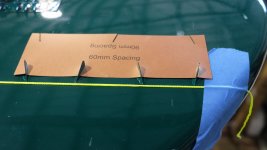
The Stolspeed set up requires VGs at 60mm spacing for the 900mm in from the wing tip, then 90mm for the remainder of the wing. My understanding is that this gives the outer 900mm of wing better boundary layer adhesion hence the aileron control.
What I’m going to say next is speculation on my part not based on research I’ve done. I imagine that different wing profiles will produce different results. A P51D has the point of max camber two thirds of the way back from the leading edge of the wing. That was to maximise the low drag laminar flow that will only exist in a decreasing pressure gradient, hence the Mustang went faster than the Spitfire with the same engine. However, I think that the Mustang wing would respond completely differently to VGs for that same reason, if you put them forward you would kill the speed and if you put them aft they wouldn’t help much because the wing area that benefitted from them would be small and likely be less effective. The reason I mention a Mustang wing is it’s the most different wing profile I know of to what we are flying.
What this means to me is that for our aircraft we need to fit and test ourselves. There maybe some wings that do break more positively and without warning but that’s not my experience with my aircraft. Bit long winded but hope that helps.
The Stolspeed set up requires VGs at 60mm spacing for the 900mm in from the wing tip, then 90mm for the remainder of the wing. My understanding is that this gives the outer 900mm of wing better boundary layer adhesion hence the aileron control.
What I’m going to say next is speculation on my part not based on research I’ve done. I imagine that different wing profiles will produce different results. A P51D has the point of max camber two thirds of the way back from the leading edge of the wing. That was to maximise the low drag laminar flow that will only exist in a decreasing pressure gradient, hence the Mustang went faster than the Spitfire with the same engine. However, I think that the Mustang wing would respond completely differently to VGs for that same reason, if you put them forward you would kill the speed and if you put them aft they wouldn’t help much because the wing area that benefitted from them would be small and likely be less effective. The reason I mention a Mustang wing is it’s the most different wing profile I know of to what we are flying.
What this means to me is that for our aircraft we need to fit and test ourselves. There maybe some wings that do break more positively and without warning but that’s not my experience with my aircraft. Bit long winded but hope that helps.

AKKen07
Well-known member
I put the VGs on my Bearhawk B model wings minus the 18” extended wingtips. Following Stolspeed’s guidance installation was a breeze. I used 5% chord to front of VG. Weather cooperated for a limited window today so I called my fellow test pilot (Dad) to give her a spin. We tested at 2250lbs with a CG slightly forward of center. All speeds are indicated and highly suspect due to high AoAs. Also, wight and CG might be off due to all the changes made since I last weighed her.
I started with two high speed taxi runs to make sure there were no major problems and got airborne briefly - but then the wings just held on! It floated nose up high well after it “should” have landed.
Power off stalls were unrecognizable. Instead of a clear stall at 56 mph (flaps up) as per previous tests at this weight/cg it slowed to 50 and just stayed there, controllably mushing its way to Earth at 1000 fpm. Flaps 2 of 4 notches went from 53 to 48 with the same controllability increase. Wild!
Full flaps now do nothing to the stall speed. It was minor before and now they are just drag.
Power on, flaps up, the plane now sustains a 33 degree nose up attitude at full power and 46 mph. Climbing at roughly 300fpm. In all cases the control stick is fully aft at the stop and the ailerons are effective through the stall.
I started with two high speed taxi runs to make sure there were no major problems and got airborne briefly - but then the wings just held on! It floated nose up high well after it “should” have landed.
Power off stalls were unrecognizable. Instead of a clear stall at 56 mph (flaps up) as per previous tests at this weight/cg it slowed to 50 and just stayed there, controllably mushing its way to Earth at 1000 fpm. Flaps 2 of 4 notches went from 53 to 48 with the same controllability increase. Wild!
Full flaps now do nothing to the stall speed. It was minor before and now they are just drag.
Power on, flaps up, the plane now sustains a 33 degree nose up attitude at full power and 46 mph. Climbing at roughly 300fpm. In all cases the control stick is fully aft at the stop and the ailerons are effective through the stall.

500AGL
Low & Slow & Door Open
I thought I would have responded to this long thread but perhaps I didn’t as so much info was already posted.
They work as described but my suggestion is to use the 5% of chord as the maximum you would want.
The whole purpose is to have them effective when your AOA starts increasing, and quite literally they work the best between 1.1 and 4% of the chord. Many think it’s too far forward but it’s not. Round it out and place them at 2-3% and they work great.
No effect on cruise speed.
As others mentioned there is no stall “break”, just a mush down like an elevator, in full control.
pb
jerry burr’s data on a cub wing
They work as described but my suggestion is to use the 5% of chord as the maximum you would want.
The whole purpose is to have them effective when your AOA starts increasing, and quite literally they work the best between 1.1 and 4% of the chord. Many think it’s too far forward but it’s not. Round it out and place them at 2-3% and they work great.
No effect on cruise speed.
As others mentioned there is no stall “break”, just a mush down like an elevator, in full control.
pb
jerry burr’s data on a cub wing
Last edited:
AKKen07
Well-known member
No change in cruise whatsoever. I can’t think of a downside other than the obstacle they pose when washing the bugs off the wing. On second thought - previously I could carry a touch extra speed to land then chop the throttle and the plane would plop down and stay down. Now if I have any extra speed it bounces back up and tries to fly again… but that’s just a matter of adapting my landings to the new characteristics.
AKKen07
Well-known member
That is some interesting info. 5 percent is what the Stolspeed manufacturer (JG) recommends and is also the farthest forward I’ve seen until your post. He also mentions that they can’t be too far forward for stall performance but at some point they are more likely to cause cruise speed losses. Maybe less of an issue on a cub than a Bearhawk.
500AGL
Low & Slow & Door Open
It’s just one man’s opinion and of course they work different on each aircraft and airfoil.
But, after a lot of time listening, reading and learning from wise old pilots, I installed the stolspeed VG’s on both cubs I had and the factory Patrol using the above chart as my reference. All three aircraft showed the same improvement characteristics over a stock wing.
With the VG’s and tail weight to get the near empty CG back close to the 25% of MAC, I had to use two additional seat cushions to get my vertically challenged torso high enough to see anything on Stol landings.
But, after a lot of time listening, reading and learning from wise old pilots, I installed the stolspeed VG’s on both cubs I had and the factory Patrol using the above chart as my reference. All three aircraft showed the same improvement characteristics over a stock wing.
With the VG’s and tail weight to get the near empty CG back close to the 25% of MAC, I had to use two additional seat cushions to get my vertically challenged torso high enough to see anything on Stol landings.
Attachments

Last edited:
500AGL
Low & Slow & Door Open
 If you zoom in on these photos, you can see the VG’s on the slope of the leading edge. We can ask Virgil to put a straight edge up and measure back, but as I recall and looking at the photos I’m thinking it was 2-2.5” back from the LE, horizontally.
 That would equate to 3.5-4% of the 60” chord.


rodsmith
Well-known member
Completed installing Stolspeed VGs on the wings yesterday at 7% chord and had my first flight today with them. You have to experience the difference with them. I normally take off with flaps 2, lift the tail at around 30k and lift off at 50k. I didn't get the tail up to level before leaving the ground, according to Flysto.net that was at 37k. My Vso has been a very repeatable 46k. I did four flaps up stalls and they all occurred halfway between the 41 and 42 on the airspeed tape. With flaps 2 the stall was occurring at 39k. Flaps 3 and 4 I could only get to 38k with full elevator and it wouldn't stall, just developed a very high sink rate. I thought I had ordered Vgs for the stabs at the same time but turned out I didn't, so I had to place another order. They are supposed tp arrive tomorrow, can't wait to see what they do. Hopefully with them in place I can get the plane to stall at flaps 3 and 4. Lots of testing to do now. I did not check my cruise speed or top speed. With what they have done for the stall speed and the overall solid feel of the airplane in slow flight, I don't mind sacrificing a couple knots on the top end.
Nev
Quick-build 4-place B #25
Completed installing Stolspeed VGs on the wings yesterday.....
Excellent results Rod.
A interesting exercise is to perform a number of stalls with power ON to keep the elevator authority going into the stall. It can change the outcome markedly with a much higher pitch attitude (28° in my case) before dropping wing. Having an aft CG on mine also keeps the elevators active at low speed and changes the stall characteristics. My lowest stall speed (F3 or F4) at 2200 lbs is also around 37-38 KIAS.
Good work !
Last edited:
With my LSA, I am easily getting in and out of a grass strip in 400 feet or less at 80 degrees with a stock o200A, Catto prop and Vetterman exhaust. Not too shabby. It handles very well at low speed with no complaints. The stall is a non event and very docile but it does stall pretty much across the wing as it does not have washout. I flew other small planes with VG's and was impressed. I bought a set of Stolspeed's and was wondering if anyone has used them on the LSA. If I can make it land a few kts slower and not lose any cruise speed for less than $200, I am all in. If I place them at 5 percent as Stolspeed suggests, this will be 3 inches back from the LE. I think 4 percent would be be better for this Riblett airfoil. This would be 2 1/2 back. I wonder if placing them that far forward will affect cruise speed.
rodsmith
Well-known member
Completed testing the VG installation. They were installed at 7% chord. I considered 5% but Jon Battson had very good results with 7% on his A model wing. I installed them according to directions with one exception. You are supposed to use 60mm spacing for the first 15 vgs inboard from the wingtip, about 36" and 90mm spacing inboard. I calculated that I had enough to cover from wingtip to the inboard end of the ailerons at 60mm spacing. I asked G J his opinion, he said can't hurt, might help. I am thoroughly impressed with them. Verified they decreased the stall speed a solid 5 kts from no flaps to full flaps. Adding VGs under the horiz stab increased the elevator authority at slow speeds. With just the wing VGs, I couldn't get a stall break at F2, F3. That changed with the stab VGs. Also I was not able to make a full stall landing before installing the stab VGs. Now I can make a full stall landing tailwheel touching just before the mains, touch down speed high 30 kts. I have verified that cruise speed dropped 2 knots which is an okay tradeoff. Strangely, full power speed seems to be the same as before. The one change I don't like is that the glide ratio decreased from 9.2 to 8.4. I will be retesting that as the air wasn't as stable as my first test, and OAT was 18F warmer.




Sierra Skydog
LSA quickbuild
I’m interested in hearing about your results with vg’s, am also thinking about adding them to my LSA. I also have O-200, Catto prop, vetterman exhaust.
I installed the Stolspeed's on my LSA and flew it this morning. I know that the bigger Bearhawks have had good success at 7 percent of chord. I couldn't decide between 6, 6 1/2 or 7 so I decided on 6.665 which is an even 4 inches of chord. This morning I flew it at 85 degrees on a grass strip solo with 1/2 fuel. Previously when I took off, if I eased it off when it started flying, it would skip on the ground once or twice. Now when it started flying, it flew right off in less than 350 feet. I lost about 1 mph in cruise but lowered my power off stall 3-4 mph. Power on is even better. I have always had good aileron control in the stall and still do. I put about 1/4 inch reflex on the ailerons when I built it. I did have to relearn how to approach and land though. Before, i would be downwind in cruise, apply carb heat and reduce power to 1500 abeam the numbers and slow to 60 mph and turn base. I would let it slow to 50 mph while reducing more power on base and turn final then slip it to a landing while reducing speed some more. It would land 3 point after floating a short distance. Now, I turned base at 60 and it would not slow down while descending on base at idle. Turning final at 60, it was hard to get it to slow down so I slipped it down and floated halfway down the runway. Interesting. Tried again but reduced power earlier in the pattern and got 50 before turning base. This time I slowed to to 45 and slipped it to a decent landing but still floated. In both of these landings, in my "hurry" to land the mains touched first. I did a couple of more like this and realized that it wheel lands much better. It had always been a struggle to wheel land it on grass. On my last landing, I turned base at 50 and got it to slow to 45 on base, slipped it a little and was short final at around 40. It landed 3 point in less than 300 ft in wet grass. The wheels locked up the wet grass so I didn't get a lot of braking. I always had aileron and elevator control. So far, I really like them. The airplane certainly wants to fly at lower speeds. Later, I will report how it does with a passenger and on pavement.
Hey 500 AGL. I now see that you have a Patrol. As you know, the LSA doe not have flaps. Also the LSA wing is a 60 inch chord instead of 66. As I understand it the LSA has a different airfoil because of this. I am perfectly willing to move the VG's anywhere to get the optimum performance. I do travel around with it and don't want to lose much cruise speed. I put them at .665 to just to get started. I would like to hear from anyone else that use the VG's on an LSA. I am happy where they are but am certainly willing to change them. Hope to see you at Oshkosh.
Bcone1381
Finished Patrol
Hey 500 AGL. I am perfectly willing to move the VG's anywhere to get the optimum performance. I do travel around with it and don't want to lose much cruise speed. I put them at .665 to just to get started. .
I am curious and want to know how difficult it is to move your VG's once you install them.
The Stolspeed's attach with their double sided tape which is included with the kit. The tape is laser cut to fit each VG. They appear to be fairly easy to remove without scratching the paint. I haven't tried it yet. I guess the easiest thing to do would be to contact them to order some more laser cut tape and just reattach them all. I won't move mine until someone else with an LSA tries something different and convinces me. It appears that I might be the first one to try it on the LSA. I will give more info as I fly it more.
rodsmith
Well-known member
I am curious and want to know how difficult it is to move your VG's once you install them.
I found if you twist them they pop right off. I bought a sheet of the 3M adhesive that JG provides laser cut, pushed the VGs into it and cut it out with an exacto knife to replace the adhesive. I had initially misunderstood the instructions for under the stabs and had to redo half of one side.
I just removed the VG's from my LSA. Last year while flying to Lakeland, I landed at an airport with a serious gusty crosswind - at least 15 gusting to 25- and managed to land on pavement with no issues. Yesterday I encountered a lesser gusty crosswind and it was a chore to keep the airplane planted on the ground. With every gust it wanted to fly when I wanted it to stay on the ground. Another problem I had was it was almost impossible to do a 3 point landing. I would run out of elevator when flying solo. Of course, I could put VG's on the tail to help that but the crosswind episode helped me decide.
I don't want to speak for Virgil but I know he's busy. This question came up at Oshkosh and I wrote down in my notes that his answer was 3%. I was thinking about installing them but have been holding off for now. I remember him saying it was farther forward than the starting point but that they had tested a few locations and liked that point.

Rspencer
Member
Ok. Good to know. I saw his old YouTube video on his 5 wing (very different) and he decided 5% wasn’t good but 7% was. Obviously lots of conversation in this thread alone, but not a real consensus on the 4A wing location. Anyone else agree for 3%. And anything special for the horizontal stab location?
If you've seen a different number it is probably worth reaching out to verify. I don't have high confidence in my notes being right.
Fred Williams
Member
Based on my touchdown speeds in my Companion, I think you guys are missing out not using the Hall Brothers VG I am using. I am not the first to use them as the testing was done by a Patrol owner who is not building a Companion.
How much difference did they make? What are your stall speeds with and without? Where did you place them. I've got a Patrol but inquiring minds want to know... TIA
Rspencer
Member
I saw a YouTube video of a Patrol owner who tried them and Stolspeed. His biased opinion was stolspeed was slightly better for a handful of reasons. Based on that and MANY other Stolspeed recommendations and writings, I went that route. Got them painted tonight. So ready to go on tomorrow.
Fred Williams
Member
I saw a YouTube video of a Patrol owner who tried them and Stolspeed. His biased opinion was stolspeed was slightly better for a handful of reasons. Based on that and MANY other Stolspeed recommendations and writings, I went that route. Got them painted tonight. So ready to go on tomorrow.
I've recently received the StolSpeeds for my Patrol as well. Haven't painted them yet but am trying to gather info on where to place them. I'll be checking back here to see if anyone can provide good guidance on where to place them and what it did for the performance of their Patrol. TIA

Utah-Jay
BH Companion
How much difference did they make? What are your stall speeds with and without? Where did you place them. I've got a Patrol but inquiring minds want to know... TIA
As per FlySto.net my average touchdown speeds is 38 mph IAS, and that includes all the early landings when I was learning the plane some of which were over 60 mph IAS.
My typical landing nowadays is 35-37 mph IAS.
Slowest was 32 mph and the plane was still flying.
I never flew without the VG’s, never felt the need after I saw the data that Chris sent me. And they were a lot easier to install prior to hanging the wings
Fred Williams
Member
As per FlySto.net my average touchdown speeds is 38 mph IAS, and that includes all the early landings when I was learning the plane some of which were over 60 mph IAS.
My typical landing nowadays is 35-37 mph IAS.
Slowest was 32 mph and the plane was still flying.
I never flew without the VG’s, never felt the need after I saw the data that Chris sent me. And they were a lot easier to install prior to hanging the wings
How far back did you place them?
Utah-Jay
BH Companion
How far back did you place them?
I can measure tomorrow, they are placed a certain distance from a Rivet line
Battson
Moderator
How far back did you place them?
I understand that they are best positioned so that when the wing is at the highest angle of attack, the VG is fully exposed to the oncoming airflow i.e. at the highest point of the wing. That's how I arrived at my recommended location for install, and practically it's proved a winner. You can apply the same approach with your aerofoil, all you need to know is the AOA at stall (in landing configuration). You want them at the highest point of the wing, when it's at the stall AoA.
My understanding comes from a lot of pre-reading, watching other guys testing on Youtube, practical experience on my own plane (the modified NACA Bearhawk-A aerofoil), and discussing the Breeden's experience from testing VGs on their Cubs in AK. Bob Breeden reached the same conclusion as I did, highest point on the aerofoil at stall AoA.
I note that the % chord would vary based on the aerofoil. So if Cub guys are saying 12% and Vans guys are saying 7%, that doesn't necessarily mean it would be ideal for the Bearhawk. We know people have tried them further back on the Bearhawk and it yielded poorer results.
You want one straight line across the wing, not a staggered arrangement.
I would follow STOLspeed's recommendation about spacing, and use the templates provided. They specify tighter spacing in the outer section of the wing.
Here's my post about where I installed mine:
https://bearhawkforums.com/forum/flying-and-flight-testing/2251-who-is-using-vgs/page3
Last edited:
Utah-Jay
BH Companion
I am a believer in results, here are some real world results with the Hall Brothers VG’s on my Companion. The Flysto.net says I have done 8 touch & go’s, but I have never done a touch and go, so the data is a bit skewed from doing low passes over strips for inspection purposes. The dots in the black circle are some of the so-called touch & go’s, but they are still calculated in the average so the average is higher than actual touchdown speeds.
Debate all ya want, here are results!

Debate all ya want, here are results!
Utah-Jay
BH Companion
Battson
I would say my average weight at touchdown is about 1800#’s, that is +/- 25 of accurate.
Location of the VG’s? Further back than the StolSpeed VG’s, all the testing was done by Chris Spira who did the testing on his Patrol. Chris’ testing data is exhaustive!!!! He tested VG location by % of the cord, included aircraft weight that day. He included humidity and DA in the daily testing data. I have a copy of all of his testing somewhere.
I am not aware of an ASI error on my plane, when checking it matches really well with my GS when correcting for my typical DA of 6000’ to 8500’ depending on the time of year (temps)
Hope that helps.
I would say my average weight at touchdown is about 1800#’s, that is +/- 25 of accurate.
Location of the VG’s? Further back than the StolSpeed VG’s, all the testing was done by Chris Spira who did the testing on his Patrol. Chris’ testing data is exhaustive!!!! He tested VG location by % of the cord, included aircraft weight that day. He included humidity and DA in the daily testing data. I have a copy of all of his testing somewhere.
I am not aware of an ASI error on my plane, when checking it matches really well with my GS when correcting for my typical DA of 6000’ to 8500’ depending on the time of year (temps)
Hope that helps.
Battson
Moderator
I think there is more opportunity for studying these numbers. Jonathan has additional wing area at the tips, and Jay has a significant density disadvantage. I would have guessed those would be worth a few knots each, but guessing isn't worth much in these contexts.
The other thought that comes to mind is how important weight is. One fellow just completed a build and his empty weight was in line with these gross weights. He's not the only one either.
The other thought that comes to mind is how important weight is. One fellow just completed a build and his empty weight was in line with these gross weights. He's not the only one either.
Utah-Jay
BH Companion
My plane weighs 1276# empty, I have never landed with less than 12 gallons, and I typically have about 30#’s of junk in the cargo area. I weigh 210 most days in flying clothes.
I land with Flaps 3 and in a 3 point attitude, I have never full stalled a landing.
My plane will not stall, the nose has never dropped, and a wing has never dipped when doing stalls. I lose the will so to speak at about 19* nose up and dropping 650 fpm doing stalls.
Sorry if my data is not in line with other BH’s, I can only tell you what my plane does.
My Companion is currently for say word of mouth, goes on Barnstormers this Sunday…. But a VERY good glider pilot is thinking of buying it and I took him up two weeks ago and he too gave up on trying to get it to stall. I add that as I am just an average pilot
I land with Flaps 3 and in a 3 point attitude, I have never full stalled a landing.
My plane will not stall, the nose has never dropped, and a wing has never dipped when doing stalls. I lose the will so to speak at about 19* nose up and dropping 650 fpm doing stalls.
Sorry if my data is not in line with other BH’s, I can only tell you what my plane does.
My Companion is currently for say word of mouth, goes on Barnstormers this Sunday…. But a VERY good glider pilot is thinking of buying it and I took him up two weeks ago and he too gave up on trying to get it to stall. I add that as I am just an average pilot