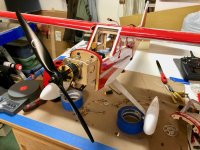
Electric powered BH ultralight

Mark Goldberg

Bearhawk Aircraft
Bob is doing some thinking/designing of an ultralight that would be electric powered. He thinks he can design something within the weight limits of the ultralights. It would have an electric engine and lithium batteries. He is shooting for 1 hour endurance. He thinks that being able to fly with little to no fuel cost, no oil changes etc - would be an appealing little plane. Kind of like a shrunk down, single seat LSA.

He has been telling me about it. Its wing would be aluminum leading edge with fabric behind the main spar. Aluminum spar & ribs. Tube fuselage structure.

I suggested to Bob that he allow me to mention here on the forum. Some of you guys are awfully knowledgeable, and have expertise where Bob doesn't. Meaning the electric motor, its controls, and the batteries. If anyone has experience in these areas and have thoughts that could perhaps help Bob in these areas - feel free to call him and talk. Mark
 
That's funny, I was just thinking yesterday that an ultralight might be fun just to go play around in sometimes. Now there might be a Bearhawk ultralight, which by the definition of Bearhawk, as far as I'm concerned, means it will outperform everything else in its category, that should be a blast.
 
I like the idea. The future of aviation will need too be electric. Currently avgas is too expensive for most of us to do the type and frequency of flying my dad did 30-40 yeiars ago. We have 1/2 to 1/3 the number of ga pilots. These ideas will directly increase access of flying for the masses. Brilliant work Bob.
 
Bob should contact Brian Carpenter of Rainbow Aviation. He's been experimenting with electric powered ultralights for a while now and should be able to share some expertise.
 
A half VW is still pretty heavy for an ultralight. Check out what James Wiebe has been up to over at Belite (www.beliteaircraft.com). He's got several different ultralight aircraft kits available, along with a bunch of different engines he recommends. Until recently (see next paragraph) he was dallying with electric power for the ultralights. He also has a line of very lightweight flight instruments that are pretty cool. Interesting guy...

His most recent project is the "Chipper" which is a 2-seat LSA-compliant experimental, currently powered by an HKS 700, a 2-cylinder, horizontally opposed 4-stroke putting out 60 HP. It just started flying, so not a lot of data on it yet, but it's pretty interesting.
 
Last edited:
In speaking with Bob I learned he is looking for electric powerplants, so I'm putting feelers out. Anyone know of some good plug & play systems? Motor, controller, charger possibly. Bob said he is not looking for batteries (they are constantly improving) or a $25k price tag.
 
Bob might want to talk with the folks who are building the "EMG" (Electric Motor Glider), as they've been experimenting with this for a few years now, and have tried literally dozens of electric motors, controllers, etc. Brian Carpenter was selected by the National General Aviation Awards Committee as the recipient of the 2017 National Aviation Maintenance Technician (AMT) of the Year Award. He has also done a bunch of videos for the EAA's "Hints for Homebuilders" program. Carol Carpenter (his wife, and fellow EMG designer / expert) may be the most organized person on earth, is an acknowledged expert in the field of aviation maintenance and regulation, and is consulted on a regular basis by the FAA. Together, they teach one of the few FAA-approved 2-day Light Sport Repair man Inspection courses, and also the 15-day Light Sport Repairman Maintenance course. Great folks, and always an interesting conversation. Their Electric Motor Glider web site (https://electricmotorglider.com/) makes for an interesting read.

I know Bob doesn't like email very much, so here's a phone number he can use to reach them: 530-527-5141.
 
I think the battery cost/weight are still prohibitive. A 5-10,000 dollar small motor still makes more sense, and doesn't use a lot of gas. I have been using rechargeable batteries since the early 70's in model aircraft. The pace of battery technology has been a snails pace, and still is. Electric Cars are getting subsidized so they are getting batteries at or below cost. Bob won't be receiving the same subsidy. Someday it will make sense, but I don't think that day is today.

Bob makes things that are highly useful. I don't think electric airplanes are there yet.
 
Come on, SV. If we wait till it makes perfect economic sense to try an electric plane, it'll never happen. Kinda like the electronic fuel injection / ignition systems for Lycomings. They're so expensive, it's hard to justify them other than because one chooses to step forward, out of the box. I think it's great that some folks choose to go that route. Good thing Wilbur and Orville didn't wait till airplanes made economic sense... Far as I can tell, they'd still be waiting! :cool:

Bill
 
Design it for a 90 lb 1/2 VW motor of 38 hp. When they can make a 38 hp electric motor and battery combination that weighs something close to 90 lbs, and at a price people will open their wallet and buy it, wah lah! Electric airplane. The electric motors are there. The batteries are too expensive, and too heavy if you want any kind of endurance.

I know of a couple of trike (Hang gliders with a motorized frame) vendors that offer electric propulsion as an option, and have for several years. I haven't looked for a while, but I believe it was a 15,000 dollar option. That is for 15 hp, and 30-40 minutes of endurance.

I love the idea. I also love the idea of the flying car that has been on the cover of Popular Mechanics for 30 - 40 years. Neither are going to happen anytime soon.

Say you are in the market for an ultralight that is going to cost 30k, all up. Would you personally pay an extra 25,000 dollars for the electric option? I would not.
 
It's great to hear Bob is considering an electric plane and hopefully we get to see it take flight. As mentioned battery cost/weight will be the challenge. Even so it is exciting to see him take interest in exploring something new. Guys in their garage doing what many think to be undoable or impractical is part of the homebuilding spirit. If this is what sparks his interest and gets him interested in creating another design, then more power to him.

I've recently switched to brushless motors in my RC planes and have been enjoying many hours of thrust/flight testing dozens of different prop/battery combinations. It's amazing how specific you can get with the ability to pair different combinations of motor kv, battery voltage, and prop size/pitch/blade count.
 

Attachments

  • photo4261.jpg
    photo4261.jpg
    378 KB · Views: 0
Last edited:
Thinking about it a bit more, I think the LSA might might make a more marketable electric plane than an ultralight. LSA builders are typically older (and better off financially), and adding 20k to a 70K airplane is easier to swallow than adding 15k to a 25k airplane.
 
Bob makes no claim that his ultralight will be practical. Ultralights are rarely so. That's the beauty of them. Once you go ultralight, you can relax a lot of the "practical" requirements you might otherwise have with standard or utility category. A one-hour flight is considered a long flight in any ultralight, with 15-30 minutes being typical. I think the biggest issue will be system cost.
 
An affordable Plans built or kit ultralight is just what is needed right now with only one real competitor (Legal Eagle). Gas powered and folding wings would be the #1 leader in my humble opinion.
 
Ultralight isn't the answer with electric, it's glider or LSA-glider if you want. Electric motor glider to be specific. The FARs treat gliders with about the same I don't care about anything you do in them as an ultralight, except without the weight limit.
A great example of taking advantage of these rules is the Pipistrel Virus. Anyone looking at it would say it's just a small plane, but it's in the glider category. They have the 912 and electric options for powerplants. Ridiculous speed and range(147kts and 7.5hrs) without the arbitrary LSA limits, especially the really dumb fixed pitch prop limit.

I see Jim above mentioned Brian and Carol Carpenter already and I'd highly recommend getting in touch with them. I've taken their 15 day course.
https://electricmotorglider.com/
 
Last edited:
The Sonex people did a flight if i remember correctly.... ...battery motor combo back in 2010...lots on info online if there is an interest....as others have said battery technology is the limiting factor..


other interesting videos...


this plane claims a 3 hour flight time

 
Last edited:
:D Just prior to reading this post, ..I've just held up the master rib of my Bearhawk LSA against the Merlin GT wing that I'm currently re-doing in the shop here, thinking how simple, light and yet strong the foam, aluminum caps and solid D-cell leading edge actually are (and single strut - which Bob likes). To be honest I was wondering if one should re-do the Merlin wings with the Bearhawk LSA airfoil. And I'm still tempted. Why, well as comparison, my BushCaddy R80 wings which are similar to the LSA wing are substantially heavier, most likely stronger but at the 1232 MTOW here in Canada maybe a little overbuilt (compared to the 601, 701, Savannah, Kitfox, Beaver's, Chinook's etc).
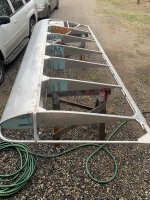
Don't think I ever felt less safe in a Merlin GT as I do in other advanced UL's or LSA's. As for the history of this foam type of wing construction, it goes right back to the Grandmother of all UL's, the venerable Lazair. And in good Lazair tradition of leading innovation they went electric, ..and electric on floats. https://www.youtube.com/watch?v=YINO0aoSAGg
Personally I'd rather see a slightly lighter version of the Bearhawk LSA as a UL vs the rather winged garden chair set up of the Lazair. I think it's time to soul search and start looking closely where we came came from in the UL field and what is available to us in state of the art materials, machining and power plants. To just re-invent 1930's designs will give you exactly that, a re-invented 1930's design over and over again.
Further more, I totally agree that one needs to take a serious look to Europe and China. Ooh ..and maybe Vancouver, BC where Harbour Air decided to go electric on their DeHavilland Fleet of Beavers and Otters. I'm certain and without a doubt, that the first company which can offer an electric plug & play drive system into a Rotax 912 engine mount will come out the clear winner. Electric flight is coming and the winners will once again be those that weren't afraid to drop the typewriter for a laptop.

And NO, I wouldn't entertain 1/2VW's, Rotax's, Polini's, Simonini's, ..what's the point, 1930's all over again? Think my calendar shows 2019. Keep dreaming, keep building, keep innovating!
 

Attachments

  • photo6005.jpg
    photo6005.jpg
    4.8 MB · Views: 0
Mark, I’m a bit late to this party, but I’m happy to chat with Bob about electric aircraft. PM if you think he’d be interested. I’ll also probably be working at Oshkosh if you think that may be a good time to discuss.

In terms of references, skim through some of the full-length papers and presentations here. This list does not show the latest publications, but I think you may find the Preliminary Design Review (Nov 2015) and especially the Critical Design Review (Nov 2016) helpful regarding the components and architectures for electric aircraft.

https://www.nasa.gov/aeroresearch/X-...cal/index.html
 
Bob told me he was concentrating on getting the structure built - and then he would focus on the electric motor and controller. He thought things are changing so fast that it made the most sense to wait until the last for that. He does have a target motor weight and power required in mind.

Mr. BC Bearhawk LSA - we think the existing BH LSA will be a good choice for the Canadian Advanced UltraLight category - AUL. Even with the restriction in gross weight to 1232 lbs, it seems to have many advantages over the planes in that category in Canada right now. Mike Silvernagle (Bearhawk Canada) will be pursuing this path. Mark
 
I could see this as my next project. I spent most my working career in electronics and motor controls. There is a lot of activity in this area, one possible related connection are the guys doing electric racing go-carts.
 
I honestly don't think this is going to work based on how much electric cars weigh and the cost. Here are a few things to factor:

1. The electric motor and speed controller are fairly heavy. You could probably get something in the 26hp/20kw range down to 75lbs, but not less than that. Here are examples: https://www.goldenmotor.com/frame-bldcmotor.htm or https://www.alibaba.com/product-det...pm=a2700.7724857.normalList.35.725a7960V9b90C or even (4) of these turning a common gear https://www.monsterscooterparts.com/48v-5000w-brushless-aircooled-motor-golden.html

2. In order to provide a 15kwatt (20hp) power output, given 90% efficiency, for 45 minutes, that would take a 48volt 234amp/hour battery. And for lithium batteries, you don't want to discharge more than 90% because it hurts the battery so much, so you really need a 257amp/hr battery. So you would need a 12336 watt/hour battery (257amp/hr x 48 volts).

3. Looking at a battery tech, right now the most energy dense batteries are Li-Polymer (read dangerous) or Li-ion (which is what the cars use, and only mostly dangerous). Li-ion cylindrical cells are around 150watts per Kg. (https://www.epectec.com/batteries/cell-comparison.html) So if we look for 12336 watts like above, this battery will weigh around 82kg, or 180lbs.

4. The battery and motor above are getting into 255lbs, and we haven't covered wiring, speed control, cooling (batteries and motor and speed controller)....

5. If we look at a fuel engine, perhaps the Polini Thor 250 Engine used in the Just Solo 103 ultralight, it weighs less than 50lbs with radiator, and starter, and produces 36hp. Add another 36lbs in fuel and you get less than 90lbs of engine/fuel and it can easily go for an hour and a half. Even the 1/2 Vdub is lighter than an electric power system, by a lot.

Call ma a pessimist, but I've done a lot of electric conversions for model scale aircraft (and I fly electric Helicopters) and the only way that electric is lighter than a fuel airplane is if you cut the run time down to 3-4 minutes. That said, if you are willing to live with the fuel payload trade-off, the electrics are very powerful and smooth.

schu
 
That is actually my next project after the Patrol.. My career was in motors and control systems. I would think some of the all electric motorcycles would make good donor machines.
 
15hp is plenty of power to rock a bike around, even 5hp would probably be enough to cruise, and you can recover some of it every time you stop.

With an airplane, 15hp is absolutely nothing, and there is nothing to recover when stopping, not to mention the lack of electrical infrastructure at various airports to charge it.

All that said, it can be done, sonex did it, it just didn’t compare to a fuel powered airplane when it came to actually flying somewhere.
 
I honestly don't think this is going to work based on how much electric cars weigh and the cost. Here are a few things to factor:


I'm surprised. Looking at Schu's avatar, I judged him to be a young man. Based on today’s technology, I’d say the arguments are correct. However, when I began subscribing to automotive magazines ( in the 70’s), the unattainable 'holy grail' was 1 hp per cubic inch displacement. Years later, the goal was 1G lateral cornering. Recently I read about Ford's new "track day" GT that was capable of 2G lateral! Horsepower/ cubic inch? Who knows!
I'm an old dinosaur. But I absolutely envision the day when battery technology approaches the energy density of an equivalent mass of gasoline in a tank. Maybe I'm dreaming. But I sure wouldn’t bet against it! Aerodynamics have been refined for over a hundred years, so that part is fairly settled for our purposes. The concept of electric propulsion is in it’s infancy. I honestly think Bob is a pretty sharp guy, to start designing a useful, back country type airplane, in anticipation of developments to come.
C'mon Schu! Push that box a bit!

Bill
 
I think about where we were 10 years ago, and where we are today, and use that trend to predict the future. An electric motor/battery pack does not have to be lighter than an equivalent piston engine, it just has to light enough.

Regarding cost, the largest cost in operating an airplane may be fuel, maybe the second is reserve for engine overhaul, third may be maintaining the engine. Eliminate those three will leave a lot of money to spend on batteries.
 
I've been watching Brian Carpenter's electric motorglider project. It is stalled at the moment due to company logistics rather than technological logistics, but interestingly he does talk about the possibility of using the battery power to climb to a soarable slope, then using a windmilling prop to regenerate when in the slope lift. I also fly paramotors and paragliders, and am watching the space closely for electric power as a means to self-launch into naturally occurring lift like thermals. When we stop trying to match electric power and IC in the same boxing ring, and let each one do what it does well, there are some off-the-shelf "today" options that are viable.

If/when Brian gets back on track with his project I'm a real customer prospect. Don't tell my wife, she might not know about that yet.
 
I have been using rechargeable batteries since the mid 70's. NICAD, NiMH, and LI. Better batteries are always only a few years away. 45 years later, it is just a few more. LOL

The only big "improvement" in the last 5 years is cost. They have come way down in cost. The only big thing on the horizon for weight is what they call solid state batteries. The solid part being a solid instead of liquid electrolyte. A couple of car companies (including Toyota) just invested a bunch of money into a couple of companies that are developing them. That was a big change in course for Toyota as they have been convinced H fuel cells were the future.

The energy density is supposed to be double that of the best LI tech today. That means batteries that weigh half. They are "hoping" for useable batteries, for sale, by 2025.

Motor and controller tech have been good enough for quite a while. But the motors aren't cheap either. Lots of expensive metal.

I plan on watching and waiting while burning dead dinosaurs for as long as it takes.
 
Schu is a young man, and also an engineer, and also one that has converted a lot of gas aircraft to electric, but only up to 25% scale. I have a 5kw helicopter, I have a 3kw aerobatic airplane, I understand the difference, and I'm using some of the best battery tech available today.

At the end of the day, the best battery tech stores maybe 300 watt/hrs per kilogram. Compare that to gasoline at 12500 watt/hrs per kilgram and you can see that we have a way to go, even if gas engines aren't all that efficient. Remember, a telsa model 3 long range only has a 325 mile range (translation, only about 280 ) and weighs 3800lbs. Compare that to a ford focus that weighs 3000lbs, and can do the same with 48lbs of gas on board.

That said, if you just need it to get you into the air (motorglider) then that could work, and you could cut some weight out with lighter engine mount and such...
 
I couldn't agree more. I think current battery tech makes a decent self launching sailplane, and a "doable" 2 seat trainer with 46-60 minute endurance in VFR weather. The last one might save some money. And I say might. The batteries would take at least an hour to get back to 80%, so you can't fly the airplane flight after flight. Also the batteries will have a finite lifespan, and will need to be replaced periodically. Right now the cost of replacing the batteries might be higher than rebuilding a Lycoming.
What happens if the runway is closed, and your need to divert? Hopefully you can land in the taxiway or grass.
 
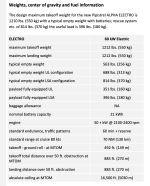
Pretty weak case if you ask me. From the specs:

payload fully equipped LSA 396 lbs. (180 kg)
standard endurance, traffic patterns 60 min + reserve
standard range at cruise 80 kts 70 NM (130 km)
nominal battery capacity 21 kWh
engine 50 + kW @ 2100-2400 rpm

In my example I suggested a 15kw motor at 45minutes needs a 12.3kwh battery assuming 90% efficient and 10% reserve capacity to not harm the batteries. In their specs you have a 50kw engine using a 21kwh battery. Now that's pretty easy math, at full power, with 100% efficient (it's not), and 0% reserve (you would destroy the batteries on the first flight) that's still only 25 minutes of battery.

This is why the standard range at cruise isn't even an hour (and I bet it's below 50% power), and the 60 minute numbers in the traffic pattern are almost certainly very careful recharging on descent, and very polite throttle inputs.

This airplane basically validates my numbers and I didn't even know about it. If you consider my numbers are for ultralight scale, and you double the motor and the battery then we have something pretty close to this pipistrel.

So if flying around for 45 minutes at a time, with a 396lb useful, with little ability to recharge at the destination airport, while telling yourself it's free when you have $100k of solar cells and electrical system mounted on your hangar, while touting that you are saving the planet does it for you, well, okay, I guess....
 

Attachments

  • photo6178.png
    photo6178.png
    239.5 KB · Views: 0
But if those "1-hour" batteries are removable, they could be recharged on a high-speed charger at the FBO for a tiny fraction of what gasoline costs, and the "electric trainer" concept might work out just fine... Even if it takes 3 hours on the charger to get to that "1-hour endurance" charge. you'd only need to purchase four batteries to be able to schedule students to fly that one plane for six hours every day... And reality being what it is, you could probably get away with only two "spare" batteries...

Assuming our hypothetical electric trainer gets utilized 6 hours every day, 7 days a week (pretty high utilization, almost 2200 hours per year), and assuming today's LiFePo battery costs hold constant, it would still seem to be a lot less expensive to replace six to eight of those batteries every year (roughly every 350-400 "cycles") than it would cost to overhaul an O-235 every year (almost 2200 hours per year).

I think eFly may have found the right market for their "soon to come" electric trainer: the big flight schools that fly a ton of hours per month year round...
 
Uh, it's not that simple. Lets consider the 21kwh battery in the pipistrel. That battery at 300wh per kilogram (which I seriously doubt it's that dense) is going to be a 150lb battery. This battery also needs cooling (this isn't a flashlight battery), and very large connectors and such. I'd bet it's at least 200lbs (actually looking at the 80hp rotax version vs electric, it's exactly 200lbs heavier).

So even at 200lbs, you still need to charge it. To charge this battery from dead to 100% in 3 hours you are going to to need a 7000 watt charger. That's a 240VAC/30Amp service given 100% efficient. You would probably need a 240VAC/50 amp. That's a lot of power. If you are planning on solar, then you would need 25 of these: https://www.wholesalesolar.com/1977...ergy-chsm6610m-285-hv-silver-mono-solar-panel again, assuming 100&% efficient. I'd bet on closer to 40-50 panels. So basically 700+ square feet of solar panels, and I've not even touched on the DC-DC converter needed to convert everything.

As for overhaul, these batteries will be expensive. The tesla model 3 (which btw, needs 12 hours to recharge at 220v) has a 50kwh battery, and it costs around $7k.

I'm not sure what it costs to overhaul a rotax 80, but I know you can buy a new one for about $16k. So if you only get 500 charges out of a the battery (which if it's just students and ran hard, I doubt even that) then the battery would have to cost less than $5000 to pencil given the rotax's 1500 TBO.

Another thing to think about is safety. When you have a 350V, 60 amp hour battery in board, fire is a very real danger. Also, electric airplanes don't make a "back, I'm dangerous" noise when they idle. They can go from dead still to totally destroying in milliseconds. In the model world, nobody starts a gas engine airplane in their house, a few people put their fingers in them, but the electrics have taken out many arms and fingers because they are dead silent until the moment they are totally on.

I'm not trying to be a Negative Nancy, but I do have an idea of the physics involved, and I think the battery tech needs to be twice as good before this even starts to pencil.
 
And the batteries will start losing battery capacity after less than 1000 hours, probably requiring replacement before 2000 hours. The retail price for battery replacement would probably currently be greater than the cost of rebuilding a Rotax or O-235.

But you could apply for carbon credits and let "someone else" subsidize your toy.
 
Schu, I bow to your expertise in the field. But considering that the VAST majority of LSA use the 100 HP Rotax, which costs a LOT more than $16K, I think there could be room for even a "small" batttery breakthrough to make a game-changing difference -- specifically for those FBOs who are doing high-volume student flights. And they probably won't be using solar power, but instead using 220V (or even 440V) power from the local electric company. It's not free, but cheaper than gas. The big issue, of course, is figuring out a way to package the batteries so that a mere mortal can swap them out. Maybe 3 x 50-lb "suitcases" or 4 x 40-lb units. Lots of stuff to still work out, as you said, and even more $$$ to justify it all and make it work.

I've got a buddy who was working with Carol and Brian Carpenter at Rainbow to help engineer their power supply and charge management stuff. They kind of stalled out waiting for technology to catch up. Turns out it's a lot harder to build a real live man-carrying airplane than an RC model of same... But you already knew that!
 
Jim,

The 80HP 912 ul is much cheaper than the 914.

https://www.leadingedgeairfoils.com/rotax-engines-parts/new-rotax-engines/rotax-912ul-engine.html
https://www.cps-parts.com/catalog/rtxpages/912rotaxengine80.php
http://zenair.weebly.com/rotax.html
https://www.rotechmotor.ca/PRICES.html

Given that is the engine that runs the electric pipistrel, that it's around 15hp stronger than the electric version, and can go for an hour on 24lbs of fuel, I just don't see how the battery tech is there.... If it was... I would be one of the first to build an electric airplane. I'm thinking about building an electric car some day. I think a Factory 5 818 would be a perfect place to start.
 
I believe there is also a little rule written somewhere requiring powered aircraft to land at their destination or alternate with no less than 45 minutes of fuel remaining. Electric powered aircraft are going to be exempt from this?

So the current Pipistrel takes off at the beginning of the flight, at critical fuel. If they flew just 30 minutes, they probably wouldn't have the juice left to climb to 1500', and cruise 10 miles. They may not be able to climb to 1500'. The Feds are going to grant an exemption for this, to give the FAA green points?
 
Last edited:
I believe there is also a little rule written somewhere requiring powered aircraft to land at their destination or alternate with no less than 45 minutes of fuel remaining. Electric powered aircraft are going to be exempt from this?

So the current Pipistrel takes off at the beginning of the flight, at critical fuel. If they flew just 30 minutes, they probably wouldn't have the juice left to climb to 1500', and cruise 10 miles. They may not be able to climb to 1500'. The Feds are going to grant an exemption for this, to give the FAA green points?

The FAA gave all sorts of exemptions (weight, etc.) to the rules for both ICON A5 and the Terrafugia Transition... But as for me - I'm sticking to Lycoming (or at least Lycloning) engines...
 
I think I read that if you cut the current cost of batteries in half, you could get a cost competitive electric car. I would extrapolate that to "if you could cut the cost AND weight in half, you might get a useable primary trainer with 2 hours endurance."

That still isn't a useable airplane for most applications other than flight training, or something else that only requires 60 minutes of useable power, plus reserve.

It is still fun to watch what goes on, but I won't be spending my own money on it anytime soon, and probably not in my lifetime.
 
I agree with the opinions expressed about the current state of electric airplanes. As a sailplane pilot I think the perfect application of the current motor/battery technology is electric self launching sailplanes. The FES (Front Electric Sustainer) system uses a 22KW motor. System with batteries weights 110 pounds. Front mounted propeller with blades that fold back against the fuselage when not in use. The drag from the folded blades only costs about 1/2 L/D point. So a sailplane with a 40/1 glide ratio, would still have a 39.5/1 glide ratio with the FES system. Currently is a sustainer for 15/18 meter sailplanes. Two manufactures make 13.5M sailplanes that are self launching. Can take off, climb 1000M and have some reserve left on a full charge. They are working on a somewhat more powerful system to self-launch 15/18 meter sailplanes. There are some current sailplanes that can be retrofited with the system. We have a sometime glider operation on our airport but the towplane operator charges what I consider an exorbitant rate and is normally only available on weekends. I have found a few other sailplane pilots that would be interested in purchasing a used sailplane capable of being converted to self-launching with this system. Just thinking about it at this point.
 
Last edited:
Schu is a young man, and also an engineer, and also one that has converted a lot of gas aircraft to electric, but only up to 25% scale. I have a 5kw helicopter, I have a 3kw aerobatic airplane, I understand the difference, and I'm using some of the best battery tech available today.

At the end of the day, the best battery tech stores maybe 300 watt/hrs per kilogram. Compare that to gasoline at 12500 watt/hrs per kilgram and you can see that we have a way to go, even if gas engines aren't all that efficient.
A ways to go, but not quite as bad as it may seem. Gas engines are 30% efficient if they are lucky. Electric motors are generally at least 85% efficient.

That effectively makes the comparison 255Wh/kg to 3740Wh/kg. So a 15x increase in battery energy density would do it.

My favorite is the Metal-air cells.
 

A few things to respond to here....

Electric is the way of the future...just maybe not the near future..

.....tesla just bought a battery company that specializes in capacitors...a battery pack of mixed lithium and capacitors could solve the whole issue of range and charge time...but time will tell...lets see what tesla wizards can come up with....until then...

...tesla released some stats on battery life....if you use your battery from 100% to near empty almost every charge.......you will kill your battery in just a few years....drivers that charge to %70 and discharge to %30 get the best battery lifetime use.... by a large margin....also slow charging and not using fast charging had a big effect...... batteries would have to increase 5X in capacity for batteries to be a swap out for a dinosaur aviation ICE engine....even then a full charge would take over night....

....the video you posted was very preachy on the global warming religion running around these days.....i`m a believer of a different reason on why the ice caps on mars are melting...and its not cause of too many cars driving around...I include here a little of what I and many others believe is cause all the trouble....keep in mind as you watch this...that dot is the same size as the earth.....it gives you a perspective on what is the prime mover in our neighborhood...if you were standing on mars looking at the sun...this is what the earth would look like...
 
Last edited:
We have been using ICE engines and batteries for 100 years. We are not about to achieve a huge breakthrough in either. Just the opposite. We are experiencing the "law of diminishing returns".

I am sure Bob's new electric plane will be a nice plane. Who knows, maybe i will build one. But I will put a gasoline powered engine in it an make it useful.
 
Last edited:
We've have tremendous improvements in both in the last 100 years. And the rate is increasing exponentially. Not slowing.

Breakthroughs are a myth. They don't happen in science or technology. What happens in the real world is a lot of small changes over some period of time that together are a very large difference than what came before. We see that in both ICE and batteries.
There's plenty of battery tech that has been done as a proof of concept is a ways from commercial production. Some of it will never come into productions, but the concepts and lessons learned will go on into what eventually will be much greater energy density batteries.
 
Last edited:
Wow, I gotta dissagree. The "big" improvement has not been ICE engines, but the electronics that control them, and to a lesser extent the transmissions that convert their power to the wheels. I think we are very deep into the law of diminishing returns on ICE engines.

The vast majority of us chose Lycoming or Continental engines for our BH. Despite the cost, I don't think most of us think we should have spent our money on an engine 60 years newer, because it was a better engine.

I would bet a whole lot of money, that in my lifetime, there is no affordable electric propulsion option for light aircraft, with 4 hours endurance, plus reserve.
I think I have a bit over 30 more years to the average american male lifespan.

I hope I am wrong, but I wouldn't be my own money on it.
 
I have a large renewable energy system, grid tied, and have not payed a power bill other then the monthly hookup fee (5 bucks) in 13 years. On an annual basis I produce 130% of my needs, so I always run a surplus. Before that I was off grid for 28 years. I'm also a former hang glider and ultralight pilot, and have a 9K ridge ridge right behind my house that faces the prevailing summer winds. I should be the poster child for a eplane. I will stick with my Rotax for the forseeable future, especially with premium mogas at $2.49 a gallon like right now. There is nothing like good old gasoline for energy density. While there are several e birds out there right now that would enable me to launch and then ridge soar to my hearts content, I've been there and done that, polishing a ridge gets old, I much prefer actually going somewhere, without the constraints of having to stay in the lift band. I like my 8 hour duration (with reserves) I have in my Rotax powered Rans S-7. BUT, as soon as gas hits, say 6 to 10 bucks per gallon, it'll be game on for a eplane, but we are not quite there yet. I also have 3 ebikes and am quite conversant with current battery tech, and amazing as it is, for an aircraft it's still pretty limited other then for local flying, real local.

I also drive a plug in Prius, and I'd have to say that a hybrid airplane would be practical way before a pure electric one. As far as using a windmilling prop to regen power? That's a joke, not if you want to stay up anyway, way too much drag, but yeah, in a hybrid, in a long descent, it'd be great. I love driving down the 1200' vertical grade I live on, in the Prius, gaining 3-5 miles in the process and not touching the brakes. I'd love to have the drive train of the Prius in my plane, but that also isn't quite here yet.
 
Last edited:
Back
Top